Family theater is growing up: “Children deserve the same respect as any other spectator”
Performing arts for all audiences see how each time there is more conscious public and they ask for more resources from the administration
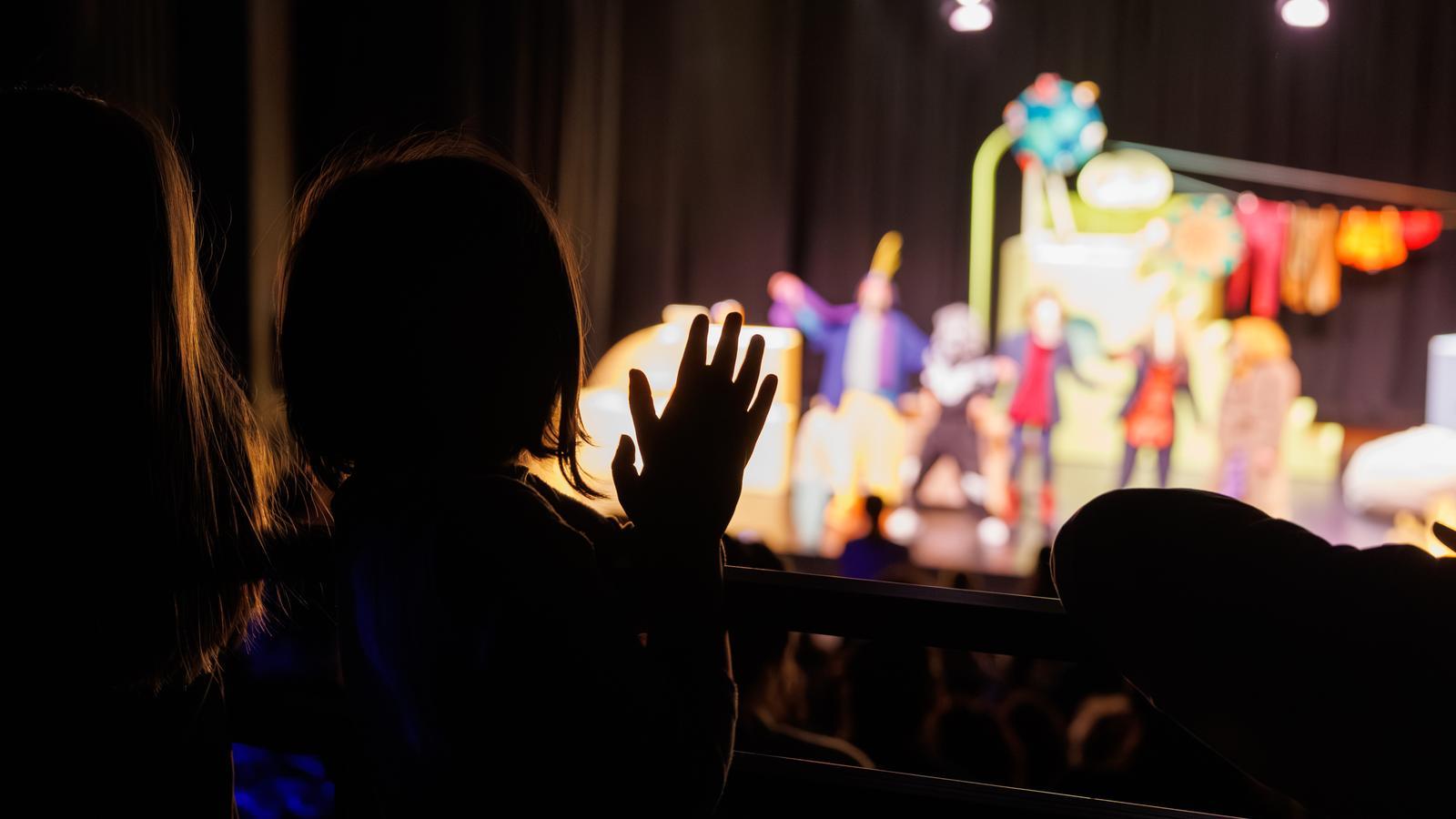

In Catalonia there is a long tradition of theatre; there are many athenaeums, civic centres and other cultural spaces that programme it. Currently, there are 200 venues, 150 of which are concentrated in Barcelona and its area of influence. Although many of these spaces have some show for all audiences on a regular basis, there are also 7 venues specialising in family theatre. Most of them, however, are small, private and very fragile. Just last year one of them, the Jove Teatre Regina, closed due to real estate pressure after thirty-eight years of history.
Verònica Pallini, artistic director and creator of L’Autèntica, acknowledges that they have to juggle to sustain themselves, and Eulàlia Ribera, director of laSala in Sabadell, is blunt. “Without public resources, it is impossible to make theatre accessible to all children. Creation for early childhood is a field with its own specificities that requires time, research, artistic rigour and adequate production conditions,” assures Ribera.
Both venues give life to their projects thanks to other actions. L’Autèntica is also a theatre school. Many of the boys and girls who go as audience later start in the world of acting with their theatre courses. And for five years now it has been producing immersive installations for the little ones and documentary theatre for young audiences. The creation centre laSala has been promoting and producing elPetit for twenty-two years, an International Festival of Performing Arts for early childhood that every year brings high-quality national and international shows to Catalonia and, in addition, they offer residence to artists during their creative processes and long-term support to studies and artistic projects focused on the ages of their audience.
For its part, the SAT! Sant Andreu Teatre, specialized in dance and family shows, has 350 seats and a small team, but as Joana Boix, corporate and strategic director, argues, “the history of the SAT! has shown us that it is indeed possible to make a living from projects where family theater is the protagonist. However, under what conditions?”. Boix also acknowledges that "the administration's aid, as in many other cultural projects, is necessary, but right now it is insufficient to get out of precariousness. With a little more, we could do great things". Òscar Rodríguez, representative of the Adetca Family Commission and artistic advisor of the SAT! Sant Andreu Teatre, recalls: “For the moment, we have managed to get the budget for culture to reach 2%, and that is already a lot!”
Viu el Teatre, a platform for performing arts projects for children, was born in 2002 and has grown a lot in recent years. In their case, public contribution does not exceed 22% in recent years. The secret is to have a diversified financing model and rigorous and coherent planning, a key point that emerged from the internationalization consultancy and subsequent strategic plan they underwent in 2018. “I have discovered that in the sector we go a bit by artistic intuition, we are moved more by emotion than by the strategic part of growth, although they can also go hand in hand”, explains Gisela Juanet, project coordinator at Viu el Teatre. Currently, they are programmers of the 'Família de teatrerus' series at the Goya and Romea theaters of the Focus Group, with whom they also created the 'Cooltiva’t' project in 2020 for theatrical programming for schools and high schools. In addition, they have been producing shows and events for years, with which they tour but always from a sustainable perspective. For this reason, they have opted to sell the rights to their own productions to creators in other countries.
Awareness and international projection
The creation center laSala and L’Autèntica in the Gràcia neighborhood of Barcelona, two of the venues that schedule shows and artistic experiences for early childhood, see how there is an increasingly aware public and believe that, in part, it is because families with young children value the artistic awakening that theater offers. Both know their audience very well and take care of every detail: the programming, the before and after the show, the spaces, and ensuring everything is tailored to them. "Just as a child needs to go out into nature, they also need to enjoy artistic experiences," states Ribera. And she highlights that it is precisely the proximity that occurs with family theater, with reduced seating capacity and families seated on the stage, where the artistic experience is richest. For her part, Pallini has a degree in social anthropology and dedicated her doctoral thesis to the transformative power of theater. For this reason, she underlines: "A baby who goes to the theater is not the same as one who does not. What they live through in the stage space transforms them, and what they experience here is never forgotten." In fact, all those interviewed in this report acknowledge that there is gradually more awareness. The best testimony is found in the continuous increase in the number of spectators in family theater venues, both small and large. For example, the SAT! Sant Andreu Teatre has had an accumulated growth of 59% in the last three seasons and L’Autèntica of 30% between 2023 and 2025.

Usually, what works in favor of this awareness and growth in audience is becoming benchmarks in the sector and the varied commitment of the programming. But their specialization, the artistic potential of Catalan family theater companies, and the original production that increasingly has more national and international tours are also important. And this is also clearly seen in festivals of our own, such as La Mostra Igualada, a great annual showcase of theater, circus, dance, music, puppetry, and clowning designed especially for children, young people, and families; and where last year out of the 114 performances by 39 companies, 27 were from Catalonia, 8 from the rest of the State, and 4 international.
The companies: stagnant fees and lack of circuit
Although venues and festivals are gaining spectators, most companies dedicated to family theater continue to live in financial precariousness, so often linked to artistic and cultural professions. These are formed by few members and are constituted under the business modality of limited company, cooperative, or if it is a single person, as a self-employed worker. It is a one hundred percent vocational trade; it requires very demanding higher studies in performing arts that often require specialization and periodic training both at home and abroad. But all this effort and preparation does not translate into being able to live afterwards with a certain peace of mind and quality of life. For this reason, many perform other related activities such as cultural events, directing, venue programming, or set up a theater school.
Joan Alfred Mengual, a member of the De_paper company and current president of the TTP, Professional Association of Theater for All Audiences, explains that the majority of the 86 professional companies that make up the TTP depend heavily on the number of gigs they get each year. Furthermore, this year they are experiencing a very delicate moment due to the halt in outings and educational activities in Catalan public schools and are surviving while "drowning".
One of the issues that causes the most concern is the stagnant fees for their shows. Pau Castillo, actor, director and founder of Cinc Cèntims Teatre, a company created in 2023 and one of the youngest in the TTP, believes that they are lower than adult fees because there is still a stigmatization within the sector itself that undervalues family productions. And he says with irony: “The need to adapt to reduced budgets and small stage spaces has led us to develop a great creative capacity. But this capacity for adaptation, this resilience, should not justify the precariousness of the sector”. It is precisely in theater productions for children and adolescents where there is more artistic and pedagogical work behind them.
For her part, Marisol Rico from the company La Tal, with forty years of history, detects that one of the main problems in the sector is the lack of a good circuit for family theatrical programming that has sufficient financial funding from administrations. She also believes that the administration does not really value family theater enough, and cites as an example the scarce family programming that many public theaters have. Such as the National Theater of Catalonia, which this season only has three shows, one of them a circus. "If the TNC engages in this discrimination, it is already setting a line and a way of doing things that must be reversed by everyone," points out Rico.
Prices: good will and democratization
Both the venues and the companies in the sector also believe that the price stipulated for family show tickets should be reviewed, as they consider it very low. “We understand that it might be a bit more affordable or that even packs might be offered, minors are accompanied and, therefore, there is a significant expense. But, even so, the standard price for family shows is much lower, sometimes more than half, than that of adult shows,” pleads Mengual. In this regard, Òscar Rodríguez recalls that in other countries the cultural VAT is lower, France is between 2.1% and 5.5% or Germany with 7%. And he smiles when making the comparison: “Going to the theatre cannot be considered the same as doing an escape room or buying a bottle of cognac. There are people who spend much more money to go to a concert or some media-hyped show; I don't believe it is a matter of price, but rather that you really have to feel like it.” He also encourages spectators to be brave and risk seeing lesser-known shows because they may have interesting surprises.
Furthermore, as Juanet says: “We must be able to break down this barrier that makes it seem like the performing arts are only for some, right? Everyone can sit in a seat, have a good time, and get emotional.” And Joana Boix underlines: “If we are capable of bringing spectators from school performances to the weekend, then we will be able to say that we have gained in cultural rights. But it is a reality that for the moment is far off.”
For Ribera, one of the most important figures they have at the creation centre laSala is that of cultural mediation: “It is the one that opens the doors of your space and ties threads together to create a network with the different agents in your environment. Let’s join forces and build a community.”
Right now, this democratization is only possible through schools and high schools, as for many families it represents an economic effort or they simply do not get to know about it. But Joan Alfred Mengual warns that this access to theater from early childhood "cannot depend on the good will of teachers and companies; it must be shielded so that the arts are truly integrated into the educational curriculum."
The Department of Culture argues that family theater contributes to the fight against inequality and allows everyone to be given the same opportunities to access culture. One of the tools that allows ensuring that family theater is present in municipalities of varying sizes and budgetary capacities is Programa.cat. The Department of Culture and the Catalan provincial councils support stable municipal performing arts and music programming by funding a portion of show contracts. Precisely to continue pursuing this objective, the Generalitat is promoting the new Cultural Equipment and Services Plan of Catalonia (Pesccat), which will allow for better planning, the identification of needs, and the guidance of future investments throughout the territory.
The audience: diverse and demanding
Family theatre is aimed at a diverse audience, reaching all ages, and this is quite a responsibility and a challenge for companies. As Mengual explains, although there are still those who consider family theatre as pure entertainment or children's animation, the survival of the sector stands out for "its hybridization of languages and its transversal capacity to attract both an eighty-year-old person and a two-year-old child".

Furthermore, it is often still thought that children and adolescents are a second-class audience, but they have the same rights as any other citizen. “Children are not an incomplete version of an adult, nor are they future spectators. They are our audience of the present and deserve the same respect, the same quality, and the same artistic demand as any other spectator. They are full members of society, with their own voice that deserves to be heard,” argues Pau Castillo.
In this sense, Gisela Juanet argues that in an increasingly individualized society, family theater is a basic tool to "foster generational empathy" in a common physical space that is one hundred percent human: "We go to the theater with the people we love, and only there do we manage to turn off our mobile phones." Furthermore, one of the great attractions of the performing arts is the presence; "being able to have a nearby, local artist performing live in front of you is unique".
On November 22nd, Catalan family theater will celebrate Porta’m al teatre (Take Me to the Theater), a festive and participatory event where more than 50 venues across Catalonia will schedule shows for family audiences. Additionally, the venues will feature a photocall area, workshops, and the opportunity for children to act as critics. The initiative will take place annually around November 20th, Universal Children's Day. It is a way to also claim their right to enjoy and participate in cultural life.
The initiative stems from the 1st Catalan Theater Promotion Plan 2023-2026, promoted by the Department of Culture of the Generalitat de Catalunya and driven by the family commission of Adetca (Association of Theater Companies of Catalonia), with the collaboration of the Professional Association of Theater for All Audiences of Catalonia (TTP) and the Xarxa Foundation for Children's and Youth Performance in Catalonia. Òscar Rodríguez, representative of the Adetca Family Commission and artistic advisor of the SAT! Sant Andreu Teatre, points out: “Beyond filling theater seats, we in the sector have long wanted to do something collective, especially to make ourselves visible and give value to the performing arts for all audiences.”
In fact, family theater represents 19% of the total performing arts audience in Catalonia. Despite this weight, its capacity for creation, transmission of Catalan culture and language, its benefits in the educational and emotional development of children, and its role in boosting critical thinking in those who are a bit older is not always appreciated. For this reason, a few days prior, there will be a professional day to share experiences, generate debate, and reflect on its value in childhood and the role played by the public, families, and the educational community.
Beyond Porta’m al teatre, within the Department of Culture's Promotion Plans, there are also other support lines that contribute to consolidating family theater. Through the Catalan Institute for Cultural Companies (ICEC), up to sixteen specific subsidy lines are offered to the sector, including, among others, three-year grants for the development and production of performing arts projects, and a specific line for internationalization. And for the last four years, concrete support measures have been articulated to favor the creation of audiences or grants for venues that exhibit family shows, among others.

One of the non-profit private entities with over thirty years of history is the Fundació Xarxa d’Espectacles Infantil i Juvenil de Catalunya (Xarxa Foundation for Children's and Youth Performing Arts of Catalonia), which currently brings together about fifty local groups of volunteers in different municipalities that are responsible for bringing culture, performing arts, and the Catalan language to families with children. Just this weekend, La Xarxa is celebrating the 15th edition of the Family Shows Tasting (Tast d’Espectacles Familiars), a performing arts showcase where professional companies present their new productions.
In addition, the new Fundació Xarxa Awards will be presented, designed to recognize and give visibility to companies, shows, and projects that contribute to the development of family performing arts. There are other Catalan awards that take the sector into account, but they only have a single category. La Xarxa's awards have three categories: the Lifetime Achievement Award, the Best Show Award, and the Creation Project Award, aimed at shows that are still in the process of being created and have not yet premiered.

