Friends who hurt
The concept of 'pet' or best friend can sometimes hide unhealthy dependency relationships

-
CAT -
CAST
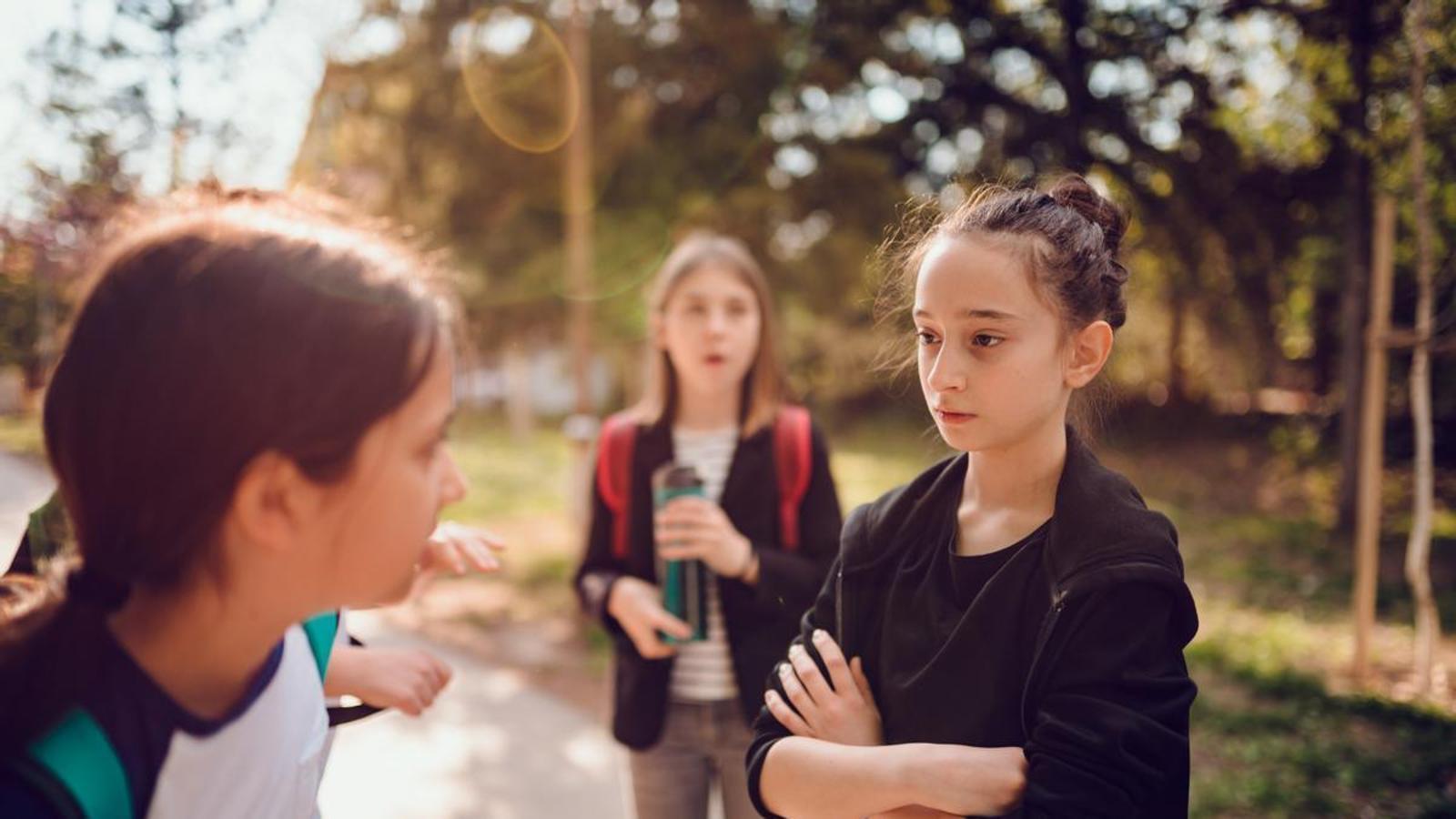
BarcelonaAll testimonies in this report are real cases that have preferred to remain anonymous.If you don't play with me, I won't invite you to my party. If you want me to do that, you'll have to give me a euro. Now I'm angry (and I won't talk to you for days). You are my best friend (but I only play with you when we are alone, when we are at school, I ignore you or I even promote a vote to see who dislikes you in the class). These are seemingly innocent and typical phrases and situations for children – more so for girls – that can be a warning sign of a controlling relationship disguised as friendship.
There is no specific age at which attitudes of this kind begin to develop, but it is considered that between the ages of six and nine, when children begin to forge closer friendships, toxic dynamics may begin to appear which, when they occur repeatedly and with a power relationship of a child who needs to please or be accepted by another, the problem arises. Experts insist that it is not about occasional arguments between children, but with a certain continuity.
At Montse's house, they have experienced this on more than one occasion, and especially with one of her daughters, who is eleven years old. She has a strong personality and often competes for leadership in class with friends whom she, in principle, likes very much. Montse, however, often detects conflicts with a certain emotional blackmail and tries to work with her on the idea that friendships should make us feel good and relaxed, and that this is not incompatible with conflict, but rather that if it arises, it should be possible to talk about and resolve it. “It is a burden that we carry and manage at home – says Montse –, but it is still a certain form of abuse, isn't it?”
Montse is a teacher and, in addition to her experience as a mother, she also has a school perspective. Perhaps that's why she pays even more attention to it, or perhaps she also sees that these unhealthy relationships are often a way of seeking acceptance within the group. “We live in a very emotionally corrupt world and children notice it and imitate it,” she reflects, recalling that as adults we also have moments when we use certain blackmail tactics, such as “if you don’t listen to me, I won’t buy you this.”
In her practice, psychologist Laia Sala sees several children suffering from these types of dynamics, which can be direct exclusion or aimed at the group to exclude them. For Sala, these are unhealthy relationships that harm at least one of the individuals involved, but can also harm both, and can lead to problems with self-esteem, social relationships, and anxiety. Although there is no clear age, Sala says that between five and six years old, some toxic or manipulative and controlling attitudes can be detected, and if not addressed, they end up translating into patterns that are reproduced later on and into adolescence.
The role of the best friend, a toxic relationship?
She also sees that many girls (and also to a lesser extent boys) seek to have a best friend, a concept that has always existed, but that recently seems to have been reinforced by the idea of bestie (best friend in English), which makes those who don't have one feel bad, and who is willing to do anything to have her. This causes, in some cases – especially when there are certain social difficulties – dependency relationships to be created between two girls. This bond can be experienced naturally, but also as a burden – feeling that the other only wants to be with me – or from a position of power that ends up opening the door to manipulation.
According to the psychologist, this type of more exclusive relationship, with behaviors by omission (I don't tell you something, I don't consider you, I don't explain it to you...) and not by aggression (punch, push, direct aggression), is more common in girls, because even now they are expected to be caregivers, empathetic, not to bother, not to make noise... And, therefore, not to be able to react strongly or viscerally and to look for ways to show anger, jealousy or discomfort with subtlety, with "keeping up appearances". On the other hand, continues Sala, in general terms, boys are allowed to get angry and calm down more easily among themselves. They don't have to "keep up appearances".
And this learning, warns Sala, can end up being transferred to couple relationships, which can lead them to conceive of them also as dependent and exclusive relationships, which imply not being able to develop other bonds.
The case of Clàudia and Pol
Alicia's family is in this phase. Claudia is nine years old and is having a difficult school year because she has a toxic relationship with one of the girls in the class from previous years. In recent weeks, the conflict has been escalating. A few days ago, Claudia arrived with her legs covered in insults drawn with pens. She says that even though she asked her to stop at first, she didn't resist. She wanted to show that she didn't care what her classmate wrote. Thus, she was applying the advice her parents had given her when she complained about what was happening in class. "We kept telling her not to be affected by what she might say, and it turns out she didn't understand the message as we thought. We failed, despite telling her that friends don't do that," says Alicia.
Pol has also gone through a similar situation, which has been resolved this school year. During his first and second years of primary school, he began to suffer "blackmail moments" from what was his best friend when Pol wanted to play with other children. "He would say things like: if you play with others, you'll never be my friend again," explains the mother. Even when he went to a birthday party, she recounts, you could see how he only interacted with his best friend. At the end of last school year, the same teacher, who had detected the situation, proposed that the families separate them into different classes. "At first, I was afraid because I thought he would be alone," admits the mother. Her son, however, has finally learned that he can play with other children without fear. "However, it took him a whole school year to see and accept it," the mother points out.
Subtlety during lunchtime
Children who have these attitudes with other classmates tend to be responsible, compliant, and cheerful, helping in group dynamics in class. They act, on the other hand, in a very subtle way and adults generally find it difficult to detect. “There is an masking and they are not seen”, says psychologist Laia Sala. The relationship is complicated because the victim continues to consider the aggressor a friend, who at certain moments makes her feel special and chosen. This is what is called intermittent reinforcement: a dynamic in which the person who exercises the role of dominance alternates moments of affection and exclusion while, at the same time, dissimulating and trying not to be discovered.
For this reason, many times, these small subtle gestures occur during playtime or meal times, when there is more free play and less adult supervision. For this reason, Sala believes it is very important to help the child to verbalize their limits (say stop) or to seek help from the responsible adult so that the correct decisions are made in this regard. “This is where it can be stopped”, recommends Sala, who sees that often, the problem is that it is managed as a conflict between equals and it is not. If the unpleasant behaviors are repeated and always in one direction, that is, there is a power role and continuity over time, it can be considered harassment.

In this regard, even though they are necessary, he/she believes that sometimes the restorative dynamics that take place in classrooms are not enough. “Empathy and conflict resolution are worked on, but it is not always addressed who is exercising this control and told that what they are doing is not correct,” says Sala, who warns that, if clarity is not maintained, the dominant girl may not identify with the content of the talk and, therefore, will not apply any change in her attitude and way of treating others. He/she also believes that the role of teachers must be protective. “It is important that the teacher can separate and protect the child and make decisions such as not putting them to work in the same group,” exemplifies Sala.
Stopping it in time, essential
Carla is seventeen years old and throughout primary school she suffered this type of attitude from a classmate. She lives in a small town and, therefore, the conflict extended beyond school, which made it bigger and more difficult. Her mother remembers specific incidents that made her feel very bad, such as a birthday party where she was the only girl not invited. But there were many others and the years went by without the school intervening. At secondary school, the situation was reproduced with the same classmate, but also with others, and it hasn't been until she changed schools, in high school, that she has been able to attend class peacefully.
This is one of the risks of not acting in time and, for this reason, Sala is in favor of training teachers so that from early childhood education they can nip these attitudes in the bud. Early intervention is essential to avoid "greater evils", since if time passes, the victim has more difficulty detecting a secure bond and more fear of rejection, more self-esteem problems that complicate their ability to understand that friendships, or even romantic relationships, should be neither codependent nor exclusive.
At school, children begin to have their first relationships "among peers", which must be characterized by good treatment, empathy, listening, and reciprocity, and, above all, convey calm and tranquility. Toxic attitudes promote the opposite, and add intermittency. Sala warns that if this pattern is extrapolated to romantic relationships, where suffering is compensated by intense reconciliation and many "ups and downs" to fight for, the idea of romantic love that causes suffering is consolidated.
