A school in Barcelona manages to reduce food waste to 17 grams per student
The children of the Josep Maria de Sagarra school serve themselves portions suitable for their feeling of hunger in order to avoid food ending up in the trash and they weigh the leftovers to keep a record

-
CAT -
CAST
Barcelona17 grams per child. This was the amount of food that the students of the Josep Maria de Sagarra school threw in the trash during lunchtime on May 13, when "Criatures" went there to get to know the "If I think, I don't throw away" project firsthand. This is one of the lowest records since the Barcelona school implemented the project in the dining area, nine courses ago. It did so at the request of Aldara Sarabia, director of the Midday Educational Time at the center, who clearly recalls the moment the project saw the light of day.
It was the 2017-2018 academic year, when the school cafeteria switched from using trays to plates. The school, Sarabia points out, "made a very important investment in all the necessary material so that the children could serve themselves from I3 to 6th grade." At that time, together with the operational manager of the catering company that the center had at the time, the need to go beyond the message of "don't throw away food" was detected. "We wanted to create a real and experiential experience so that the children would understand food waste for themselves and be aware of it from daily practice; that is why we promoted a project where the children were the protagonists and actively participated in the day-to-day life of the dining room," Sarabia highlights.
Self-awareness process
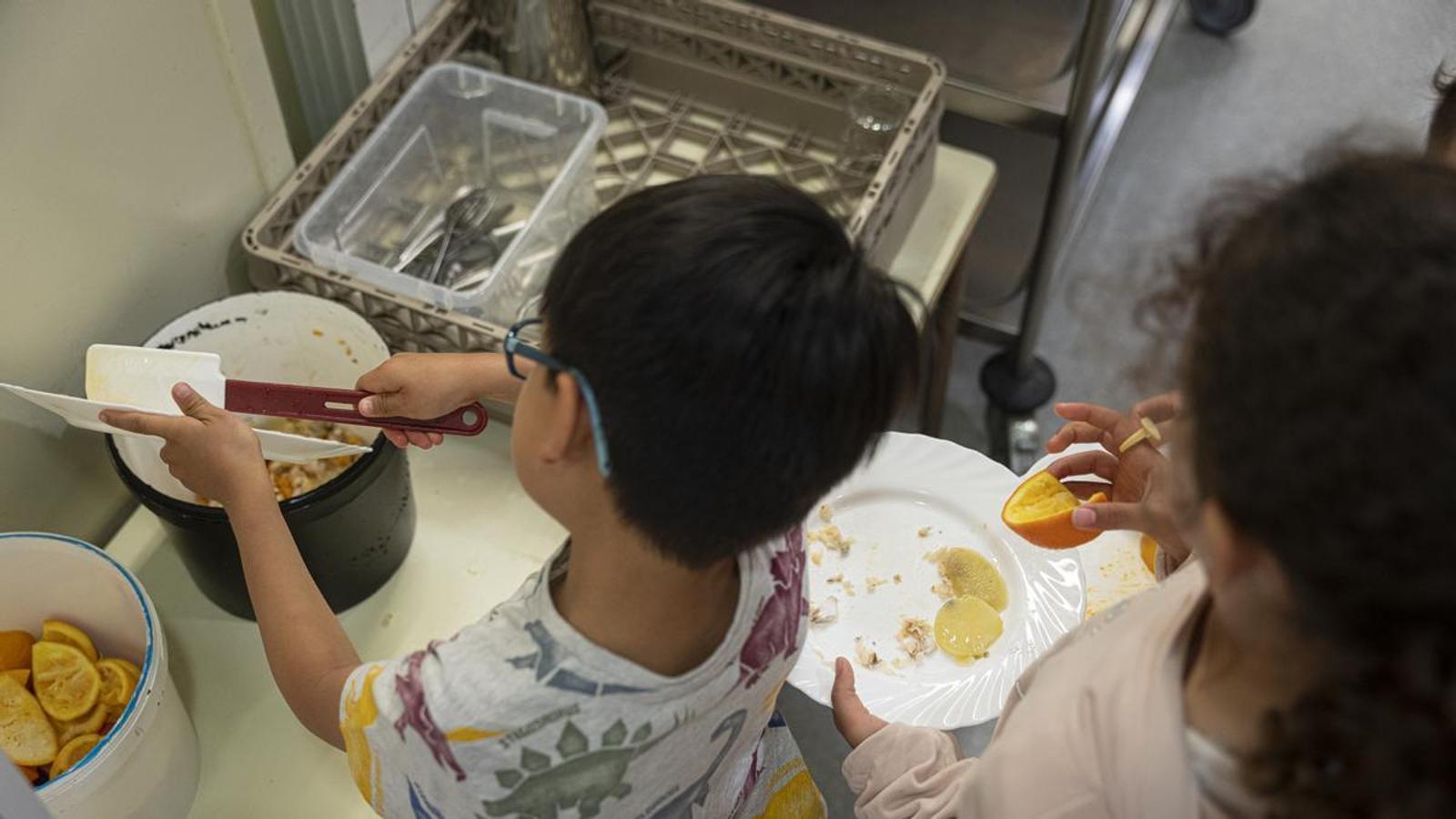
The day we visited them, the teaching staff and the Criatures enjoyed a menu consisting of brown rice with tomato, hake with a base of potatoes and orange, the portions of which were served by the students themselves according to how hungry they felt. The ladles available to them – in three sizes, depending on age – mark the minimum quantity they should take, but, even so, it becomes essential that they serve themselves the portion they know they will finish. Maria Pujol, the school's director, emphasizes that the midday space is not separate from the rest of the school,
but rather it is a shared project, where from the methodology to the perspective and the treatment given to the children is evident
.
Núria Torres, the school's head of studies, also points out that applying in everyday moments such as lunchtime everything that is dealt with in the theoretical field provides much more significant learning and facilitates the midday space and the learning space being a community.
The idea is to make them responsible, from I3 to sixth grade, for their actions, from the moment they serve themselves lunch. “There is respect for the students and their feeling of hunger, but they are also given the responsibility to serve themselves an adequate amount, because if they are not hungry and serve themselves too much, the food will end up in the trash,” states Pujol.
This, in Torres' words, “also involves self-knowledge that is not achieved overnight.” The head of studies points out that, within the framework of the project If I think, I don't throw away, not only is food waste being addressed, but also autonomy, self-analysis – how you feel, what you want to do, do you like this or that, how did you feel doing this...–. “And if we apply this to basic and physical needs such as eating, it rounds off and gives meaning to self-discovery,” she adds.

A cross-cutting cultural change
The 2017-2018 academic year, at the Josep Maria de Sagarra School, not only were trays replaced with plates, but the school's management also made a significant investment in glassware and cutlery. Little by little, paper napkins were replaced with cloth ones, as were the picnic bags that students take on excursion days. It has also been promoted that children bring their mid-morning snack in lunchboxes and without packaging, unlike before, when aluminum foil was overused.
These breakfasts, since the school promotes varied, balanced, and seasonal eating, are much healthier, in line with the menus the center offers at lunchtime, and where vegetables, fruit, legumes, and protein predominate. “It is a transversal approach, in which all educational agents are involved, from management to teaching staff, including those responsible for and monitors of the midday space, in order to provide coherence and make the project sustainable,” states Núria Torres, head of studies.

The success of the project lies in the involvement sought from the students, who are responsible for setting and clearing the table, correctly separating waste, and finally, weighing the amount of food thrown away each day and keeping a record that is then published on the school's social media and in periodic communications and meetings with students' families. The day Criatures visits the school, we witness how three students from each educational stage – who rotate weekly – are in charge of setting the table. Also, how they serve themselves food, clear the table, and separate waste according to its type, and how, finally, three sixth-grade students – Bruna, Masha, and Irene – carry out the weighing. A weighing that today yields one of the best figures of the course: a total of 2.95 kg of food thrown in the trash, which, divided among the 166 students who ate at school that day, amounts to a total of 17 grams per student.
Continuous improvement as an objective
The project also aims to train skills such as self-knowledge, informed decision-making, autonomy, etc., as the child is encouraged to serve themselves by proposing prudent quantities with the option to repeat and to be educated to finish what they have served.
According to Bruna, a sixth-grade student and one of those in charge of weighing that day, making a reasonable choice of food when serving oneself “is important to ensure that one eats in a varied and balanced way”. As well as to “see how much we throw away and, depending on the data, improve every day”. She also tries to raise awareness about responsible consumption at home, with the help of her younger brother, who goes to the same school. “We both go for it”, says Bruna.
Izar is in second grade, has been participating in the project since she started school, in I3 and, of all the tasks she does during the month in the dining room, what she likes most is weighing the leftovers. “I get very happy when there are few leftovers, and I also like everything I learn about food”, she explains. For her part, Nahia, from third grade, confesses that what has surprised her most is that not much food is usually thrown away at school, which makes her happy: “because together we do a good job”.
Promoting children's critical thinking
Critical thinking in children is also promoted, as once the records for an entire school year are made, emphasis is placed on the social, economic, and environmental implications of this food waste. Last year, the school threw away food worth 1,758 euros. The environmental footprint was equivalent to the emissions of a car traveling about 12,000 km, and the water footprint was enough to fill four small swimming pools.
Nahia comments that knowing that with the amount of food wasted at school last year, 24 children could have had two meals for a whole month surprised her a lot, "because it's a very large amount of food and we need to keep working to reduce the figure".
All students who use the school's dining service participate in the project, but, as Aldara Sarabia points out, "each stage experiences it differently". From I3 to third grade, they mainly work on routines and autonomy. "As they grow, they better understand the part of responsibility and environmental awareness, and between fourth and sixth grade they also participate in the recording, weighing, and data analysis," she states. The students in these three grades are responsible for weighing the waste from the two shifts in the dining area and recording the daily data.
As Sarabia points out, it is a job "that they do with great responsibility and that helps them see the real impact of what happens every day". Once the data is collected, they inform the responsible monitor, and the results are communicated via the "walkie-talkie". "Then we calculate the average with all the diners of the day and share it with all the groups during the final circle time, where we talk with the children, reflect on the results, and think together about how we can continue to improve," Sarabia concludes.
Since the project was launched and children are more aware of having responsible meals, the amount of food and water that ends up in the bins and the leftover water container respectively is significantly less. Aldara Sarabia describes the evolution of these past few years as "very positive, as children think more before serving themselves, adjust quantities better, and are much more aware of what they are doing". Sarabia acknowledges that "there is still a way to go", but celebrates that "children's perspective towards food has changed a lot".During this period, the Josep Maria de Sagarra school has also observed that the days when more food is wasted coincide with days when foods that are usually more difficult to eat are served, such as some vegetables or less common dishes for children, like trinxat. Nevertheless, Sarabia clarifies, "we always try to work on it calmly and with support, never from the obligation to finish everything, although we always encourage them to at least try it". For Sarabia and the rest of the school's management and teaching team, "it is crucial for children to have a healthy relationship with food, to try, get to know new foods, and learn to respect them without pressure".
