The difficulty of forming a government in Israel reopens the debate over the military obligations of the ultra-Orthodox
The possible support of the Haredi parties for an Eisenkot executive could guarantee him governing, but would force him to negotiate on the military exemptions that divide Israeli society

-
CAT -
CAST
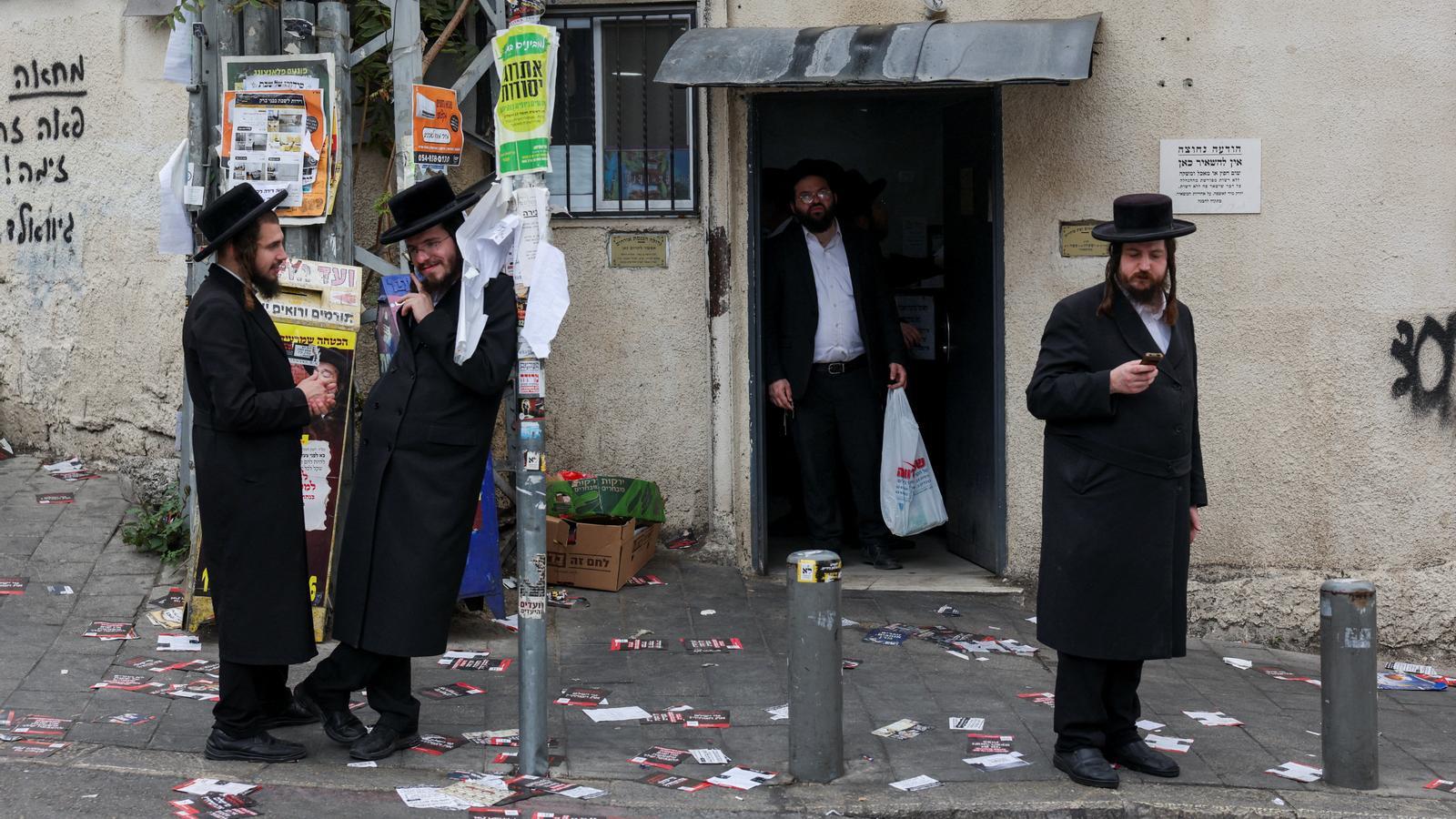
JerusalemIn the streets of Mea Shearim, the most emblematic ultra-Orthodox neighborhood in Jerusalem, life seems to take place in a parallel universe. Men in black hats walk between synagogues and Talmudic schools, on the sidelines of a debate that is shaking Israel: who should defend the state. The controversy has returned to the center of politics after Avigdor Liberman, one of the leaders who has most harshly criticized ultra-Orthodox privileges, opened the door to making a deal with them to form the new government of Israel.
Meanwhile, the protests and arrests of ultra-Orthodox youths, also known as Haredim, who refuse to join the army, continue. “Why should I serve in an army that I do not recognize? Our parties must put an end to this madness,” says a young man during one of the protests on Jaffa Street. “Studying the sacred texts is a full-time job. I serve my people and my faith. I don’t care what they say about compulsory military service,” says another protester.
The responses reflect one of the great fractures of Israeli society. For part of the ultra-Orthodox community, the study of the Torah is a way to contribute to the continuity of the Jewish people; and for a good part of the rest of society, military service should be a shared responsibility. The war initiated after the Hamas attacks of October 7, 2023, the exhaustion of reservists, and the demographic growth of the Haredim community have intensified the debate. Some 80,000 men between 18 and 24 years old who have not joined military service would be liable to be called up, while the armed forces are demanding more personnel.
“From their perspective, it is not a question of privilege, but of essential necessity,” explains sociologist Nissim Leon from Bar-Ilan University to ARA. According to the expert, a part of the community considers that the study of the Torah sustains the existence of the Jewish people and that military service could distract young people from this mission. This vision also explains the complex relationship with Zionism: some Haredi leaders consider that the State of Israel does not fit with the traditional conception of Jewish history, but ultra-Orthodox parties have been participating in coalition governments in the country for years.
It is in this context that Liberman's shift must be understood. Historically, the leader of the Yisrael Beytenu party has made equality in military obligations one of his main banners and has refused to govern with ultra-Orthodox parties. After the elections of October 27, however, he has shown himself favorable to negotiating with Shas and United Torah Judaism to facilitate a government led by Gadi Eisenkot, to avoid the continuity of Benjamin Netanyahu and the dependence on Arab parties.
Liberman has defended a law that has the backing of the Supreme Court and has left open the possibility of using as a basis the proposal that he himself promoted in 2018, when he was Minister of Defense, although he has not provided further details. That initiative established annual recruitment targets, a gradual increase in inductions, and economic sanctions on yeshivas (Jewish religious study centers) in the event of failing to meet the quotas. According to the Israeli channel Channel 12, the Haredi parties could demand, in exchange for their support, a transition period of one year or a year and a half without significant inductions or effective sanctions.
The two ultra-Orthodox parties, however, do not share the same position. United Torah Judaism –Netanyahu's traditional ally that has withdrawn its support for a new term– has admitted contacts with the opposition bloc and does not rule out reaching an agreement. The party continues to condition its support on concessions regarding conscription, the funding of religious schools, and ultra-Orthodox influence in public life, such as commercial restrictions during the Sabbath, the holy day of rest that begins on Friday evening and ends on Saturday night.
Shas, on the other hand, has publicly maintained its support for Netanyahu and has denied that it is negotiating with other leaders. According to Leon, this position is explained by its electoral base: at least a third of the voters are not ultra-Orthodox, but traditional or observant Jews who send their children to perform military service. “Shas seems to be waiting to see which path United Torah Judaism takes, because it faces a crucial decision: to align itself with the Haredi ideology or with the heterogeneous composition of its electoral base,” summarizes the sociologist. This division pits voters who do not rule out military service against the ultra-Orthodox sectors that reproach the party for not having achieved a satisfactory exemption.
Against the main election promise
For Liberman, the operation entails risks. “If the agreement succeeds, he will become the architect of a government without the participation or dependence of Arab parties. If it fails, he will be able to argue that he tried to find an alternative and that there is no other option than to negotiate with the Arab factions,” explains Ilana Shpaizman, a researcher specializing in Israeli society, to this newspaper. The negotiation, however, contradicts one of his most important campaign promises and highlights a contradiction within the very bloc that wants to replace Netanyahu: Eisenkot, former chief of staff and in charge of forming a government, and also several members of the bloc, have campaigned defending that all citizens must contribute to the security of the state.
A pact between the ultra-Orthodox and Liberman could facilitate the formation of a government, but it would leave unresolved the fundamental issue that divides Israel: who should serve and contribute to the defense of the state.
