Two AI gurus illuminate the path for European leaders
The members celebrate the first European summit on artificial intelligence to address the competitiveness and risks of this technology in Europe
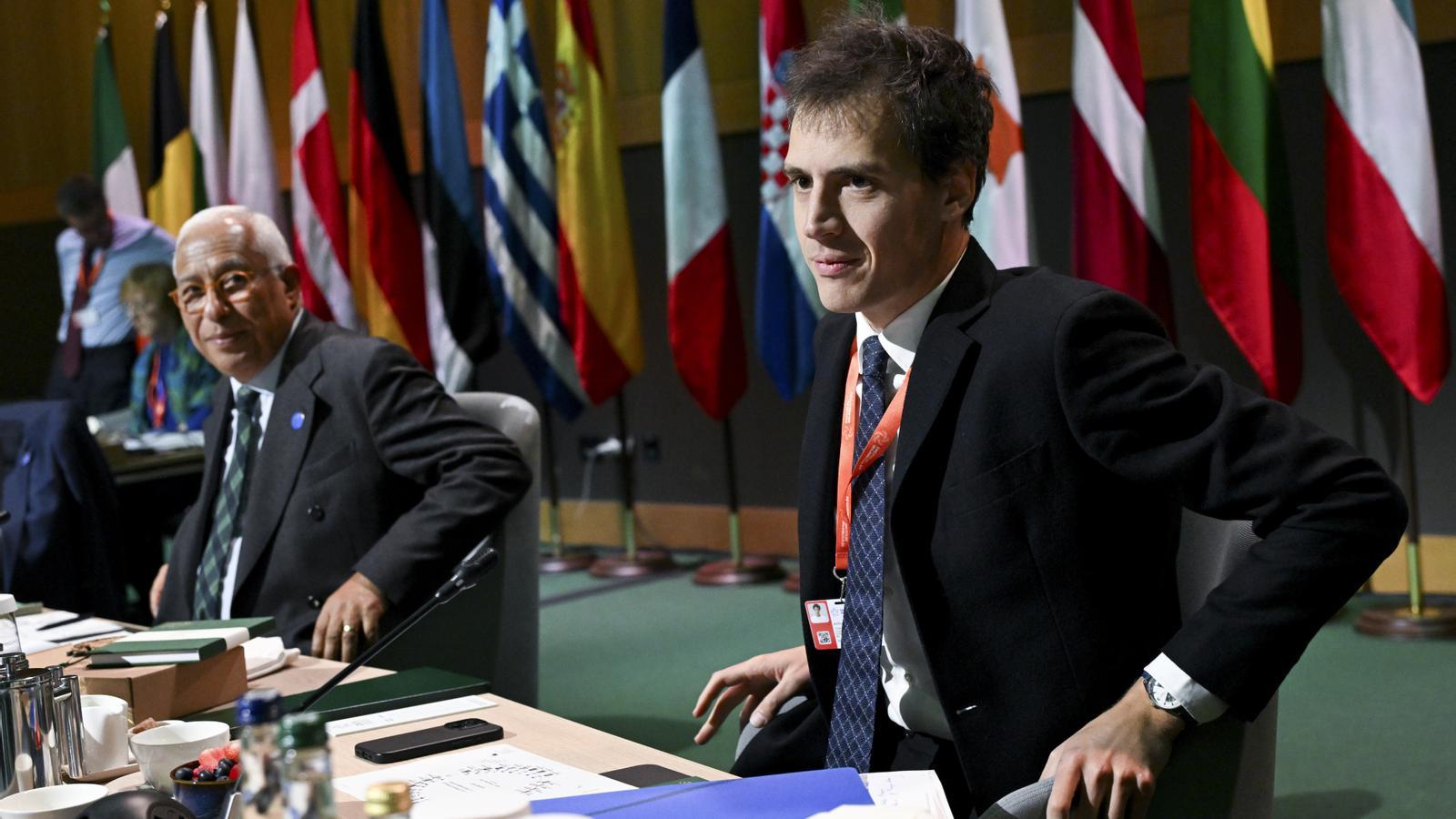

-
CAT -
CAST
Special envoy to DublinEurope fears being irrelevant in the artificial intelligence race. Although the continent has been a pioneer in regulating this new technology, it is a consensus admitted by community officials that it has fallen behind in development, which is led by China and the United States with the most advanced models. But the European Union does not want to throw in the towel and maintains that it still has room to become a leading power. "I detest the idea that Europe has lost the race," said the President of the European Parliament, Roberta Metsola.
To be guided in this still unknown terrain, European partners have entrusted themselves to two technology gurus, who were the star guests at the leaders' summit held this Friday in Dublin. They are Arthur Mensch, the CEO of the French company Mistral AI, and Geoffrey Hinton, a British-Canadian researcher awarded the Nobel Prize in Physics (2024) for his pioneering work on artificial neural networks, and who, after leaving Google in 2023, has become one of the most critical voices regarding the risks of AI.
Each guest embodies a core debate that the European Union wants to address regarding artificial intelligence. The first is that of competitiveness. Mistral AI is the only European company that has options to make a place for itself on the technological podium, now monopolized by Washington and Beijing. For this reason, as the leaders have reflected, the debate has revolved around strategic autonomy and the urgent need to mobilize capital, both public and private, so that "ideas can expand," in the words of Metsola. "Now we need to invest more, decide faster, and, above all, act all together," insisted French President Emmanuel Macron.
The lesson of dependency has been learned the hard way. Donald Trump's tariffs and the war in Ukraine have highlighted the fragility of alliances in an increasingly convulsive geopolitical context. And, for European partners, AI—a sector that will be increasingly strategic—cannot be an exception to this maxim. In this sense, the President of the European Commission, Ursula von der Leyen, has argued that Europe already has the necessary ingredients to compete and that its goal must be to use its capital to boost the industry "made in Europe," that is, to empower the continent's companies. This consists, however, of resolving challenges such as lowering energy costs and finding the balance between regulation and innovation. This last point brings a recurring dilemma to the table: whether the EU's regulatory initiative—with the world's first AI law—could end up slowing down technological development.
The darker side of AI
Beyond the competitiveness debate, the Twenty-Seven have also addressed the ethical dimension of the emergence of this new technology in the lives of Europeans. “AI is a revolutionary technology that can give a lot to a few or can raise the level of the entire society,” summarized the Prime Minister of Estonia, Kristen Michal, at the doors of the meeting. “We should try to raise the level of the entire society,” he defended.
Thus, Geoffrey Hinton’s presentation served as a wake-up call for the leaders and provided clarity on issues related to security and trust, in areas such as child protection or interference in public opinion. Guided by Hinton, the leaders delved into the darker side of this technology, which carries risks for democracy, for the labor market, or for inequality. Kaja Kallas, the head of European diplomacy, was also in charge of reminding everyone of the dangers of the military use of this tool in the war in Ukraine where, she said, Russia uses AI drones to “identify targets and kill”.
It is not unusual for there to be guests at leaders' summits, but they are usually allied world leaders, high-ranking economic officials of the EU, or authors of strategic reports. It is the first time that the CEO of a private company has entered the room of the Twenty-Seven; a precedent that reflects the extent to which artificial intelligence has become a strategic and competitiveness emergency for Europe.
Without concrete commitments, the summit has noted the need to accelerate policies related to a technology that has already become common in our lives. “I use it every day, and I see the potential it has,” assured the Prime Minister of Latvia, Andris Kulbergs, on Thursday, who joked that he even used it to prepare for leaders' meetings. But it has also made clear that Europe will not have enough with good intentions to stay alive in the race. To close the gap with the leading runners, the EU will have to demonstrate that it can turn diagnoses into deeds.

