Israel opens the legislature with the first assault to oust Netanyahu
The opposition wants to replace the President of the Parliament, an ally of the Prime Minister, to start reversing his policies before forming a government

-
CAT -
CAST
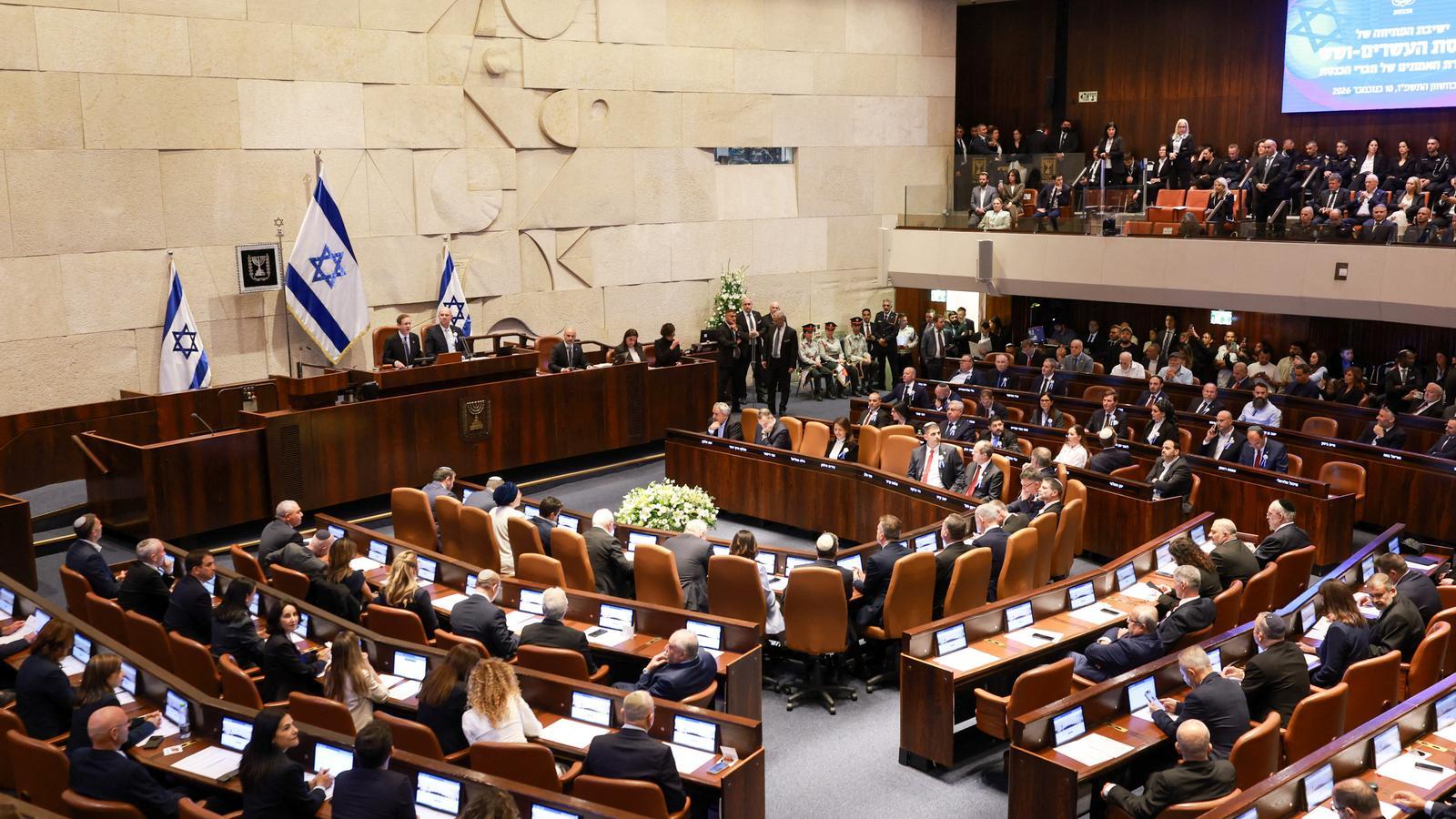
JerusalemIsrael inaugurates this Tuesday the 26th legislature of the Knesset, the Parliament that emerged from the October 27th elections, with a first political battle that goes beyond the constitution of the chamber: the replacement of its president. The parties opposed to Benjamin Netanyahu want to remove Amir Ohana, one of the prime minister's trusted men, and replace him with Matan Kahana, from the Yashar party, led by Gadi Eisenkot. This is not a simple change of institutional positions: controlling the presidency of the Parliament can give the opposition tools to set the political agenda and begin to undo part of Netanyahu's legislative legacy, even before having managed to form a government.
The maneuver has already taken a decisive step. This Tuesday, the Yashar party formally delivered to Ohana more than 61 signatures of deputies from the new chamber to demand a vote to replace him with Kahana, former Minister of Religious Affairs and number five on Eisenkot's list. With this majority, the vote could be held in the coming days. Ohana had assured that he would convene the debate within a maximum period of one week if he received the formal request from 61 deputies.
The importance of the vote is understood by the power concentrated by the president of the Knesset. The president directs parliamentary sessions and has a central influence over the organization of debates and the calendar of legislative activity. His position, moreover, is key to the institutional functioning of the chamber and in the relationship with the different parliamentary bodies.
The opposition's strategy is clear: first, to elect a new President of the Parliament and constitute the Knesset House Committee, which can create temporary committees and facilitate the opposition in pushing forward initiatives even if there is no new executive. This committee can create two temporary commissions, one for Foreign Affairs and Defense and another for Finance, which would serve as a platform for the anti-Netanyahu bloc to promote some of its initiatives as early as next week, without having to wait for the formation of a new government. Among the objectives are reversing the laws of the judicial reform promoted by the Netanyahu government, promoting a state commission of inquiry into the October 7th attacks, and limiting the prime minister's terms.
The support of the Arab parties is once again key
One of the keys to the operation has been the support of the Arab parties. Ahmad Tibi, leader of one of the factions of the Joint List, the most voted Arab force, has announced that his deputies will vote in favor of Kahana. Tibi has presented the replacement of Ohana as a decisive first step for political change and has assured that his party wants to contribute to it from outside the government. The deputies of Ra'am, the party of Mansour Abbas and the second Arab force, also figure among the signatories of the petition.
This understanding, however, should not be confused with the formation of a government. The 67 deputies who gave support to Eisenkot in the consultations with President Isaac Herzog are also the ones who have pushed for the change in leadership at the head of Parliament, but there is still no closed government formula. Several Jewish parties opposed to Netanyahu continue to rule out governing with Arab factions or depending on them parliamentarily. Avigdor Lieberman, leader of Yisrael Beiteinu, has proposed, for example, exploring an agreement with the ultra-Orthodox parties, despite the differences over military service exemptions.
The leader of Yashar continues working to form a government. He has 26 days to gather the necessary support, with the possibility that President Isaac Herzog will grant him a two-week extension. If he does not succeed, the mandate could pass to another leader, predictably Netanyahu. If neither candidate manages to articulate a majority, Israel would be pushed into new elections. Meanwhile, Netanyahu and his allies will continue at the head of the acting government.

