Why is religion the ace up the sleeve of the Democrats to defeat Trump in the midterms?
At least four Democratic candidates for the midterm elections are pastors or seminarians

-
CAT -
CAST
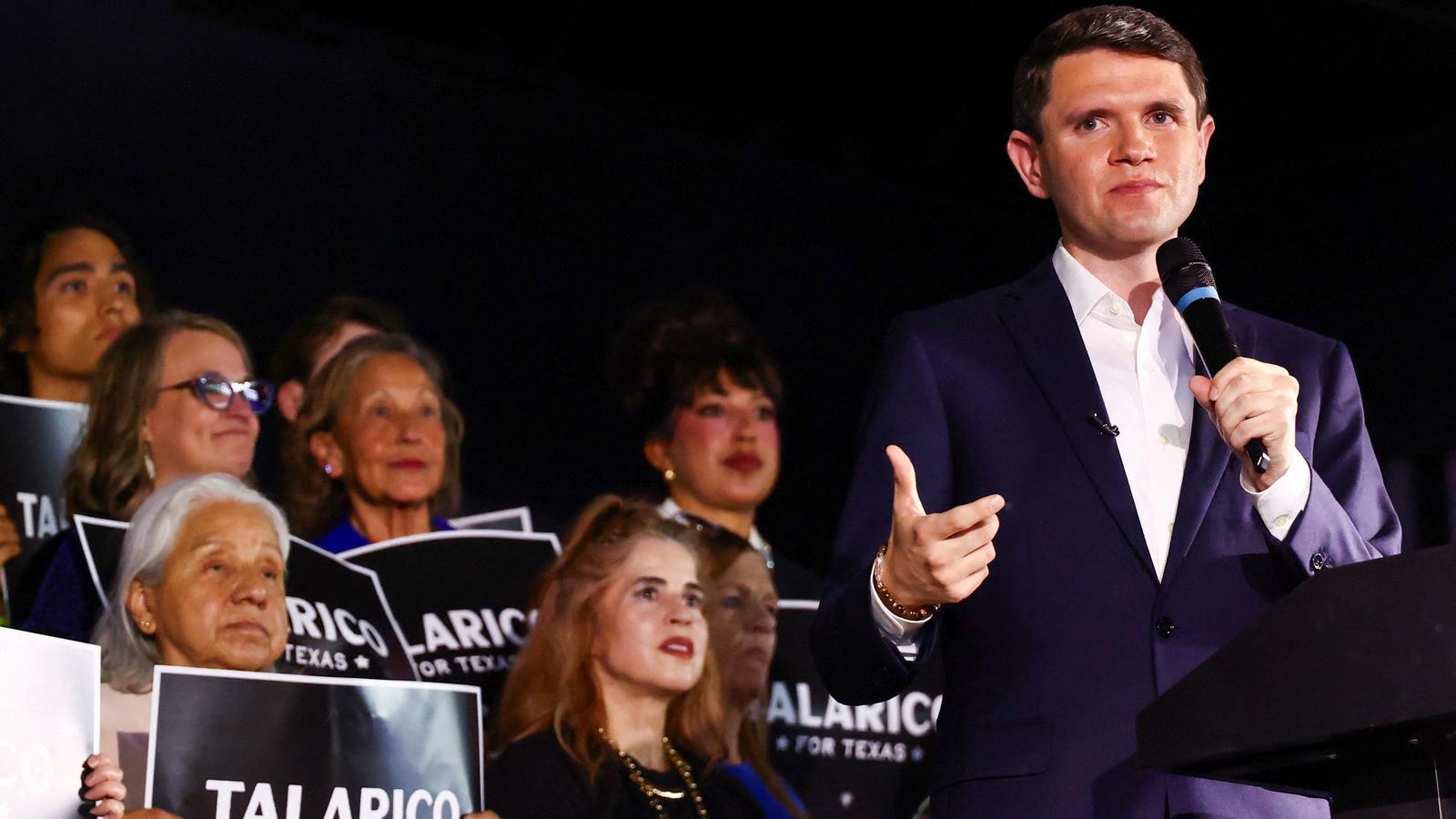
WashingtonThe Democrats have achieved an unusual scenario in these midterm elections: shaking the Republican supremacy in Texas and Kansas. If the party has penetrated into Trump territory, it is because the profiles leading the candidacies for the Senate in both states are not common either: a Presbyterian pastor, James Talarico, and the chaplain of a Methodist megachurch, Adam Hamilton. It is strange to see religious figures at the center of Democratic campaigns, but that is precisely what is happening in these legislative elections, and it seems to be working.
At least four candidates competing for a seat in Congress are pastors or seminarians, and many of them are doing so in markedly Republican states. In Iowa, two Democratic pastors, one Presbyterian, Lindsay James, and another Lutheran, Sarah Trone, are putting up a fight in two districts of the state where Trump won in 2024. Both are well-positioned in the polls and could win a seat in the House of Representatives.
The common denominator that all these candidates share is clear: to dispute religious capital with Donald Trump, and, above all, with white Christian nationalism, which thanks to the alliance with the Republican seems to have become the only possible way to live spirituality in the United States. "They want to demonstrate that Christian values can also endorse more humane policies, such as guaranteeing Americans' access to healthcare or treating marginalized groups, such as LGBTIQ people, with love and respect. For a long time, it has been taken for granted that the religious perspective is very conservative," explains Melissa Deckman, director of the Public Religion Research Institute (PRRI), to ARA.
A progressive Christianity
Talarico has become a real headache for Trump in Texas thanks to how he has integrated biblical scriptures into his speech to appeal to Christian morality. The 37-year-old relies on the most humanistic side of Christianity to claim the right to healthcare, denounce the campaign of mass deportations, or defend the right to abortion.
The success of the formula is such that when Talarico went on the Jimmy Kimmel show last September, the White House pressured for it not to be broadcast. The video, however, was published on YouTube, where it has accumulated more than 11 million views. There you can see how Talarico uses the Sermon on the Mount, in which Jesus announces that he will cast the false prophets out of his kingdom, to build an anti-establishment speech. "I wonder," says Talarico, "what Jesus would say if he visited the United States Senate?". And he continues: "I think he would say to the senators: 'Depart from me'."
In the video, you can see how the audience already wants to applaud, but Talarico takes a breath and continues: "Because I was hungry and they took away my food stamps. I was sick and they unenrolled me from Medicaid [the United States' medical subsidy program]. I was a stranger and they deported me and my family. And then I think he would knock those elegant desks to the floor in the United States Senate and demand that we take care of all our neighbors, especially the smallest and most vulnerable ones.".
It is thanks to this fusion of religious discourse with an economically and socially progressive agenda that Talarico could make history on the third of November. If he wins the Senate seat, he would be the first Democrat to win an election in the southern state since the 1976 presidential election, when Jimmy Carter managed to turn the electoral map blue. Not even former Democratic President Barack Obama managed to change the color of Texas in 2008 and 2012.
More exceptional would be the case of Hamilton in Kansas, who, if he defeats his Republican rival, Roger Marshall, would be the first Democrat to secure a Senate seat for Kansas since before the Second World War.
The Trump effect
Just like the wave of leftism being experienced by the Democratic Party, this emergence of numerous white pastors in the party's candidacies is a clear reaction to Trump. "Many progressive Christians feel that Christian nationalists have appropriated the idea of Christianity" thanks to the alliance they have woven with the American president, points out the director of the PRRI. Another key factor in understanding the appearance of this type of profile right now is that, for the first time in years, a response is being given to the feeling of helplessness that many progressive Christians had experienced with the Democratic Party.
"The Democratic Party has strived to try to be a party open to everyone, and it thought that the best way to do that was to pay no attention to the religious dimension. But it has ended up making many people feel that, if they want to be part of the Democratic Party, they have to leave a part of their identity at the door," explains the progressive evangelical pastor Doug Pagitt to ARA.
The key to everything is that these Democratic pastors, in the eyes of many religious voters, are an exception. "In general, they would not vote for a Democrat because they start from the idea that being Christian and voting Democrat is contradictory, but with them they feel they can make an exception," he points out. The clergyman also leads the organization Vote Common Good, which tries to recover the Christian voters who support Trump. During the last year and a half, explains Pagitt, more and more Christians who had voted for Trump have approached him to tell him that they believe they were wrong.
But for Pagitt, this transformation of the religious dimension of the Democratic Party also responds to a broader pendulum movement, which goes back almost 40 years. In 1976, he recalls, Carter won the presidency as an evangelical Democrat with the "63% of the white evangelical vote." "Forty years later, in 2016, Hillary Clinton only managed 16% of the white evangelical vote. In his view, this shift was the result of decades during which the Republicans strengthened ties with religious voters, while the Democrats stopped doing so. And, in part, it was also one of the factors that allowed Trump to weave this alliance with white Christian nationalism.
