Thiago Ávila: "We do not surrender to the world that Trump and Netanyahu want: we must set sail for Gaza now"
Global Flotilla Sumud Coordinator

-
CAT -
CAST
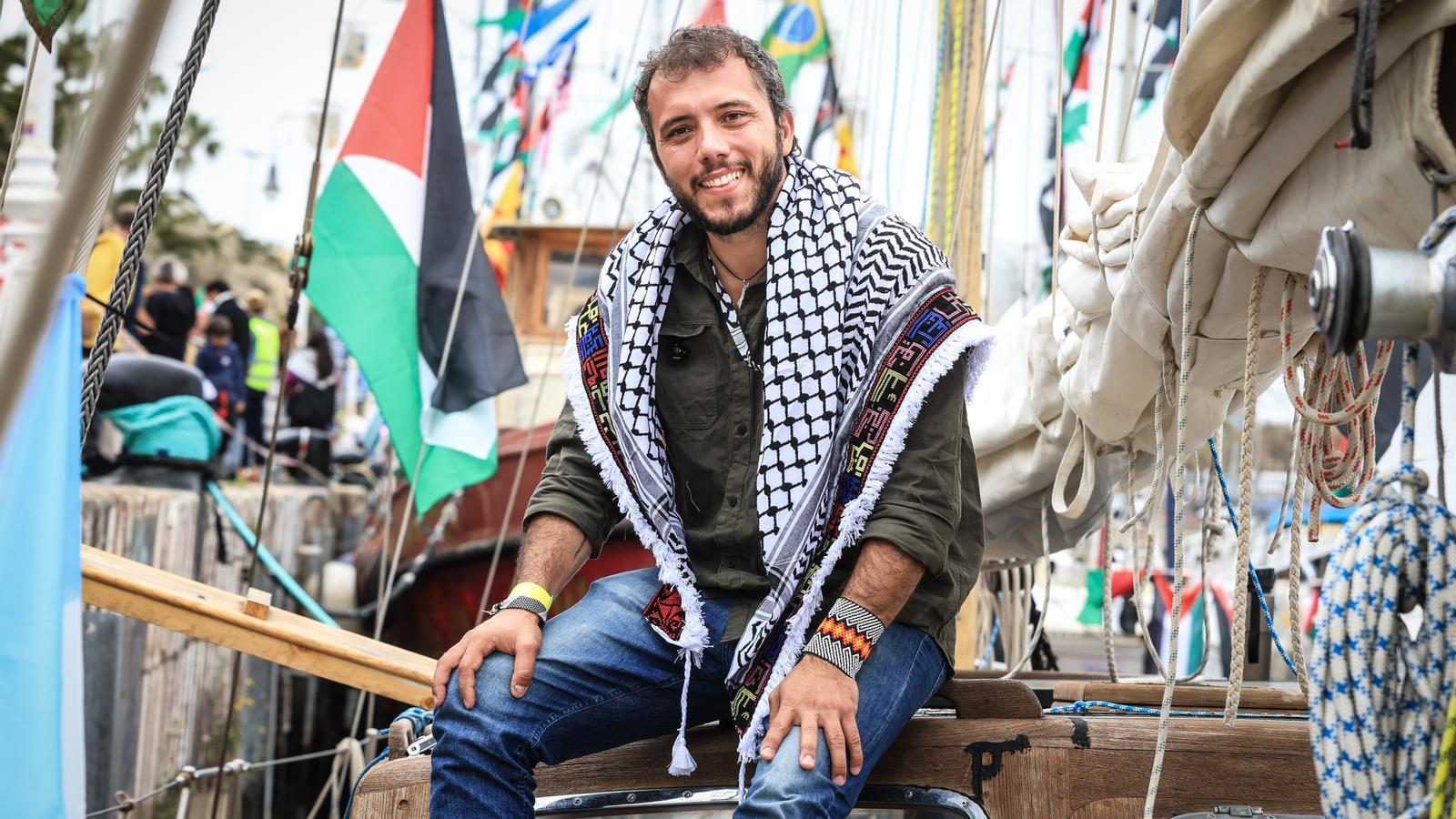
BarcelonaThe Brazilian Thiago Ávila (1986) is one of the coordinators of the Global Sumud Flotilla, the new international flotilla that seeks to break the blockade of Gaza and the largest yet. Ávila, an activist and political analyst, was part of a previous flotilla, which was intercepted last year. The mission plans to mobilize more than eighty vessels and more than 1,000 participants from about a hundred countries. It sets sail from Barcelona in an even more dangerous context of regional war and will be accompanied, up to the exclusion zone imposed by Israel, by the ships of Open Arms and Greenpeace. Its objective: to reactivate international mobilization in support of the Palestinian people. After the farewell events this weekend at Moll de la Fusta, 41 vessels will set sail from Barcelona in the coming days bound for Gaza, when weather conditions permit. In Sicily, more boats from France and Italy will join, and more vessels will be added along the rest of the route through the Mediterranean.
This flotilla will sail at a much more difficult time than the previous one. How is a peaceful civilian mission prepared in a context of regional war?
— This flotilla faces more difficult external conditions. Beyond hateful figures like Donald Trump and Benjamin Netanyahu, the systems they represent, imperialism and Zionism, are advancing in their attempt to subjugate peoples. Netanyahu and Zionism with the expansionist project of Greater Israel, from the Nile River to the Euphrates, a colonial, racist, and supremacist plan. And to this is added an imperialist project by the United States, which seeks to contain China, and therefore attacks Iran – one of Beijing's strategic allies – and control gas and oil. At the same time, Trump is trying to dominate Latin America: that is why he has kidnapped Nicolás Maduro and imposed a naval blockade on Cuba. All this causes destruction and human suffering, but we also see how the United States and Israel suffer military defeats.
There are few reasons for hope.
— The resilience of the Palestinian people, rooted in the land of their origin, is our reason for hope and our inspiration. Many people around the world have risen up against the genocide in Palestine and we see how governments intensify persecution, silencing, censorship, and criminalization, and this diminishes mobilization. Our enemies are not stronger, but they are more willing to do harm. The solidarity movement with Palestine is disoriented, which is why we must make an even greater effort, because we know that the result of previous flotillas was to encourage more people to fight, in the cities, in the countryside. The flotilla sounded the alarm, saying: “Now is the time to take to the streets”. Driving mobilization was the main success of the previous flotilla. The system has seen that the flotilla is an effective tool, it has wanted to silence us, and it is preparing to react.

Why have they decided to set sail again now?
— Let's sail when we can, there will never be an opportune moment. And we cannot wait. Six months have passed since the false ceasefire in Gaza, the Israeli army continues to murder Palestinians, humanitarian aid continues to be blocked and they continue to steal land. It is suggested that Gaza should be governed by Trump and the worst people in the world. And in the face of this, the flotilla must be a tool capable of mobilizing and inspiring people. This is the great battle of our generation. In the summer we were 42 boats and now we will have more than 80; we were 462 participants and now we will be more than 1,000, from a hundred countries. We will have a convoy by land, marches and demonstrations, strikes, encampments, a congress of parliamentarians in Brussels... The flotilla is just a grain of sand in this historic mission. We find ourselves at a key moment in the history of humanity, and in these moments of crisis one cannot simply wait for things to improve on their own. In times of war, with a generalization of violence, people seem small and helpless. But history tells us otherwise: fascism, Nazism, or apartheid in South Africa also seemed invincible. And people continued to move and organize. Things can be changed, but to do so, one must move. We do not surrender to the world that Trump and Netanyahu want: we must set sail now for Gaza.
You have a young daughter and have received repeated death threats: why did you decide to board again?
— I am the proud father of Teresa, a precious two-year-old girl. When she was two months old, she contracted dengue: my heart broke when I had to hold her arm while she was being injected. I would have done anything to be in her place. And at that very moment, fathers and mothers of Palestinian children were holding their children's arms so they could be amputated without anesthesia. It is the love for my daughter that leads me to the flotilla. There are risks, but it would be much more dangerous for my daughter to live in a world where this spiral of destruction continues.
The summer flotilla was intercepted by the Israeli army, just like all previous ones in recent years. Why do they insist on the same strategy?
— Who would have thought that Israel and the United States would one day be begging for a ceasefire agreement with Iran, after forty days of aggression? Who would have thought that such a poor, sanctioned, strangled people as the Yemeni people could inflict so many maritime defeats on the United States in the Red Sea? Who would have thought that the people of Vietnam would defeat the United States? Or that the people of South Africa would defeat apartheid? These struggles are the result of much persistence, of constant mobilization, of knowing that there are tactical defeats, but that the strategy of imposing attrition on the enemy, of showing the conditions of vulnerability, of creating a social majority, also has its value. It is also not unthinkable to reach Gaza. On August 23, 2008, the first two ships arrived in Gaza and four more missions succeeded in the following months. Afterwards, all have been intercepted, but we must continue to insist, to create the conditions so that one day we can break the blockade. The summer flotilla was intercepted, but Trump ended up announcing a false ceasefire and Netanyahu had to back down. And let's not forget that on the day they attacked us, the fishermen of Gaza were able to go out to fish. Our social networks reached two billion people, who are now asking themselves the right questions.
