"In Poblenou only English is heard now": this is how gentrification impacts the use of Catalan
Platform for the Language asks for measures to reverse this dynamic

-
CAT -
CAST
BarcelonaYou only need to walk down Rambla del Poblenou towards the sea to see that the neighborhood's landscape has changed. A graffiti on a wall at the height of Pere IV summarizes it, which at some point said Expats go home (Fora expats, in English) and which someone has partially erased until it seems to describe – in English, of course – the expats' house. It is the antechamber to a promenade where, in recent years, businesses with signs exclusively in English have proliferated and where residents complain that it is increasingly difficult to live in Catalan. "You only hear English spoken now," laments Xavier Vidal, owner of the No Llegiu bookstore, in conversation with ARA, who emphasizes that "the neighborhood has changed a lot in just two years".
The impact on Catalan is one of the consequences of gentrification. Plataforma per la Llengua has put data to this perception. The organization has presented a report analyzing demographic, economic, and Catalan language usage data that confirm how the progressive transformation of the neighborhood – one of the favorite areas for people coming from richer countries to work for a season in the city – has penalized the vitality of Catalan, especially in the commercial sphere.
On Amistat street, Ramon has had Le Figaro, the Financial Times, the Daily Mirror, or Die Zeit at his newsstand for years. At first, he sold them mainly to tourists, but now many of those who buy them are people who live in the neighborhood. Most have arrived from countries with a higher GDP per capita. A phenomenon that has skyrocketed in the last decade. Between 2015 and 2025, the population born in Australia and New Zealand has grown by 165%; that of North America, by 144%; that of Northern Europe, by 89%; and that of Western Europe, by 38%. In total, 6.58% of Poblenou's inhabitants were born in countries with a GDP per capita higher than Catalan, practically double the average for Sant Martí (3.36%) and also well above the average for the city as a whole (3.77%).

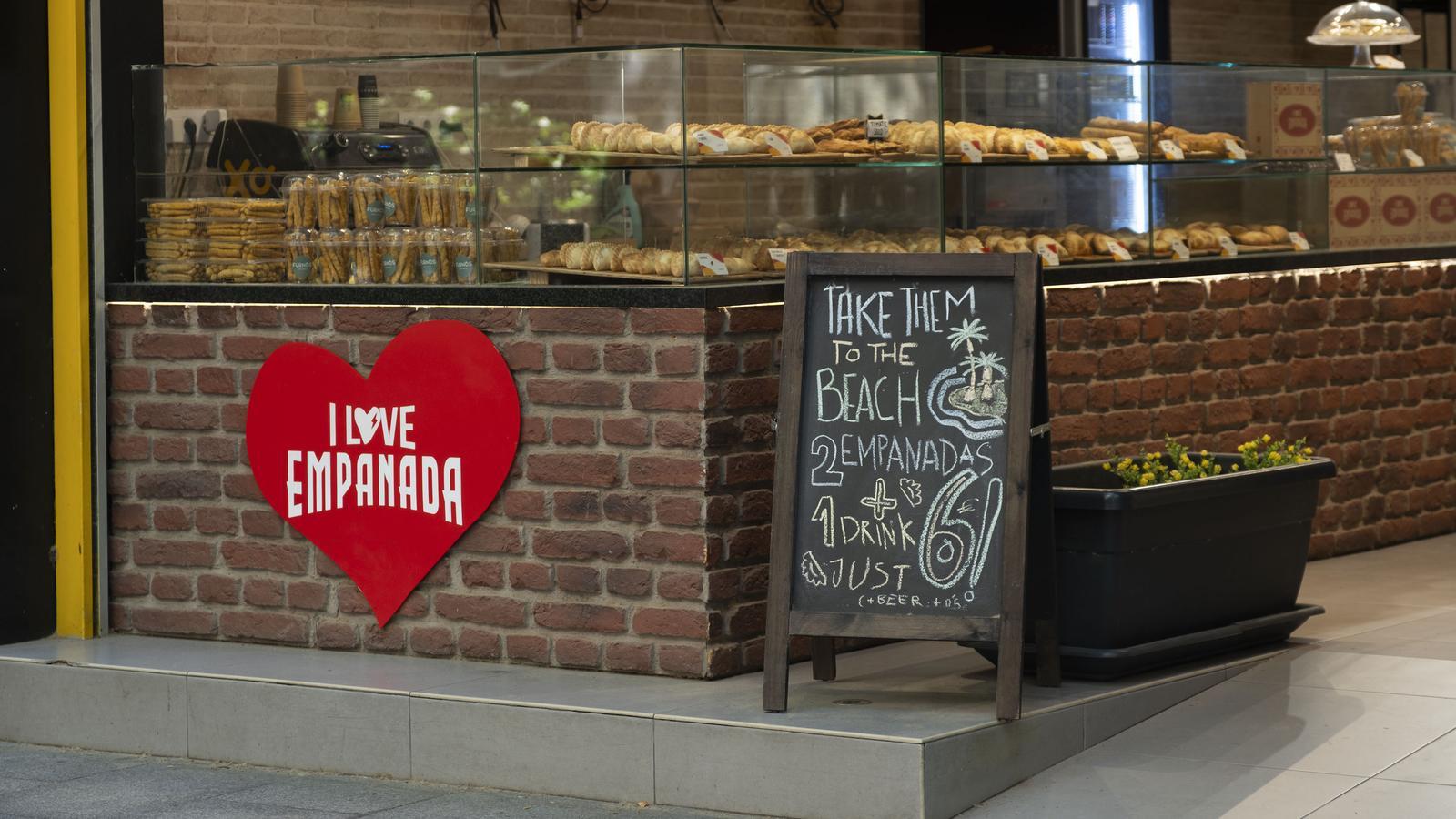
"There is a commercial adaptation to the new demand for a monolingual English-speaking population. Signage and oral communication are migrating towards this language," explains Xavier Dengra, coordinator of Business and Consumption for Plataforma per la Llengua. Returning to the walk along La Rambla, it is easy to grasp. What was once the Coral hardware store is now a supermarket that advertises in English with slogans like Happy Barcelona. A few meters away, a specialty coffee shop and a shop selling açaí have all their signs in English. The same language with which an Argentine empanada shop encourages you to take some to the beach. According to the report, between 2022 and 2026, businesses with signage in a language other than Catalan and Spanish have gone from being 2% to representing 26%. In 2012, there were none.
Catalan fares even worse when analyzed by the language with which merchants initially address customers. The study highlights that in 79% of businesses, greetings are made in Spanish, and only in 21% in Catalan. If the customer responds in Catalan, 48% of merchants switch languages. 52% maintain Spanish. In 2012, 69% responded in Catalan and only 31% continued with Spanish. One of those who advocates for maintaining the language is Vidal, who laments that often, when foreign customers arrive, "they make no effort to understand or speak Catalan," and that he has even received some criticism online for having few books in English.
The impact on housing
Regarding the language spoken on the street, there is no specific data for the neighborhood, but the Municipal Services Survey of the City Council indicated that in 2025, only 31.8% of Sant Martí residents had Catalan as their usual language, below the city's average of 34.8%. Residents whose usual language was a language other than Catalan or Spanish already accounted for 10.2%. Despite this, on Wednesday morning, Catalan can be heard spoken on La Rambla. There is a strike at the school and many grandparents are talking with their grandchildren while walking. With the data at hand, it is most likely that the grandparents' neighborhood is no longer that of the children.

Two raw figures provided by the report. Although the foreign population represents 26.5% of the residents in the neighborhood, 35.8% of the flats purchased in 2025 in Poblenou have been acquired by people without Spanish nationality, a figure much higher than the city average (23%); and the rent price has grown by 70.5% since 2014, above the price increase experienced by the district (67.7%) and the city average (62.3%).
All in all, it can be summarized by the snapshot that Idealista offered on May 6th: of the 57 flats for rent in the neighborhood, only 11 are for long-term stays, while 46 are for seasonal stays. There is no flat offered for less than 1,200 euros per month and only six for under 1,500. These days, in the "rodones" of La Rambla – in Poblenou, the intersections of its main promenade have never been called roundabouts or small squares – you can see banners for the week of mobilizations that are taking place in the neighborhood for the right to housing. "In recent months, about twenty neighbors have come to the bookstore to say goodbye because they are leaving," explains Vidal.
Measures in defense of Catalan
During the walk along the Rambla, it is easy to notice how Catalan is diluted as you approach the beach and the luxurious first-line sea-view apartments. When you cross Taulat street, everything is already called Beer Garden, Da Mamma or Quick Greek and advertises plant based burgers or cocktails. A few meters away, an emblem of this mutation of the neighborhood. On the corner of Taulat with Sant Francesc, where the daily menu of Racó del Taulat used to be, there is now a cafe called In Dheli we trust. Everything is white, aseptic, full of people with headphones and laptops. There is no trace of Catalan."Take it slow, enjoy your day", says the sign on the door.
The report by Plataforma per la Llengua does not limit itself to analysis and also proposes solutions, among which are more control of linguistic regulations, but also making it mandatory for companies and coworkings in Poblenou to have linguistic reception plans for their workers, including the possibility of attending Catalan courses during working hours. Among the more innovative measures, it also calls for institutions to create periodic indicators of social use of Catalan that allow for the establishment of thresholds for linguistic substitution and to distinguish where preventive, corrective or shock plans are needed.
