Tony Lawrence: "A military response from NATO against Russia is very unlikely"
Head of the Defence Policy and Strategy Programme at the International Centre for Defence and Security (ICDS) in Tallinn

-
CAT -
CAST
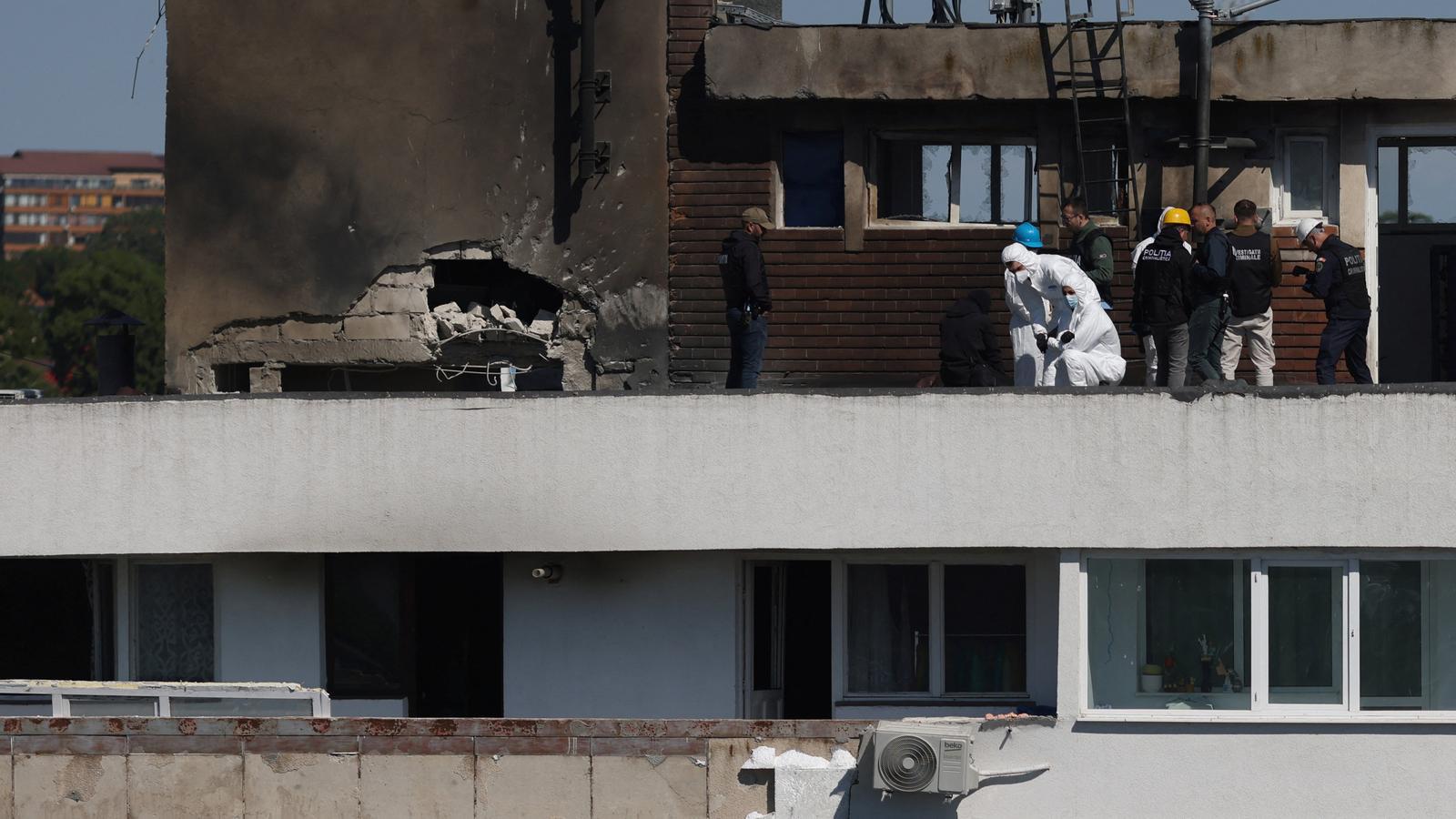
BarcelonaThe impact of a drone against an apartment block in the Romanian city of Galati, near the border with Ukraine, highlights the danger that the war could end up involving NATO more directly. Friday's incident has not been the first incident with Russian drones or missiles outside Ukrainian territory, while the Baltic countries also warn of the risk they face due to the deviation of Ukrainian drones entering their airspace. We analyze this with Tony Lawrence, head of the Defence Policy and Strategy Program at the International Centre for Defence and Security (ICDS) based in Tallinn (Estonia).
How serious is this incident in Romania?
— It is not an unprecedented event because the same thing happened in Poland last September. But there is still too little information. It could be a Russian drone that has been diverted by Ukrainian electronic warfare or simply a drone that has malfunctioned. Or it could be a deliberate action, but we don't know. If it were deliberate, obviously, it would be a very serious matter, but it is too soon to say.
Would it being deliberate be the condition to activate Article 5 of NATO?
— If it were a deliberate attack, it would certainly have to involve the activation of Article 5, which means that member states will stand united and respond appropriately. It does not necessarily mean there will be a military response against Russia. It just means that member states will agree that an attack has been carried out against all of them. I think a military response would be very unlikely. I think it would be very, very difficult for NATO to find any kind of consensus for that. But there are other options, such as sanctions.
How do you assess NATO's response to these types of incidents?
— NATO's response today has been to repeat the usual message, that they will defend every inch of NATO territory. It is not the most forceful response, but throughout the war, allies have been concerned about escalation, they are concerned about provocation, and I would say it has been very difficult to find consensus on any kind of firm response. NATO is deterred by Russia, but equally Russia is deterred by NATO. Russia has had every opportunity to attack NATO allies throughout the war, and has not done so. So there is this kind of cautious behavior on both sides.
What could be a more forceful answer?
— It could be many things. It could be a military response. But, as I said before, I think that is really unlikely, because I don't think the Alliance would find consensus to do it. In general, I think the Alliance would struggle to find consensus on any kind of response, because there are all sorts of questions about authorship and proportionality, and getting the 32 members of the Alliance to agree on an appropriate response, taking into account this context and this background, I think it would be quite complicated. For example, the response could be to offer more support to Ukraine. But that is also increasingly difficult, due to our own limitations. So my impression is that it will again be another case of words rather than something more practical.
Is Trump making consensus in NATO even more difficult?
— Yes, I think so. And not just because the United States is involved in a peace negotiation process. For the moment, this is not progressing much or very well, but they probably wouldn't want to risk their chances of reaching some kind of agreement between Russia and Ukraine by acting in a stronger and more forceful way in response to this incident.
Do you think there is a risk that this unconvincing response from the Alliance may encourage Russia to go further?
— It is not impossible. Undoubtedly, we should not rule out anything, and one of the issues with Article 5 is that we don't really know what the exact threshold is, and this is deliberate. That is to say, this kind of constructive ambiguity is maintained about when Article 5 could be considered activated. Therefore, yes, these scenarios are possible, but I would say again that throughout the war it has become quite clear that Russia has been deterred by NATO, and NATO has been deterred by Russia, and I believe that this kind of basically stable situation has a strong chance of continuing. I think something really very important and clearly deliberate would have to happen for the Alliance to react, especially militarily.
Romania has asked NATO for a faster transfer of anti-drone capabilities. Would you say this is one of the main challenges for the Alliance right now, especially on the eastern flank?
— Undoubtedly yes. Air and missile defense in general is a significant capability gap across the Alliance. And anti-drone defenses are an even bigger problem. NATO's integrated air defense system is designed for conventional aircraft, not for drones. Nor do we have cost-effective ways to eliminate drones, and shooting down a drone with a very expensive air-to-air missile; it's simply not a sustainable option. Therefore, we need both sensors and sensor coverage as well as new means to neutralize drones. The good news is that this is widely recognized, and there are all sorts of national and international programs underway aimed at developing technologies against UAS (unmanned aerial systems). But we need them now, and right now they are still not available.
