Education and the majority unions reach an agreement for 50 euros more
The pact that teachers will now have to endorse in a consultation has not led to the strikes being called off

-
CAT -
CAST
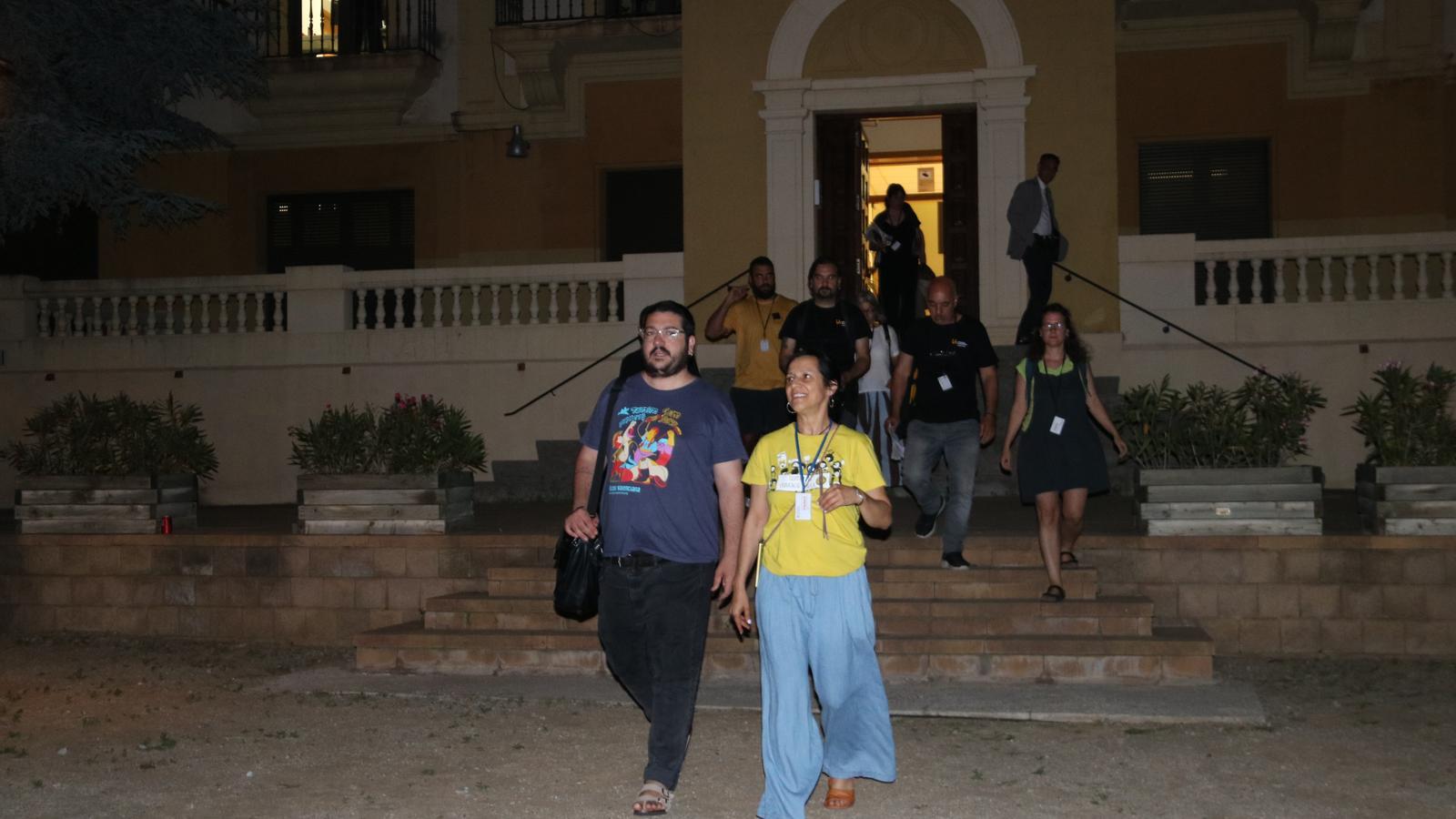
BarcelonaApplause and silence. After twelve hours of negotiation and up to eight meetings between the Department of Education and unions, the person in charge of delivering the good news was none other than one of the building's security guards. "I think so...", he said hesitantly, when journalists approached him as he left the room where the Minister of Education, Esther Niubó, and the unions were negotiating. After 16 days of strike this course, finally, the majority unions and Education have reached an agreement, which will now have to receive the endorsement of teachers in a consultation.
It is a pre-agreement that has been unblocked with the Government putting 50 euros more on the table and which has been celebrated with deafening shouts of "Niubó resignation" in front of the ministry. And it is also an agreement that has not led to the cancellation of next week's strikes. "We have to decide among all the organizations based on the consultation whether we call a ceasefire or not," admitted the spokesperson for USTEC, Iolanda Segura. The next strike call is this coming Monday, but Segura said that the Government has not "demanded" that they call off the protests to sign the pact.
The pre-agreement has been reached by USTEC, Professors de Secundària, CCOO, and UGT. The breakthrough in the negotiations was that, this Friday, the Minister of Education, Esther Niubó, raised the stakes on remuneration and offered 50 euros more in salary than on Thursday. The increase would be through the new supplement that the Government put on the table this week and which will reach all teachers. Until now, the supplement was 124 euros and, instead, with the new offer it rises to 170 euros.
Finally, between the 200 euros agreed last March and the new supplement, the ministry has put on the table an increase of about 450 euros per month over four years. In addition, as the unions demanded, almost 400 euros of this salary increase for teachers will come from regional supplements. However, if state increases are taken into account, with all of this, in four years, Catalan teachers will earn 599 euros more and secondary school teachers 633.
Regarding the remuneration part, the agreement also includes compensation for stadium debt: the money that teachers did not receive during the cutbacks when stadiums began to be paid for after nine years instead of six. However, at the moment the preliminary agreement does not contemplate an increase in remuneration for the colonies nor a decrease in the teacher-student ratio on outings, nor the commitment not to close more groups in public schools.
Results of the Tuesday consultation
Now, as USTEC has explained, the forecast is that "a priori" this Saturday afternoon the consultation will be launched to all teachers so they can decide whether to approve or not the pre-agreement reached with the Government. Teachers and professors will be able to respond electronically until Monday and it is expected that the results may be known on Monday evening or Tuesday morning. In the event that with this consultation teachers vote against the pre-agreement, USTEC has already warned that it would call a new strike on June 8, just before the visit of Pope Leo XIV to Barcelona.
Friday's negotiation, however, has also ended with the breakdown of union unity: the CGT, the Intersindical, and COS have walked away from the table because the new proposal from Education does not include aspects such as a reduction in ratios in 1st grade of primary school, a timeline for the internalization of support staff, and the reclassification of educational support staff (PAE). "For honesty, we have walked away," explained Laura Gené of the CGT.
In fact, the battle for the narrative between union forces to decide who gets the credit for each new agreement is what has caused the negotiation to be extended by two more hours once the measures had already been agreed upon with the Department of Education. The fact that the new agreement is an extension –or an annex depending on which union you ask– of the pact that the Government signed with CCOO and UGT in March has caused the union forces to dig in their heels to decide how they would explain who had achieved each point of the agreement.
6,400 provisions in 4 years
Regarding staff reinforcement, Education and unions have finally agreed to incorporate a minimum of 6,413 positions in four years. Among them are profiles of social educators, speech therapists, or figures to improve language acquisition. In fact, this is one of the points of the agreement that has generated the most controversy about who deserved credit, as it would be a development of a point previously agreed upon by UGT and CCOO. The agreement also includes the call for 5,000 secondary school positions and "new monitoring spaces for infrastructure, air conditioning, and curriculum".
Furthermore, as USTEC explains, this Friday's pre-agreement also includes an expansion of the famous "country pact" that the Government agreed upon with UGT and CCOO. Among other things, it is planned to have an annual transfer competition and to reach 85% of teachers with a permanent position within two years. There is also a commitment to hold annual opposition exams with a call for more than 5,000 pending positions and the elimination of interviews by management teams to choose teachers, as well as the limitation of profiled positions to a cap of 3%; something that was already included in the March agreement. Finally, the pre-agreement would also include the implementation of the plan to reduce bureaucracy and the incorporation of more administrative and service staff (PAS), in addition to a progressive decrease in ratios to reach 20 students in primary school and 25 in secondary school.
