Netanyahu accelerates the construction of Greater Israel
The offensives in Lebanon, Gaza, the West Bank and Syria show the expansionist zeal of the government
-
CAT -
CAST
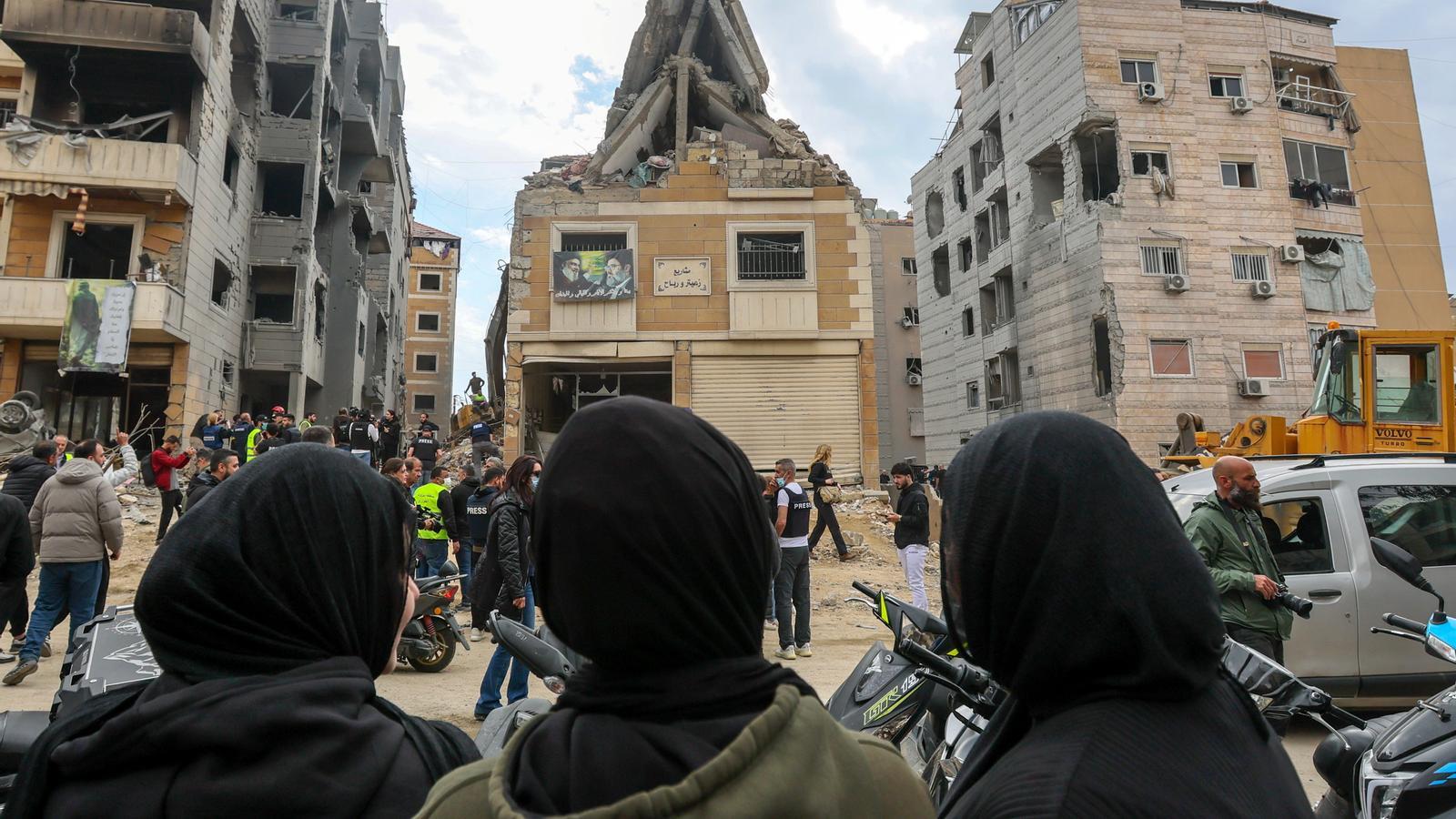
The same day that the ceasefire between the United States and Iran came into effect, the Israeli army redoubled its attacks on Lebanon. In just ten minutes, more than 160 bombs fell on Lebanese territory, leaving more than 300 dead in a single day. The deadliest attack in decades. Added to this situation is the Israeli military presence in the south of the country for weeks, with the stated objective of creating a supposed "security zone" against the Hezbollah group up to the Litani River, about thirty kilometers from Israel's northern border. In this context, with various fronts opened by Israel, not only in Lebanon, but also in Gaza and the West Bank, and with both air attacks and military presence on the ground, an idea that has hovered over the region since the origin of the Zionist movement is regaining strength: that of building the so-called Greater Israel.The concept of Greater Israel, inspired by the Genesis of the Hebrew Bible, speaks of a territory that would extend from the river of Egypt to the Euphrates, a vision already evoked at the end of the 19th century by Theodor Herzl, considered the father of political Zionism. In practical terms, it would imply that Israel would incorporate the Palestinian territories, Lebanon, Jordan, parts of Syria, Iraq, Egypt, and Saudi Arabia as its own. That is, nearly 25% of the Middle East. In this scenario, Israel would go from its current 20,770 km² of surface area, recognized by the international community, to controlling about 500,000.The idea of Greater Israel is also found in the early days of the State of Israel. In 1947, Zionist leaders initially accepted the UN partition plan, with a Palestinian and a Jewish territory, but the then Israeli Prime Minister David Ben-Gurion made it clear at the time that he considered it only a first step: "After the formation of a large army as a result of the creation of the state, we will abolish the partition and expand." In 1948, this became a reality in part with the Nakba, when about 750,000 Palestinians were expelled from their homes.The movement gained more strength after the 1967 war, when Israel took control of the West Bank and Gaza, the Sinai Peninsula (Egypt), and the Golan Heights (Syria), territories it continues to occupy today, with the exception of Sinai, returned to Egypt in 1982. From that moment on, the concept of Greater Israel gained relevance, especially among religious Zionists, who considered these territories a right granted by God.Since the current Israeli government came to power in 2022, and especially after the Hamas attacks on October 7, 2023, various analysts point out that references to Greater Israel have become more frequent and visible.Netanyahu's objective
Prime Minister Benjamin Netanyahu has stated on several occasions that he identifies "fully", and last year he even said it is a historic and spiritual mission. According to Professor of International Relations at Oxford's St. Antony's College, Avi Shlaim, Netanyahu pursues "the dream of Greater Israel", within the "most right-wing, xenophobic, messianic, and openly racist government in Israel's history". In fact, in 2025 the Israeli parliament approved a non-binding motion calling for the annexation of all of the West Bank, declaring it an "inseparable part of the Land of Israel". In the same vein, Defense Minister Israel Katz has announced several times that Israeli forces will remain indefinitely in parts of Gaza, Syria, and Lebanon with the justification of creating "security zones". Furthermore, one of the main promoters of Greater Israel, Finance Minister Bezalel Smotrich, displayed a map a couple of years ago that included Israel, the West Bank, and all of Jordan as Israeli territory. Since then, he has repeatedly defended the annexation of the West Bank and has even suggested an expansion that would include Damascus, the capital of Syria.The opposition also gives its support
The Greater Israel idea is not questioned by the opposition to the government either. The main opposition leader, Yair Lapid, argued before the start of the war against Iran that territorial expansion based on "biblical" criteria should be carried out, despite having supported the two-state solution in the past.“Israel is expanding its borders and moving beyond its proper Israeli territory. In Gaza, it controls 53% of the territory; in Lebanon, it is at least 8 to 10 kilometers north of the Blue Line [a de facto border drawn by the UN between Lebanon and Israel]; and in Syria and the West Bank, it has also had a presence for years”, explains to l’ARA Dr. Ahron Bregman, an Israeli historian specializing in Middle East conflicts and a former officer in the Israeli armed forces. According to him, since the attacks of October 7, 2023, two trends have consolidated in Israel: a military mindset that advocates for broad control zones for purely defensive reasons, and a settler movement that takes advantage of the army's advance to consolidate civilian presence in new territories. A clear example would be the settler group Uri Tzafon, which claims to expand into southern Lebanon due to biblical and historical ties with this area.Unlike in 1967, when these ideas were more confined to certain branches of religious Zionism, today they have a greater presence in various sectors of Israeli society. “It has become a more central idea due to political and social changes, with a shift to the right after the Hamas attacks and increased influence of settlers in the media, the army, and the government,” Bregman concludes.
