The US and Iran are heading towards the resumption of talks
Washington assures that its negotiators will travel "soon" to Pakistan and Tehran sends the Foreign Minister
BarcelonaFinally, the second round of talks between the United States and Iran seems to have been unlocked. Both Washington and Tehran announced this Friday that they are sending delegations to Islamabad. However, after a week of announcements and subsequent denials, and amid an escalation of assaults and interceptions of ships in Hormuz, skepticism still predominates about the fruits that dialogue between the two parties may yield. The few details about when and how this second round of negotiations may occur add uncertainty to the situation.
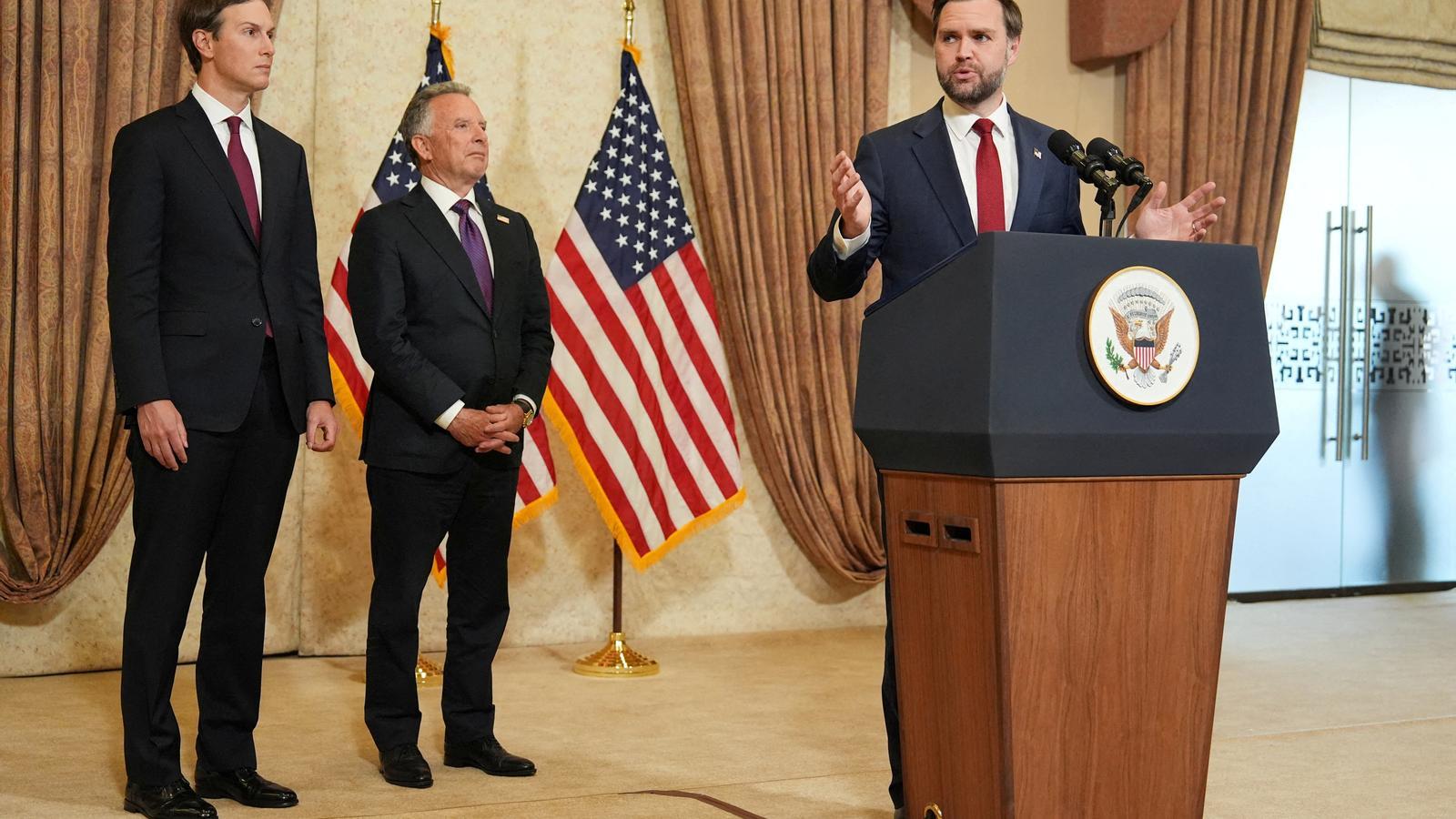
Predictably, Washington and Tehran will sit down to negotiate this weekend. The White House announced this Friday that it will send its main negotiators, Steve Witkoff and Jared Kushner, this Saturday to Pakistan. At the beginning of the week, with just over two days left until the ceasefire ended – subsequently extended – the United States had indicated that Vice President J.D. Vance, who participated in the first round of talks, was about to travel. But Iran was reluctant to sit down and negotiate with the United States, accusing them of imposing red lines unacceptable to Tehran, and Vance ultimately did not travel to Islamabad. Now he will also stay on the ground, at least until the talks progress.
On Iran's side, Foreign Minister Abbas Araghchi traveled to Islamabad this Friday. Araghchi's visit is part of a tour in which he will also visit Oman – a country that mediated before the war – and Russia. Once in Pakistan, the minister will communicate the ayatollahs' stance to the mediators. What will be discussed, initially, are the conditions for resuming talks. Once this point is agreed upon, White House spokeswoman Karoline Leavitt assured in an interview with Fox News that there will be "direct talks with representatives of the Iranian delegation." According to Leavitt, Iran had contacted the United States in recent days to request a meeting.
However, distrust regarding the talks is significant. Iran has not stated at any point that it is heading to Islamabad to speak with the United States – framing the visit as an official trip by the foreign minister –, and the ayatollahs also do not confirm that they have requested a meeting in Washington, as Leavitt has assured. After Pakistan forced Trump to extend the ceasefire and with the Strait of Hormuz controlled by Tehran for two months, Iran has few incentives to negotiate, and the United States is seeking an exit from a conflict they have not been able to win, for now, through military means.
Israel continues to attack Lebanon
In Lebanon, on the other front of the war, attacks continue despite Trump announcing on Thursday night that the ceasefire between Israel and Lebanon has been extended for three weeks. The Israeli army launched an attack this Friday against a supposed rocket launcher in Lebanese territory. But it's nothing new. While the agreement has lowered the intensity of the fighting, attacks have continued in southern Lebanon, where Israeli troops have occupied a "security zone" that extends five to eight meters beyond the border.

The extension of the ceasefire was announced by the US president after he hosted the Israeli ambassador, Yechiel Leiter, and the Lebanese ambassador, Nada Moawad, in the Oval Office on Thursday for a second round of talks. The extension also allows the Trump administration to gain time in the parallel negotiation with Iran, which demanded that Tel Aviv stop the attacks as a condition for sitting down to talk about any agreement.
Trump has assured that there is "a great possibility" that Lebanon and Israel will reach an agreement in the next three weeks, but he is balancing to please the ayatollahs and, at the same time, not to cause more problems for his partner Netanyahu, with fragile popularity among Israelis. In this regard, the Israeli prime minister assured this Friday that, in a phone conversation, Trump told him that he has "freedom of action" in Lebanon despite the truce. In Israel, the majority of the population believes that Tel Aviv must maintain bombings against Tehran and Beirut.
The role of Hezbollah
The negotiations between Israel and Lebanon are historic because they are the first direct talks between the two countries in 34 years. But the exclusion of Hezbollah casts doubt on the durability of the pact. Without their approval, the implementation of whatever is decided will be extremely complex in a large part of Lebanese territory, considering the terrible relations between the Lebanese government and Hezbollah.
Ambassador Moawad, who went to the meeting requesting an extension of the ceasefire, thanked Trump for hosting the talks. "I believe that with your help, with your support, we can make Lebanon great again," she said, emulating the slogan "Make America Great Again". For his part, the Israeli ambassador assured during the meeting that the talks should focus on eradicating Hezbollah instead of withdrawing Israeli troops. Meanwhile, the Shiite militia refuses to disarm and opposes talks between the two countries, but views positively the continuation of the ceasefire as long as Israel fully complies with the truce.
