The last testimonies of the republican exile: "Life never again had the same meaning"
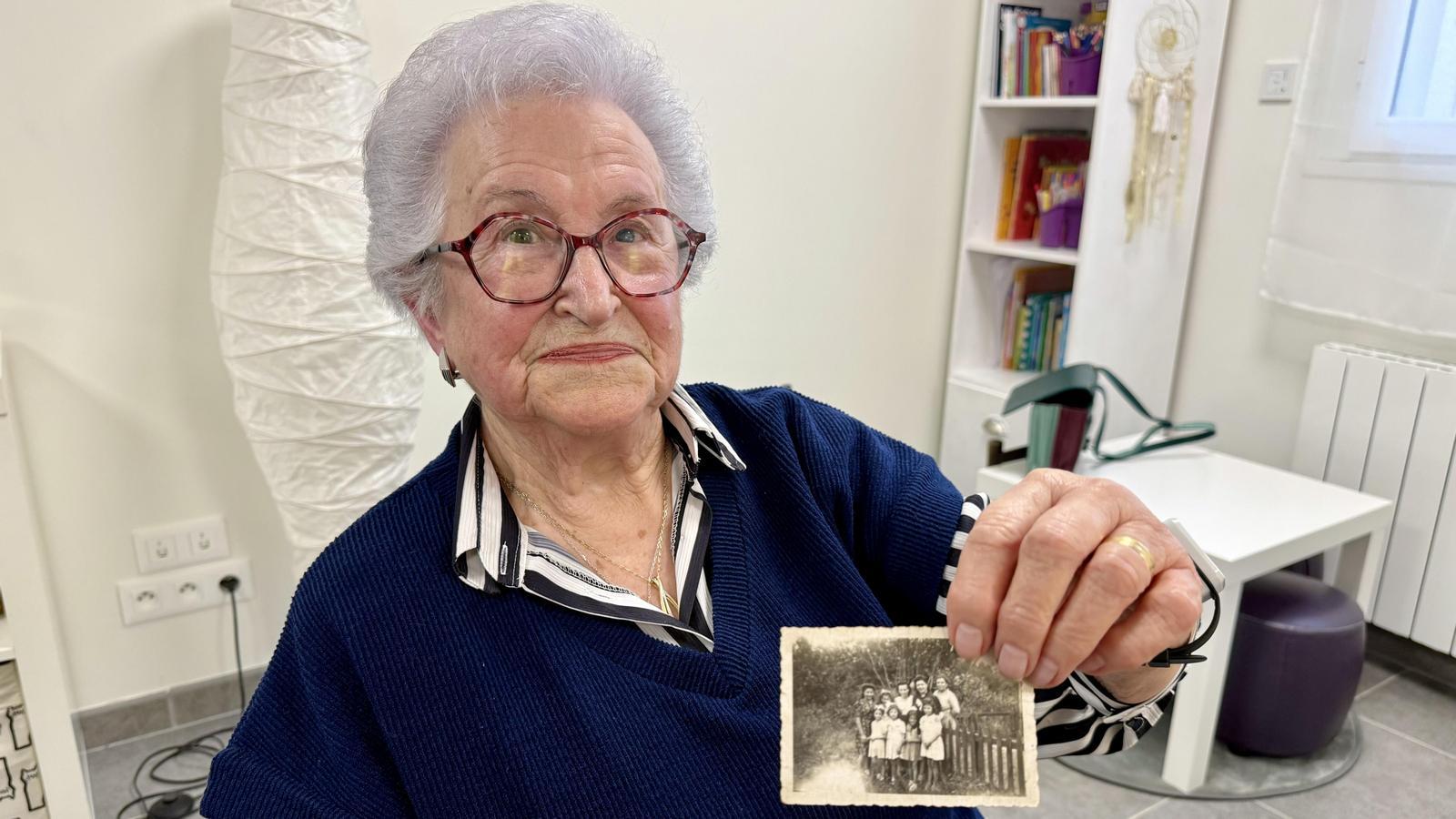

ParisA few days after crossing the Pyrenees on foot to flee Francoism, in the middle of February and in the midst of a glacial cold, Montserrat Casals fell ill. She was only three years old. She was transferred alone to a hospital in France while her mother and brother were locked up in Gaillon Castle, in Normandy, and her father was interned in the Barcarès concentration camp. A week later, a nun from the French hospital where Montserrat had been admitted went to the castle with the child in her arms to hand her over to her mother, Rosa. "I bring you your daughter because she is about to die. We can do nothing more," the nun told her. It was 1939.
Eighty-seven years later, that child who was about to die recounts the story with fortitude and a sense of humor: "I suppose bad weeds are good, because I'm still here." Montserrat, born in Avinyó (Bages) in 1936, is 90 years old and is one of the last Catalan exiles in France still alive. Neither the Spanish government nor the Generalitat have data on Catalan republicans still living in the neighboring country – some of them don't even retain their Spanish nationality – but, logically, all survivors are at least 87 years old. Montserrat Casals is one of the last direct witnesses of the Retirada and exile, although she was a small child and has few memories of it.
Nearly half a million Spanish republicans exiled themselves to France during the first months of 1939, after the fall of Barcelona on January 26. The French government, however, did not receive the refugees with open arms. Once on French territory, the Spaniards were identified one by one and dispersed throughout France, where they were confined. Families were systematically separated: men were sent to concentration camps, most of them located in the south of the country, and women and children were distributed among different reception centers where they were interned in precarious conditions.
Locked up in the castle
What Montserrat explains about fleeing Catalonia and the first months of exile in a conversation with ARA, she knows through what her parents, Rosa Bas and Jordi Casals, who was a captain in the republican army, told her, and from some images that remained etched in her memory. "We spent two or three weeks walking in the cold and snow. When we arrived in France, they vaccinated us against whooping cough and put us – my mother, my brother, and me – on a train, which was not a passenger train. The train would stop, people would get off, we would hear shouts, and then it would start again – she recounts. They made us get off at Gaillon and locked us in the castle."

No photographs from those days are preserved, but the local newspaper of the time, Montserrat keeps a copy of the letter her father wrote to the prefect of Eure to request the transfer, as well as the letter in which the director of the refugee center at Gaillon Castle accepted Casals. "I have no objection to this refugee coming to Gaillon. However, I would like to point out that he will be the only man in the camp," writes the director. Days later, he obtained the safe-conduct to go to Gaillon Castle.
Without beds or hot water
The two documents were found by the French historian Jean-Louis Breton while he was rummaging through the archives, investigating the passage of Spanish exiles through the castle of Gaillon, an imposing Renaissance building located at the top of the Norman village of the same name. The castle, which was a prison during the 19th century, hosted more than 450 Spanish refugees, including Montserrat and her family, during the first months of 1939. They had no beds or hot water. "We were locked up, with guards around, and we slept on straw," recalls Montserrat.

No photographs from those days are preserved, but the local newspaper of the time, Le Gaillonnais, described the arrival of the exiles as follows: "From their arrival by train, women and children, with their meager suitcases, were loaded into trucks and private cars. Thus, with the coldness of a foggy winter morning, they left for the place of asylum." Days later, the same newspaper explained the life of the Spaniards in the castle and recounted how the children cleaned themselves with cold water in the open air. "We could see in the courtyard, despite the low temperature and the humidity-laden fog, children bathing with their torsos bare," the chronicle states.
For the population of Gaillon, which currently does not reach 7,000 inhabitants, the arrival of the exiles meant a revolution. "There were municipal decrees that dictated the prohibition for Spaniards to communicate with the population. There was a fence around the castle and they did not have the right to leave. The refugees were initially completely isolated," says Breton. On Sundays, the villagers would come to the castle to see the Spaniards through the gate in front of the main entrance.

In the town there was a young man who had been part of the International Brigades and had fought in the civil war two years before. As he spoke a little Spanish, he acted as an interpreter. Always through the grate. According to Breton, that young man fell in love with a Catalan exile, whom he would marry years later. The couple is buried in a village near Gaillon.
German occupation
The arrival of the Nazis in France in September 1939 forced the evacuation of the castle and the refugees were transferred to a nearby unoccupied colony. Months later, already in 1940, with the advance of the occupation by Hitler's troops, the region experienced an exodus and the Spaniards were freed. Some returned to Spain, others sought refuge in the unoccupied zone. Only about twenty families, including Montserrat's, returned to Gaillon when France was liberated.
The exile profoundly marked Montserrat's parents. "For them, life never had the same meaning again," she assures. She also went through difficult times at school. "French children insulted us exiles: 'Dirty Spaniard, go back to your country', 'You've come here to eat our bread', they told me." When she and her brother asked why they were being insulted, their father silenced them. "France has welcomed you, we owe it respect. Therefore, we must remain silent and endure," he told them.

"My mother always said we would return [to Catalonia], but my father replied that as long as Franco lived, we couldn't." Neither Montserrat nor her parents ever returned. They could only set foot on their land again and visit their Catalan family when Franco died. "They had a very hard life. Very hard," she laments. She married a Frenchman, had children, and currently still lives in Normandy, a few kilometers from Gaillon, in the municipality of Fontaine-sous-Jouy.
Despite her advanced age, Montserrat has a good memory, expresses herself without difficulty, and speaks Catalan. She feels more comfortable in French – a large part of the conversation with ARA is in French – but she is capable of expressing herself in her mother tongue. However, she feels closer to the country she arrived in at the age of three. "I am French because my husband and my children are French, but when I go on vacation to my cousins' house [in Catalonia], I feel a bit Catalan. Let's say I am Catalan, but France is my country," she explains. When she got married, she adopted her husband's surname, Bizard, as is customary in the Gallic country.
Talks in high schools
For years, Montserrat did not talk about exile, not even with her children, but for some years now she has been giving talks in high schools to explain to students the Civil War and the exile in France of thousands of Spanish Republicans. Until her death last year, she was accompanied by Josefa Llobet, another Catalan Republican from the Bages region who was at Gaillon Castle and lived her whole life in France. Born in 1928 in Navarcles, she was 11 years old when she crossed the French border with her family. In France she met another exile originally from Andalusia, Justo Cuadrado, and married him.
Her daughters, Jasmine and Stella, very active in preserving the historical memory of exiled Republicans, recorded a video shortly before their mother died, in which Josefa recalled her exile and her arrival at Gaillon Castle. Despite the difficult living conditions at the castle, she assured that for the Republicans coming from the war and the very hard trek through the Pyrenees on foot, Gaillon was a safe place. "We had white bread, food, we slept on straw, but we were warm and, above all, we were safe from everything," she states in the video.

In another interview with the local newspaper L'Impartial, in 2022 Josefa recalled the most difficult moments of the Retreat. "We crossed the Pyrenees; we saw dead people and animals by the roadside after being machine-gunned. They had even killed the donkeys that helped people. It marked me deeply," she assured.
Family trauma
Just like at Montserrat's house, Josefa didn't tell her children anything until she was older. The trigger was Jean-Louis Breton's research, who for years interviewed dozens of exiles to learn stories that even their own families didn't know. "Exile was for a long time a trauma within our family. When we approached the subject, my mother cried. We are happy for Mr. Breton's constructive and respectful initiative," assures Jasmine, 73 years old. "I didn't know anything about exile. I only knew that my parents had been born in Spain and had come to France during the war," explains Stella, who is 55 years old.
The Château de Gaillon is currently undergoing renovation and is expected to fully reopen in 2028 with a museum dedicated to the history of the building. The museum will exhibit the pieces of wall that were recovered from the room where the more than 450 republicans lived. These are walls with graffiti, names, and inscriptions in Spanish, a testament to the history of exile.
Every May, the exiles who are still alive and the descendants of the disappeared celebrate an act of homage at the château to the republicans who passed through Gaillon. They don't want it to be forgotten. A few years ago, Montserrat went with her daughter to see the château on a tourist visit. The guide did not mention that the republicans had been held there for months. When she told her, the guide showed her the room where the exiles had been. Montserrat thanked her and left without telling her that she was one of the 450 republicans who inhabited the château in 1939.
