Yuliia Sokolovska: "The day of the invasion I went to the office. There were Zelensky and the whole government: nobody thought about leaving"
Ukrainian ambassador to Spain, former deputy director of President Zelensky's office and former Minister of Social Policy of Ukraine

-
CAT -
CAST
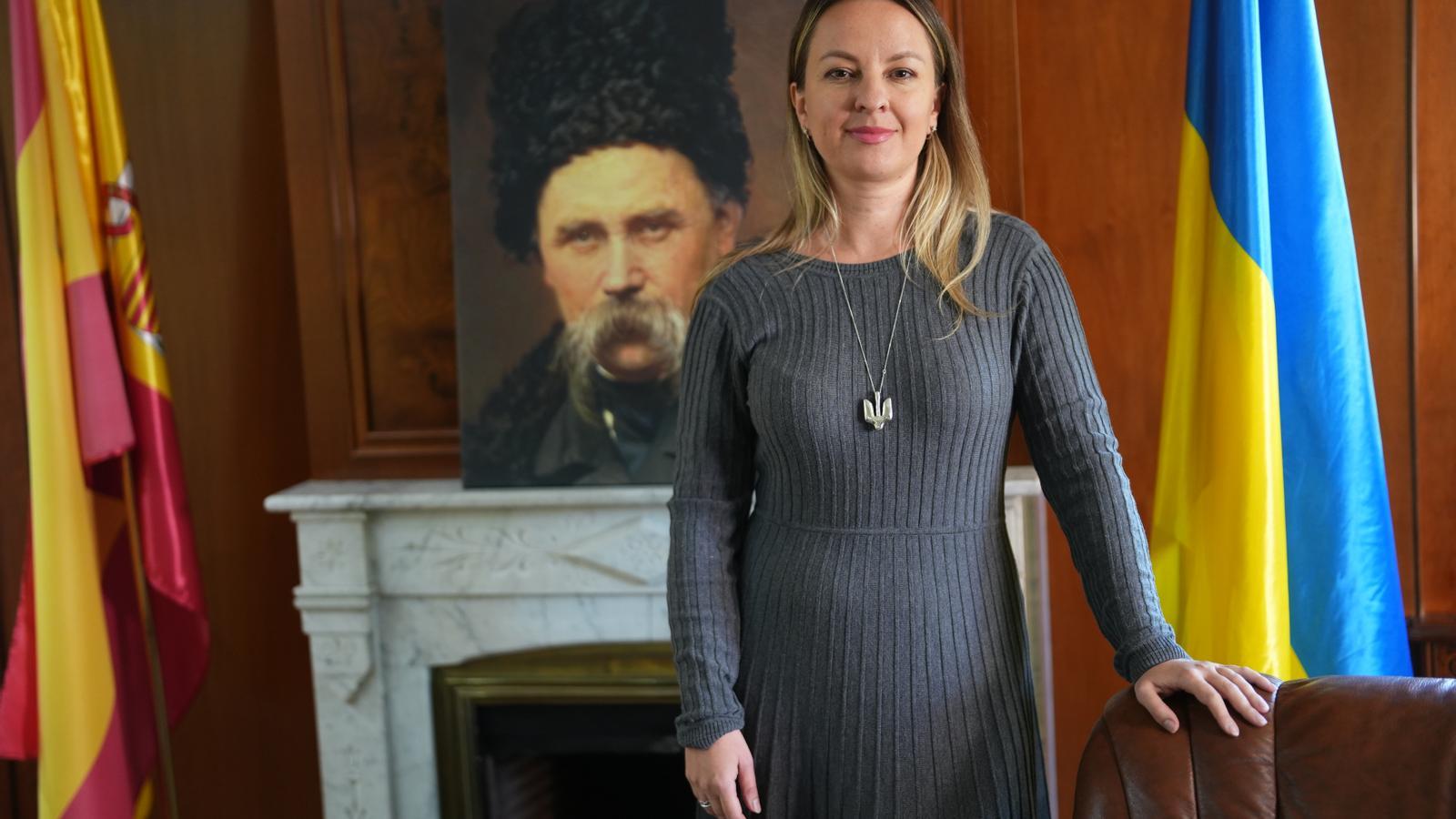
MadridIn the garden of the Ukrainian embassy in Spain, in the high-end area of Madrid, the blue and yellow flag flew at half-mast on Friday. A member of the Kyiv diplomatic corps explained that it was a sign of mourning for the railway accident in Chaplyne. "Well, and also for Dnipro. Yesterday Russia bombed a train station full of civilians and killed 15 people", they added. Inside the building, Yuliia Sokolovska, the ambassador, was waiting for the ARA. A little over a year ago, she came to the Spanish capital to take up this position. Her recent political trajectory suggests that Sokolovska is one of the voices that best knows the inner workings of Kyiv in these dark times of invasion: after serving as Minister of Social Policy, she was, for four years, deputy head of the Office of the President of Ukraine, one of the closest positions to Volodymyr Zelensky. The interview took place in a room presided over by a portrait of the Ukrainian poet Taras Shevchenko, a symbol of national identity and resistance against Russian oppression.
A few days ago, a Ukrainian soldier told me that he was more worried about his family, who are in Kyiv, than about himself, as he is fighting on the front lines. Russia has intensified its attacks against cities, which are now more deadly. Has the war changed?
— Well, there has been a major change. Russian troops have seen that they cannot achieve what they wanted on the battlefield, especially in the Donbas. The situation at the front remains difficult for us, but stable enough. And that means Russia must find another way to fight against the Ukrainians. And this way is terrorist attacks against the civilian population of big cities. Just yesterday [Thursday] they attacked a train station in Dnipro, full of civilians. It is a strategy: Russia wants to demoralize the Ukrainians, it wants to make the civilian population tell the authorities that we need peace at any price, under any condition.
And do you think the Russians are succeeding?
— Look, I travel to Ukraine once a month. I have been in Madrid for a year, and since then, I have been to my country nine times. And before moving here, I lived in Kyiv and worked in the office of our president [Volodymyr Zelenskyy] since 2020, so I have been there at all times, since the beginning of the invasion. Therefore, I can see what is happening in Ukraine. And I have reached a conclusion: we have become stronger, more prepared, more flexible. The situation is very, very difficult, undesirable, unimaginable, but people do not want to give up, they do not want us to give up.
Since Trump became president, United States support for Ukraine has dropped drastically.
— I cannot deny it to you, the data shows it as such. That is why I want to highlight that Europe has taken a step forward and, faced with this new situation, it has helped us a lot. Without European support, most likely, the situation in Ukraine would be very different at this moment.
Do they feel abandoned by Washington?
— We do not want to escalate the situation with the White House. It would make no sense, we need them: the United States is a huge, vital actor, and every move they make has a real and direct influence on our lives. Currently, we continue to receive a huge amount of intelligence information from our American partners, and we continue to buy material from them. I was in Kyiv when [the United States] stopped sharing intelligence information that is key to anticipating Russian bombings. And that, in practical terms, means that you don't even have those two or three minutes to go to the shelter and protect yourself from the attack. In other words, you can only pray that that missile does not hit near your home.
Is Kyiv following any strategy to appease Trump's onslaughts?
— I do not think I am the right person to answer that question. I am not the ambassador to the United States. Fortunately, I am the ambassador to Spain, a very friendly country. However, I reiterate that, obviously, we do not want to escalate the situation with the White House.
Is Europe doing enough for Ukraine?
— Europe has done a lot, very much indeed, for Ukraine. But I believe the time has come to draw even closer. We are now emotionally, politically, and even socially close, due to our values. We feel European and have paid a very high price to be independent and to draw closer to Europe. But it is also important that we have a joint defense strategy, joint arms production, and even a joint vision of the threat posed by Russia and how to prevent it.
That is to say, it advocates for Ukraine to join the European Union.
— Yes, and I believe this would also be beneficial for the European Union. There is the idea that each country must contribute something to the community club. In our case, a modern, highly prepared army, and, unfortunately, we can also contribute our battlefield experience, the experience of living from the front line situations that could potentially break out in other parts of the world. This experience gives us the confidence to think that Ukraine can protect Europe and help other European countries.
You know Volodymyr Zelenskyy well, and have for many years. How would you define him?
— Sincerely, very kind and very human. In fact, it even surprises me that he continues to be so after everything that has happened. I don't know if he sleeps much. He works constantly. He is a good person. And he has another great virtue, which is creativity. He finds solutions where only he sees them. I think that has been key for Ukraine to have resisted.
What do you remember about February 24, 2022, the day the invasion began?
— I went to work. I was at the office. The whole team was there. The president and all the political leaders were there too. Outside, bombs were falling, we could hear the missiles, but we were there; we had to be there. We knew that the Russian troops were advancing towards Kyiv, that they wanted to occupy it, and that we, the government, were a target. And obviously, we thought about that, that there was an enormous risk: at those moments it was not clear what would happen, whether we would survive. But we decided to stay and I believe that this was crucial for the defense and the unity of Ukraine, because it sent a very powerful message to the population. I often think that those first days were crucial for the next five years.
President Biden and President Macron offered Zelensky to leave the country. They had prepared a plan for him to flee.
— And he refused. We were all certain that our duty was to stay in the country. We didn't even think about leaving. I understand the concern of European leaders. At that moment, in fact, everyone took for granted that Ukraine would fall in a few days, Kyiv as well. We didn't know what would happen either.
Did they have a plan in case Russian troops entered Kyiv and came to capture them?
— From the first day, the members of the government had to leave our homes and go live in safer facilities, if there were any safe facilities at all. And yes, there was indeed a basic plan in case everything went very, very wrong. But, obviously, I cannot share the details.
In 2022, despite warnings from American and British intelligence, neither Europe nor Kyiv believed that Putin would launch a full-scale invasion. Did you not believe it either?
— We were aware that the deployment of troops that Russia had made at our border was exceptional, but I thought that finally the situation would evolve in a different way. From our perspective, we thought that Putin would not do it because the war, more than benefits, would mean economic and political losses for him. But we did not interpret his logic well, which is not rational, which is simply related to his ego, to his legacy. Putin has shown that he does not care about human lives. He proves it every day at the front.

According to official figures, at least 50,000 Ukrainian soldiers have died since the start of the invasion. Other unofficial estimates suggest there would be many more. What does this mean to you?
— Each death is an enormous loss. These are deaths of young, intelligent people. And this, certainly, will also have an enormous influence on the future of our country. But I know that both for President Zelensky and for our Ministry of Defense and for our military, every life matters. And that we are working hard in this regard, to break the logic of Soviet-style armies, in which the lives of soldiers were not a priority. Now, while we fight, we evaluate above all what happens on the battlefield to minimize as much as possible the casualties of our soldiers.
Is recovering all territories occupied by Russia non-negotiable for Ukraine?
— These are our territories and we will not renounce our territories. They are our people. I can imagine how difficult it is to live under Russian occupation. In fact, to do so, they make you choose if you want to live or if you want to be Ukrainian. And if you choose to be Ukrainian, you will probably not survive, or you will live turned into a prisoner, tortured.
Can Ukrainians think about the long-term future?
— We must think and talk about this future. Living five years in the middle of a horrible war would be simply impossible if one did not have hope for the future. I see my country as a hub of technology, construction, ambitions, and democracy. Once there is a lasting peace and security guarantees, there will be many opportunities in Ukraine. And I am sure that the Ukrainians who had to flee will return one day, starting with many of the 350,000 Ukrainians currently living in Spain.
Let's go to Spain. Zelensky and Pedro Sánchez have a good relationship, but there are elections in a month. Does a hypothetical change of government worry you?
— Spain is a very reliable partner. And, after a year in this country, I am sure that Spain, with regard to Ukraine, will be on the right side of history. I see very clear messages in society, regardless of political parties, that make me think that, whatever happens in the elections, we will have support for Ukraine.
The far right is growing across the continent, including in Spain, where it could eventually govern. Europe has seen how a large part of this far right has had ties to Moscow and, in some cases, advocates turning off the tap to Kyiv.
— I can only say that, whatever happens, I trust that we can find ways to work together. As long as there is no Russian disinformation, financial influence, or hybrid interference, we are all reasonable people and can find a way to collaborate.
You were key in the organization of the trip by President Salvador Illa and the Mayor of Barcelona, Jaume Collboni, to Kyiv, where they were received by Zelensky.
— For me, it is really important to work with Catalonia. I believe that, to establish a better relationship, a better cooperation, it is essential to also establish regional links, to strengthen alliances at different levels. We are aware that Catalonia contributes a lot to the economy and to the GDP of Spain and, evidently, Barcelona is Barcelona. Therefore, when I arrived here, trying to strengthen ties with Catalonia and with Barcelona was necessary. And in this sense, it was a pleasure and an honor that President Illa was the first regional governor to come to Ukraine during the full-scale invasion and, moreover, to be received by President Zelensky. We treated it as a high-level visit.
However, the Russian threat is experienced in a very different way from southern Europe than from the countries closest to the Russian border...
— I think I can only tell you that it is important for Europe to show strength and unity in the face of Putin. Showing readiness is the best way to deal with the threat. If we fail to do so, we have a dangerous precedent: the weak European response to the annexation of Crimea and the war in Donbas in 2014 was seen by Russia as an opportunity to, years later, launch the full-scale invasion. And regarding the current situation, and from our experience, I would like to add a reflection: being aware of a threat is not the same as being prepared to face it. And Europe must be prepared to respond to it and defend itself.

