"Do we have a clear conscience?": the shadows behind Snowflake
A research by the Observatory of Daily Life provides unpublished information on the capture and transfer of Snowflake 60 years ago
-
CAT -
CAST
BarcelonaThis November marks sixty years since the arrival of Snowflake in Barcelona. Hunters sold the then-gorilla infant for 15,000 pesetas to primatologist Jordi Sabater Pi, and he was first moved to Ikunde, the center established a few kilometers from Bata (Equatorial Guinea) that supplied collections for different institutions linked to the Barcelona City Council, and later to the Catalan capital. He became an icon and an endearing figure, but behind it there are also some darker episodes linked to Spain's colonial past.
"You will know to what extent you need these animals and how far we can go... But believe me, these captures, deep down, do not please me," wrote Sabater Pi, who directed Ikunde, on March 25, 1964. "Our Center [referring to Ikunde] is gaining prestige, and that is why they consult us, but... do we have a clear conscience? We must do something to save the gorillas of Rio Muni, it must be done and we must look good before the world, I trust in your help, I do not want to be part of the exterminators' side and our Zoo cannot join that faction either," he added in a letter addressed to the director of the Barcelona Zoo, Antoni Jonch. Two weeks later, Jonch replied: "I have been observing you being very pessimistic about this issue for some time. I feel these concerns just as much as you do, and I am moved by no other interest than that of the preservation of nature. What I do not share with you is the opinion that our hands are not clean. The fact that we have removed a few hundred animals from the forest does not mean, nor does it presuppose, that we are attacking their dignity. Our profit is constructive and nature must be at the service of man and not the other way around."
The Observatory of Daily Life has been investigating for ten years everything surrounding the hunting and exhibition of the famous white gorilla: from his capture in 1966 –when he was torn from the arms of his mother, shot dead by a hunter in a forested area near Nko (Spanish Guinea)– to his long captivity at the Barcelona Zoo. "We want to explain the most uncomfortable memory in relation to Snowflake; next year we will release a documentary with unpublished images and videos that we have obtained from international archives and families of Catalans who lived in Equatorial Guinea," explains Andrés Antebi, from the Observatory.
A practically secret transfer
The hunter brought Snowflake to Ikunde in a very precarious state of health. He was on the verge of death following the attack on his family. Once stabilized, his discreet transfer to Barcelona by air was organized, taking advantage of the civil governor's absence and without specifying the gorilla's uniqueness; if they had, it was feared that Guinea would not have granted the permit for him to leave Río Muni. In fact, a letter details that the news did not please the local authorities much and that in the future, the shipment of certain animals might become more difficult.
The Observatory of Everyday Life has not found documentation on exactly how the air transport of Snowflake took place. There is the testimony of Francesc Fermín Andreu, who is now 84 years old and was a primate keeper at the Barcelona Zoo for nearly 20 years. "I remember the day they transferred Snowflake. He arrived in the morning. The driver who usually did our shopping at Mercabarna and picked up the packages from the airport came into the infirmary and told me he had a delivery. It was a small plywood box—so that it would weigh less—it was not transparent and only had a hole or two for breathing. The animal must have been locked up there for many hours. When I opened the lid, I reached out my hand to pick him up and he bit me on the arm. He had traveled by plane, in a seat, as if he were a passenger," says Fermín, who remembers having played a lot with Snowflake, both when he was small and when he was older.

The day it arrived, he explains that he immediately put it in a cage and notified the management. "When the director and the veterinarian came down, not even they knew exactly what it was. It had been brought with great secrecy to prevent Guinea from denying its exit. The papers only said "primate" and nothing else. In the infirmary, I fed it, I cleaned it... At that time there was no "nursery" for the animals; if one was born or needed care, the veterinarian or the keeper would take it home," he explains.
Despite being a self-taught researcher passionate about the study of primates, Sabater Pi's private correspondence reveals that he felt quite uncomfortable with everything that had to do with the capture of the animals and, over time, the letters hint at a certain regret regarding the role of Ikunde.
What was Ikunde?
"The Ikunde Zoological Adaptation and Experimentation Center (created in 1958 and funded by the Barcelona City Council) was sold as a research institution, but it functioned primarily as a structure for the massive extraction and export of natural resources (fauna, flora, and ethnological pieces)," details the Observatory historian, Pablo González. "Transport by ship or plane was deficient at that time because there was not much prior experience in this regard. The conditions of ventilation and space caused a mortality rate for which there was barely any official record." For example, the BBC details how in September 1963, several chimpanzees died of suffocation in a shipment to London.
"In the letters exchanged between Sabater Pi and the Zoo director, Antoni Jonch, it is evident that the official figures of animals sent were constantly understated compared to the actual captures," adds González. In a scientific report prepared by Sabater Pi in 1967, a count was made of the number of specimens that had arrived at the Barcelona Zoo since the center's foundation in 1958: 1,614 mammals, 776 birds, 528 reptiles, 339 amphibians, 22 fish, 8 insects, 14 arachnids, and 142 mollusks. A total of 3,443 animals. "That is what the documents say, but the real number of those that had left Guinea is unknown," qualifies González.
In 1954 there was a change in colonial legislation and the hunting of gorillas was prohibited, except with special permits granted to entities like Ikunde. This pushed many local hunters to become poachers or to depend absolutely on Ikunde. "They paid them for the pieces at lower prices compared to the international market, because they were citizens of a colonized country. There was a situation of inequality," details González. "Ikunde took advantage of the colonial situation, and Guinea became the main engine for the modernization of the city's zoo, which went from 3 to 12 hectares in just five years," he adds.
The mayor's reception
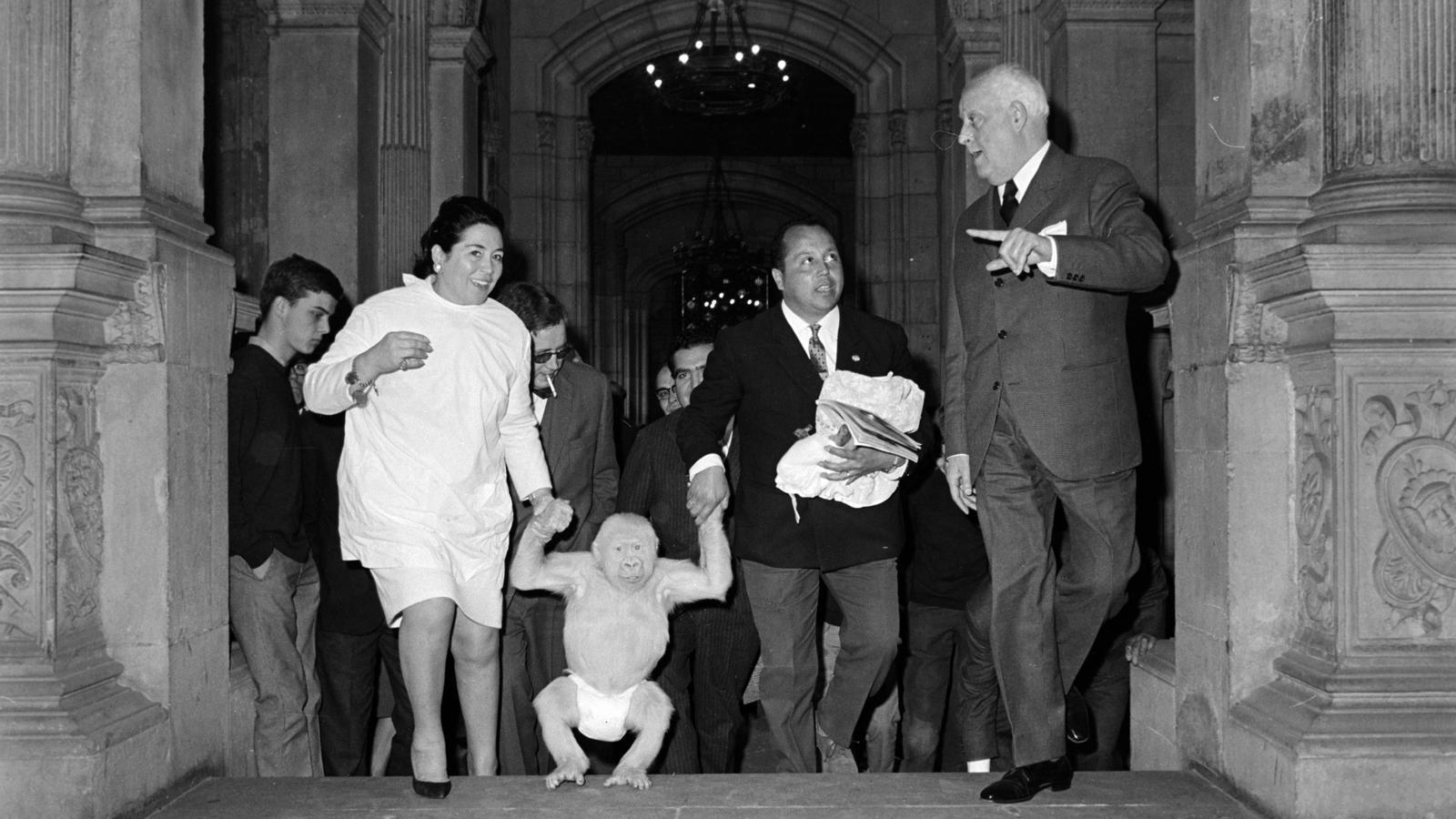
Snowflake was the Zoo's icon for many years. Upon arriving in the city, he was not immediately installed at the Zoo. He was moved to an apartment on Urgell Street, where he was cared for by the family of the veterinarian Román Luera and his wife, Maria Gràcia, receiving attention as if he were a human baby. On December 1, 1966, the official presentation of Snowflake took place in the gardens of the Barcelona Zoo. Months later, in March 1967, the veterinarian's couple took him in their utility vehicle to the Plaça de Sant Jaume, to officially present him to the Francoist mayor, Josep Maria Porcioles. Holding his caregivers' hands, the camera captured Snowflake climbing the steps of the City Hall with great docility, as if he were a child, and they invited him into Porcioles' office and he even sat in his chair.
This staging took place during years of great political tension. On March 9, 10, and 11, 1966, students, intellectuals, artists, friars, and journalists resisted for three days at the Capuchin convent and defied Franco. It was the famous Caputxinada, and the Catalan university raised a whole series of demands. In the faculties, an audacious spirit of freedom was breathed, and in May of that same year, it was the priests who took to the streets to protest against the torture that the students had received.
"When Snowflake arrived in Barcelona, the Zoo was a municipal institution under Francoist directives and played a relevant role in the policy of Mayor Porcioles, who visited it often and maintained a close relationship with the director of the institution, Antoni Jonch. The Zoo served to project an image of modernity and normality abroad, very useful for a regime that needed international legitimacy," says González.
Local hunters originally named him Nfumu Ngui (white gorilla in the Fang language). The adoption of the name with which he became an icon occurred when National Geographic sent a team to make a report and christened him Snowflake. Covers of magazines from all over the world, such as Paris Match, turned him into a global tourist attraction. After the Transition, the new democratic city councils did not break with this iconography. Snowflake continued to be one of the great symbols of Barcelona.

