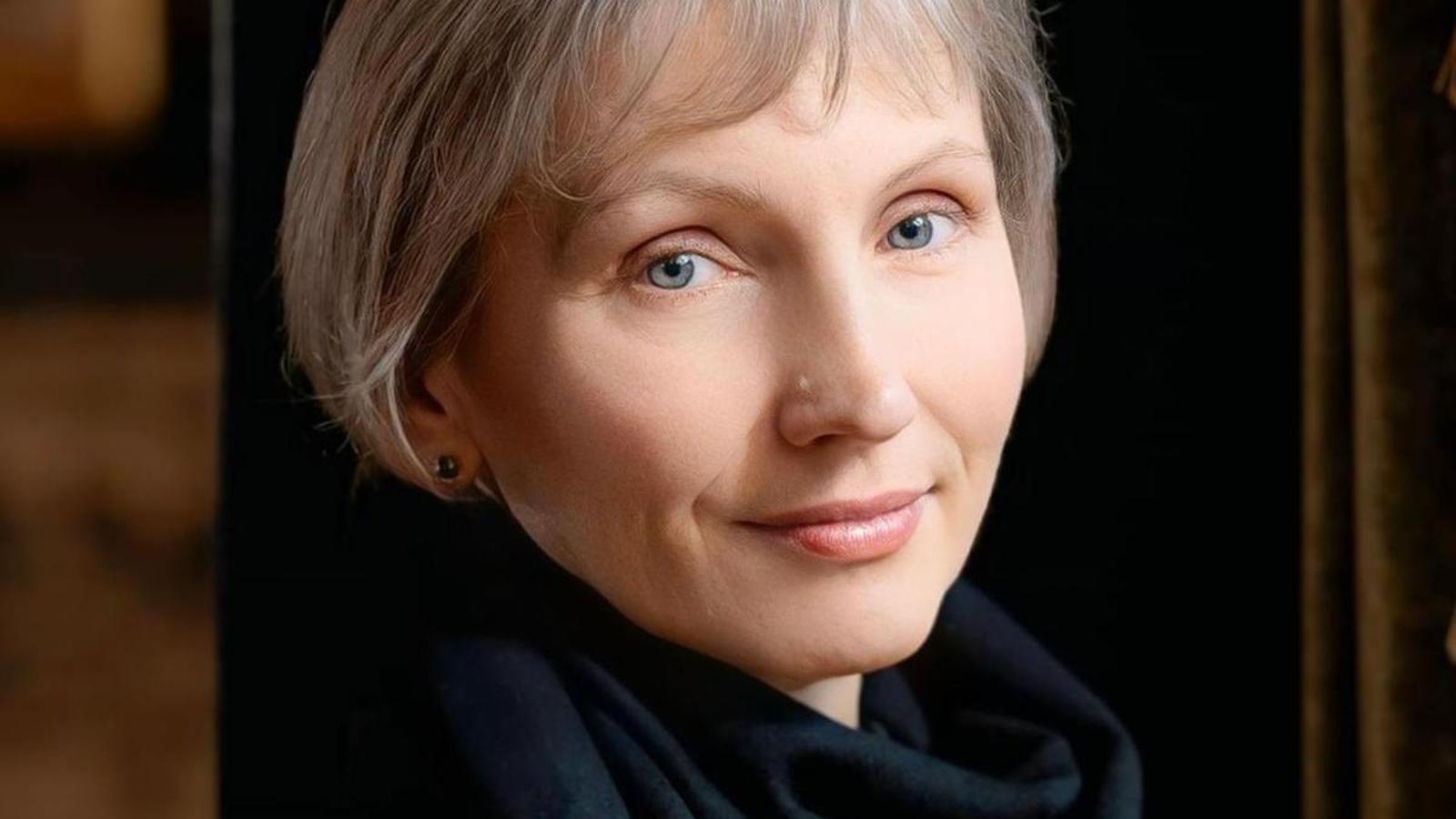
Marina Litvinenko: ‘1984’ is a work of fiction, but in Russia it has become reality
Activist and widow of Aleksandr Litvinenko

-
CAT -
CAST
MoscowThe radioactive trail left by Aleksandr Litvinenko’s assassins on the streets of London allowed the British justice system to implicate Russia in his poisoning with polonium. This former KGB agent had to go into exile in the United Kingdom after denouncing the corrupt and criminal drift of the Russian secret services, with the acquiescence of their brand-new director, Vladimir Putin.
His death, on November 23, 2006, became the vital driving force for his widow, Marina Litvinenko (Moscow, 1962), who has spent the last twenty years clamoring for justice. Now, with the publication of the book A life in fragments, she vindicates his struggle and her husband's prophetic view on the nature of the regime that the Russian president has ended up building.
Do you feel that justice has been served for your husband’s murder?
— I already knew that there would be no justice in the usual sense of the word, that it would not be possible to bring before the courts the people who had committed the crime. That is why we tried to give the maximum possible publicity to the case, because the more people who understood what had really happened, the better. Concluding that the Russian state sponsored this act of terrorism and that there is a very high probability that Vladimir Putin, as president, and the former director of the FSB, Nikolai Patrushev, planned this attack, is not full justice, but we have a case. The European Court of Human Rights confirmed all these facts beyond any doubt and now we can only hope that my husband's case becomes part of a macro-case against this brutal regime. That will be, in the end, justice.
What do you think when you see that one of his assassins, Andrei Lugovoi, is a deputy in the Russian Parliament?
— It is the face of the new Russia. Now we can say that Russia is a murderous state because what it is doing in Ukraine is, quite simply, killing people. This is what makes me think of Lugovoi. And I do not even feel offended, because there are even people who can cynically defend him: “Oh, he is an active member of Parliament!” But no, everyone knows what he did.
From his deathbed, her husband was clear that Putin was behind it.
— Aleksandr, Sasha, was very lucid during his final days: he collaborated intensely with the police and provided all the evidence he could. He also asked to have a photograph taken, which today everyone considers an iconic image. For me it was difficult, of course, but for him it was absolutely correct to leave that proof behind. That was his message: this is what can happen to anyone who starts to fight against this regime.
You say that he did not trust Putin from the very first handshake. It was in 1998, when he met with him after having denounced that they had ordered him to assassinate the oligarch Boris Berezovsky.
— He left that meeting very disappointed. He understood that it would be of no use and would not change absolutely anything. I believe he already began to realize that Putin could be involved in any criminal activity against which Sasha had tried to fight. Afterwards, it left me totally shocked to see how the director of the FSB was trying to destroy his reputation and that of his colleagues on television. He spoke about it in a very derogatory way, as if they were not heroes, but small-time criminals who were simply trying to protect themselves. For me, that immediately demonstrated the low status he had: he was not a real man, but someone very small. And, in fact, that way of acting became one of Putin's main weapons against the enemies of the security services. In Russia, no one fights against the mafia; it is the mafia that fights against everything that might threaten it.
Shortly before dying, Litvinenko wrote: “If you do not stop this monster, a war will begin and millions of people will die”. They did not listen to him.
— Sasha was a professional, but not a politician. He had never played these types of games. I remember a conversation I had with Boris Berezovsky after his death. He told me: “Marina, we never managed to understand what Sasha was telling us. Only now do we see that he was right”.
Did the West not take his poisoning seriously enough?
— Back then there was still a certain idealized vision of Russia as a developing democracy. What really mattered was business, but what was at stake were principles. It was clear that it had been an attack with a radioactive substance, but perhaps that person was a defector or had a personal conflict with Putin. It seemed that could not happen to anyone else, that it did not affect the civilian population. They wanted to turn the page when Putin stopped being president, but when he returned to power it became clear that he did not intend to leave, that we would have him forever. But why were we trying to appease him? Why did the annexation of Crimea not make us react? Why was there no forceful response?
How do you see Russia today, more than 25 years after leaving it?
— 1984, by George Orwell, is a work of fiction, but in Russia it has become reality. Propaganda works very well. It all began in the year 2000, when the figure of Putin was built. Little by little, they managed to make the population believe what was being told to them through the screens. Even brilliant Russian intellectuals have not realized at what moment all this has happened. I think it is a kind of Stockholm syndrome: when you have been a hostage of a system for so many years, you end up trying to adapt to its rules and you think that things could still get worse if you started to protest.
You have been a victim of this propaganda.
— A series was made in Russia in which our story was presented in a completely different way: Sasha was a double agent, an alcoholic, who had been poisoned by Berezovsky. Lugovoi served as a consultant for the production and, cynically, my character was played by his wife. My mother did not see it, but one day she asked me: “Marina, are you sure you know exactly how everything happened?” I replied: “Mother, how can you ask me that? When you have known everything from the beginning!” Even her perception had begun to waver.
Do you ever hope to be able to return to Russia?
— When we fled and finally arrived in the United Kingdom, I wondered why I did not feel any nostalgia. I had never planned to leave Russia permanently and, therefore, I always kept in mind the possibility of returning there one day. And that day has not yet arrived, for many reasons, one of which is that, if I go, they might force me to change the version of what happened. But perhaps yes. Who knows?

