Sánchez discovers a great miscalculation by the European Union
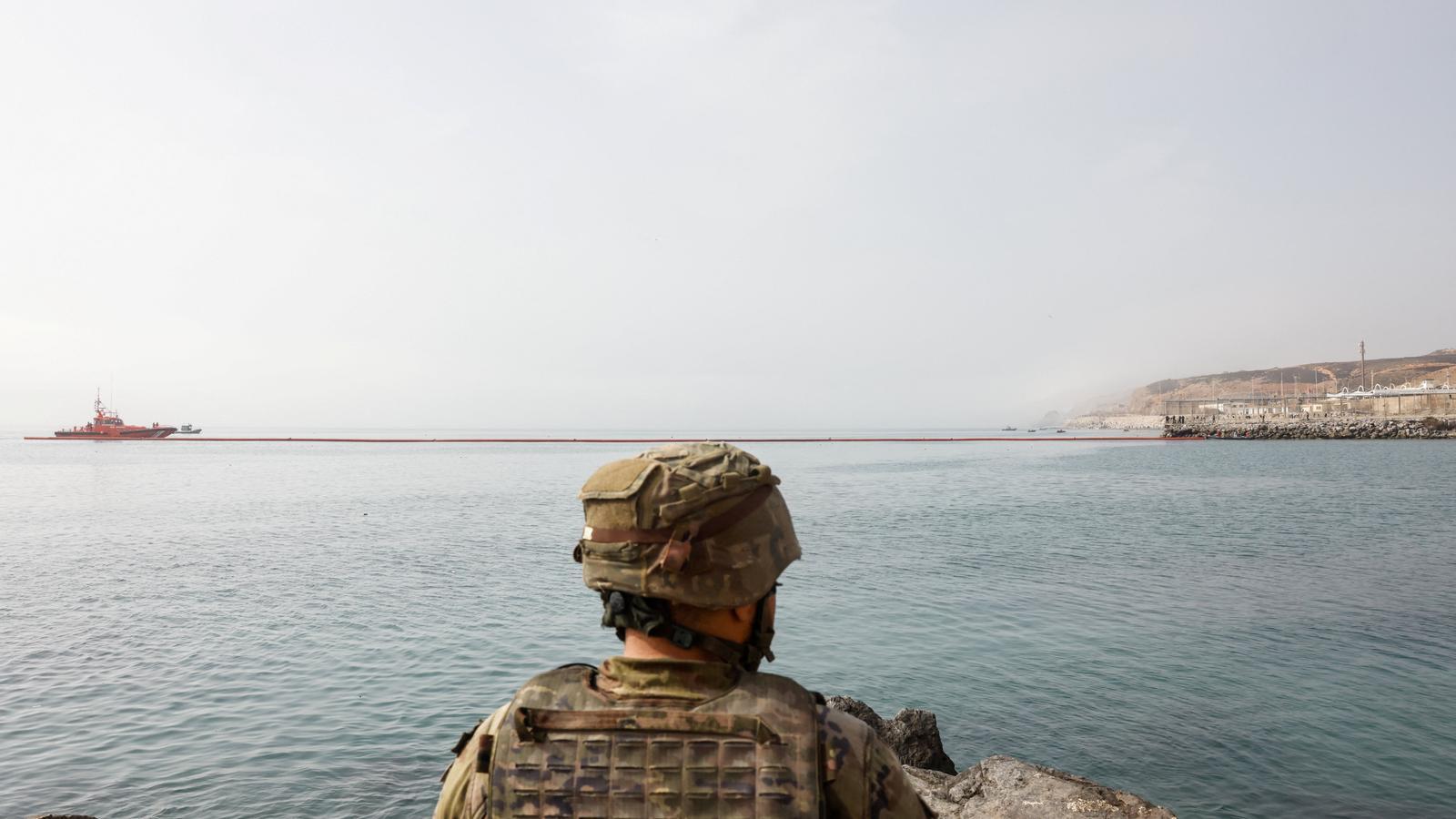

The first response —and therefore the most sincere— from the European Union to the crisis in Ceuta orchestrated by Morocco has been what community policy can least afford: once again, division, a lack of unity. Pedro Sánchez, who from the outset has asked European partners for "solidarity and empathy", has found himself practically alone, singled out, questioned, threatened in the face of an external destabilization attempt. It took Ursula von der Leyen five days to publicly support Madrid. It is the minimum required by her office. Tuesday's emergency meeting in Brussels could serve to minimize the damage or make it deeper.
So far, the worrying silence in many capitals has been the best news Madrid has received. From others, led by Giorgia Meloni's Italy, voices have been raised directly to blame the socialist government for the assault on Ceuta and have warned it with absurd—because impossible—punishments such as Spain's expulsion from the Schengen area. Paris was one of the European chancellories that preferred silence, but it did not take long to reinforce its borders hours after tens of thousands of young Moroccans managed to enter Spanish territory. These are images that are completely contradictory with the discourse of unity and strength that, from Brussels, is being attempted to be projected towards external dangers.The calculation error of European partners is important and, above all, recurrent. The one in Ceuta is a very, very European crisis, and a warning for the future for Brussels, which faces the most decisive years since its founding.
I don't mean that Rabat's political objective was to point out the division of the community partners — it has become quite clear, as on other occasions, that Morocco's main purpose is to influence Spain's foreign agenda—, but it is framed within a growing context of hybrid warfare that will become increasingly common in the EU's political landscape. Migratory pressure used as a weapon has also been a reality on other community borders for a long time: Finland, Poland, Greece, Croatia and Italy itself, which is now shouting so much.Vladimir Putin has taught us Europeans that the forms of foreign interference can be very diverse: from flying drones over airports to stop air traffic to launching massive disinformation campaigns to condition elections of great strategic value for the community's future.
The lack of European unity in the face of these interferences is, directly, a shot in the foot. Division only deepens the many geopolitical vulnerabilities that Europe already presents in an increasingly virulent and unpredictable world. Faced with all the strategic emergencies that the EU has, like a great war on the continent with an unpredictable outcome or a covert divorce with Washington, unity and solidarity should be non-negotiable.
But unfortunately for the bloc's interests, Sánchez's solitude was to be expected. Immigration continues to be a huge taboo, a deep wound to pick at, in almost all the community capitals: probably, nothing scares European governments more than a migratory crisis, because immigration, as all surveys show, continues to be one of the great concerns of European societies.
This would not be the case, obviously, without the role of the far-right, which has instrumentalized and criminalized migrant people as it gained spaces in the political spectrum. Or, in fact, the reverse: it has gained political weight by launching hate speeches against immigration. Precisely Meloni, that has conditioned the great migratory reform of the entire EU to its liking, is its great exponent. Also one of the great responsible parties —with the approval and patronage of Von der Leyen— for the anti-immigration tone that strongly permeates the political debate in Europe. To be the with migrants —soft, in many cases, meaning respecting human rights— takes its toll.
The result is difficult to digest: significantly, not even the EU's two great engines, Berlin and Paris, have chosen to raise their voices forcefully to defend Madrid from foreign interference. Germany and France are holding important elections soon. In both cases, the far-right is heading into the different elections with real and historic chances of victory.
