Zelensky seeks in London and Brussels the support that Trump denies him again
At least eight dead and 22 injured in a new wave of bombings against energy infrastructure that shows that Putin rejects the truce announced by Washington
-
CAT -
CAST
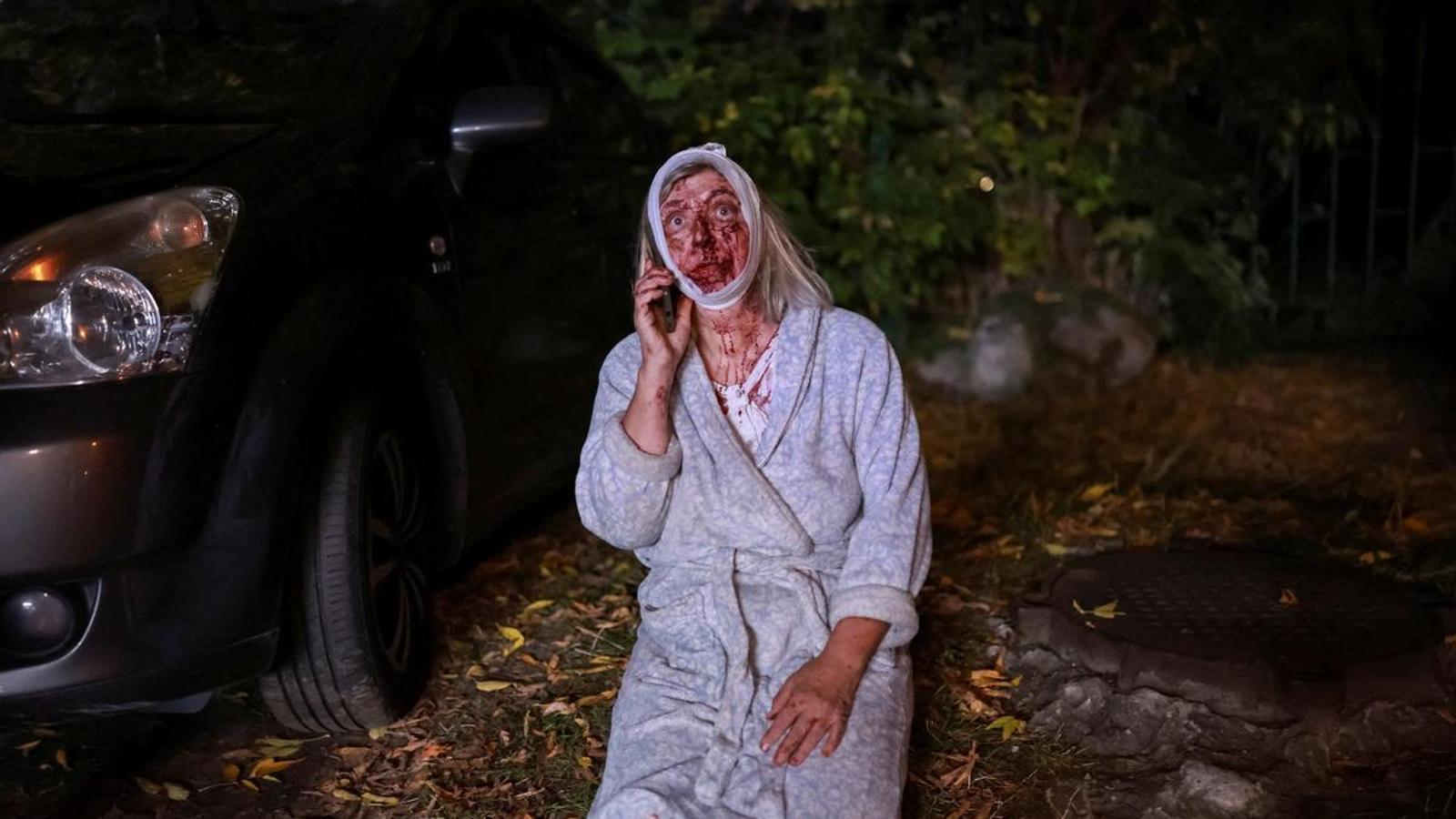
Barcelona / LondonThe announcement that Donald Trump made on Sunday regarding an energy truce between Russia and Ukraine has no value on the ground. This was confirmed this Wednesday afternoon by the Ukrainian president, Volodymyr Zelensky, from Downing Street, after Russia once again punished Kyiv with a large-scale attack of ballistic missiles and drones during the early hours. The impacts in residential areas have caused at least eight deaths and around twenty injuries, and the projectiles have damaged several energy facilities, which has once again left parts of the capital in the dark and aggravated supply difficulties.
Alongside the premier British, Andy Burnham, Zelensky was categorical: "There is no energy truce. We have again suffered attacks with ballistic missiles and hundreds of Iranian drones, which have again caused deaths and numerous injuries. This is, evidently, not a ceasefire. Everything indicates that Russia continues to intensify the escalation". The Kremlin justified itself by saying that the pact announced by Trump "was not finalized, which means it cannot be said that Russia is not complying with it".
The visit to London has opened a new tour for the Ukrainian president, who will travel to Brussels this Thursday to try to strengthen the support of European allies at a time when Washington's commitment is increasingly uncertain. Faced with Trump's rapprochement with Vladimir Putin, following the lifting of sanctions on the diesel that reaches markets from Moscow, and the lack of guarantees regarding American aid, Zelensky is seeking the political and military support he needs in Europe to resist the Russian offensive.

Due to the withdrawal of logistical support from the United States, the situation in Kyiv has worsened significantly in the last few hours. "It has been a very difficult night: the attack began around four in the morning and did not stop for three hours," explained Oxana Klimuk, a professor at the Taras Shevchenko University, to ARA from the Ukrainian capital. "At home we have intermittent power cuts, and there are many neighborhoods without electricity and problems with public transport." According to the energy operator's restriction schedule, her home will be without supply between two and four-thirty in the afternoon, and again from eleven at night, to distribute the available electricity. As long as she has power, she will continue to teach Hispanic philology classes online, as she has been doing for a month.
It is in this dramatic context, after consecutive nights of large-scale Russian attacks, that Volodymyr Zelensky was received in London with great applause. From the central courtyard of the Foreign Office, numerous people cheered him as he embraced the British Prime Minister and both shook hands. Previously, the Ukrainian president had received a new show of British support in a half-hour audience with King Charles III.
Zelensky feels "betrayed" by Trump
But neither the solemn reception nor the careful diplomatic choreography in London has managed to hide the grave and worried face of a Zelensky who feels "betrayed" by Washington, and who has expressed deep frustration at the decision of the American allies not to share intelligence information on Russian attacks. The blackout of the Starlink satellite network, owned by tycoon Elon Musk, leaves Ukraine even more exposed at a critical moment in the war.
"What I want to talk to Andy [Burnham] about is Starlink and intelligence services. I am referring to all these surprises that you cannot count on when you have a real strategic partnership. We count on this partnership with the United States. We just want to be very honest and clear with each other," said the Ukrainian president. Trump, however, does not seem to be playing in his favor, much less being honest. Especially after having lifted sanctions on Russian diesel, which Zelensky has described as an economic "gift" to the Kremlin's war machine.
Without criticizing the White House, Prime Minister Burnham assured Zelensky that "the world is once again clear about who the aggressor is in this conflict." For this reason, he pledged to "accelerate the delivery of British-made air defense systems" that are currently in the manufacturing process. The premier also said: "We will ensure they reach their destination as soon as possible." But some sources speak of many months, if not years. A time that Zelensky perhaps does not have, as of now, and even less so at the gates of winter.
Hours before Zelensky's arrival in London, Burnham gave another clue about the role he wants to play in bringing Kyiv and Washington closer together. In response to a question during the parliamentary control session, the premier explained that he is "trying to change the United States' mind" and expressed his understanding of Zelensky's "difficult situation." Right now, he said, "he carries the heaviest burden of all." "What I have to do in my role is try to rebuild bridges so that support is recovered," he said. For this reason, he added, he wants to act "with caution and prepare the ground to bring the parties back together." A task that seems increasingly difficult.
The visit of the Ukrainian president this Wednesday to London is very reminiscent of the one he made after he was humiliated at the White House by Trump and Vice President J.D. Vance, in February of last year. The next day, European allies offered him all their support at a summit in London. The problem is that it is limited aid and that European chancelleries do not dare to directly confront Trump's United States, as shown by Burnham's words.
Effects of the bombing
The early morning attacks have targeted several power plants in the capital, according to an official in the energy sector who spoke to the portal The Kyiv Independent. Russia continues to intensify attacks against energy infrastructure ahead of the winter months. The first explosions were heard in the capital late Tuesday evening, when a Russian missile, with practically no prior warning, struck a nine-story residential building in the Desnianskyi district and caused a large-scale fire.
Oksana's fourteen-year-old son also studies online at a school in Kherson, where they are originally from. Kherson is very close to the front line, and schooling there has been entirely online for a long time. They prefer this option over sending him to his school: in Kyiv, classes continue to be in-person, but every time the sirens sound, they must be interrupted to go down to the shelters. The teacher is resigned and still has the strength to endure what will be the fifth winter of the war: "And what can we do? We must defend the city and continue with our jobs and our lives." She admits that if things get too complicated, they will leave the capital to settle at her husband's parents' house in the city of Lutsk, in the west of the country, where the attacks are not as intense.

