Netanyahu resists, but Israel remains in the hands of an uncertain and difficult negotiation
The elections do not give any clear majority to either the Netanyahu bloc or the opposition, while the Arab parties gain weight and hold the key to the next government

-
CAT -
CAST
JerusalemIn 1996, the Israelis went to sleep convinced that Shimon Peres would continue to be prime minister and woke up with Benjamin Netanyahu in power. Thirty years later, history seems to be repeating itself. Last night, the initial exit polls had fueled the hopes of the opposition, but as the count progressed, Netanyahu returned to the center of the stage.
In Jerusalem, the day after the elections has a very different soundtrack from that of the night before. The campaign begins to fade from the streets: posters and flags lose prominence, while conversations revolve around the results and a key question: who will be able to gather the 61 deputies necessary to govern?
With 85.6% of the votes counted at three in the afternoon, the bloc led by the prime minister totals 53 seats, compared to 48 for the opposition, led by Gadi Eisenkot, leader of Yashar. Likud would obtain 26 deputies and Yashar, 21. Neither of the two blocs has a guaranteed parliamentary majority, while the Arab parties emerge as one of the great surprises of the day with 19 seats. Result: the elections do not give a clear majority to either Netanyahu's bloc or the opposition and Israel remains in the hands of an uncertain and difficult negotiation where the Arabs will play a decisive role. According to the latest vote count, with 19 seats they would exceed their historical maximum of 15, reached in 2020. Both one bloc and the other would need their support, or their abstention, to tip the balance.
Several voices from Arab groups have shown themselves willing to be part of a coalition led by the “change bloc”, while the Joint List is more reluctant to enter directly into an alternative government. The main obstacle, however, is that several opposition leaders ruled out governing with Arab parties during the campaign. Naftali Bennett, head of B’Yachad, and Yair Lapid, who already shared a government with Ra’am between 2021 and 2022, have placed limits on this possibility, as has Eisenkot. Yair Golan, leader of The Democrats with 8 seats, has been the only one to defend the possibility of collaborating with Ra’am if it means removing Benjamin Netanyahu from government.
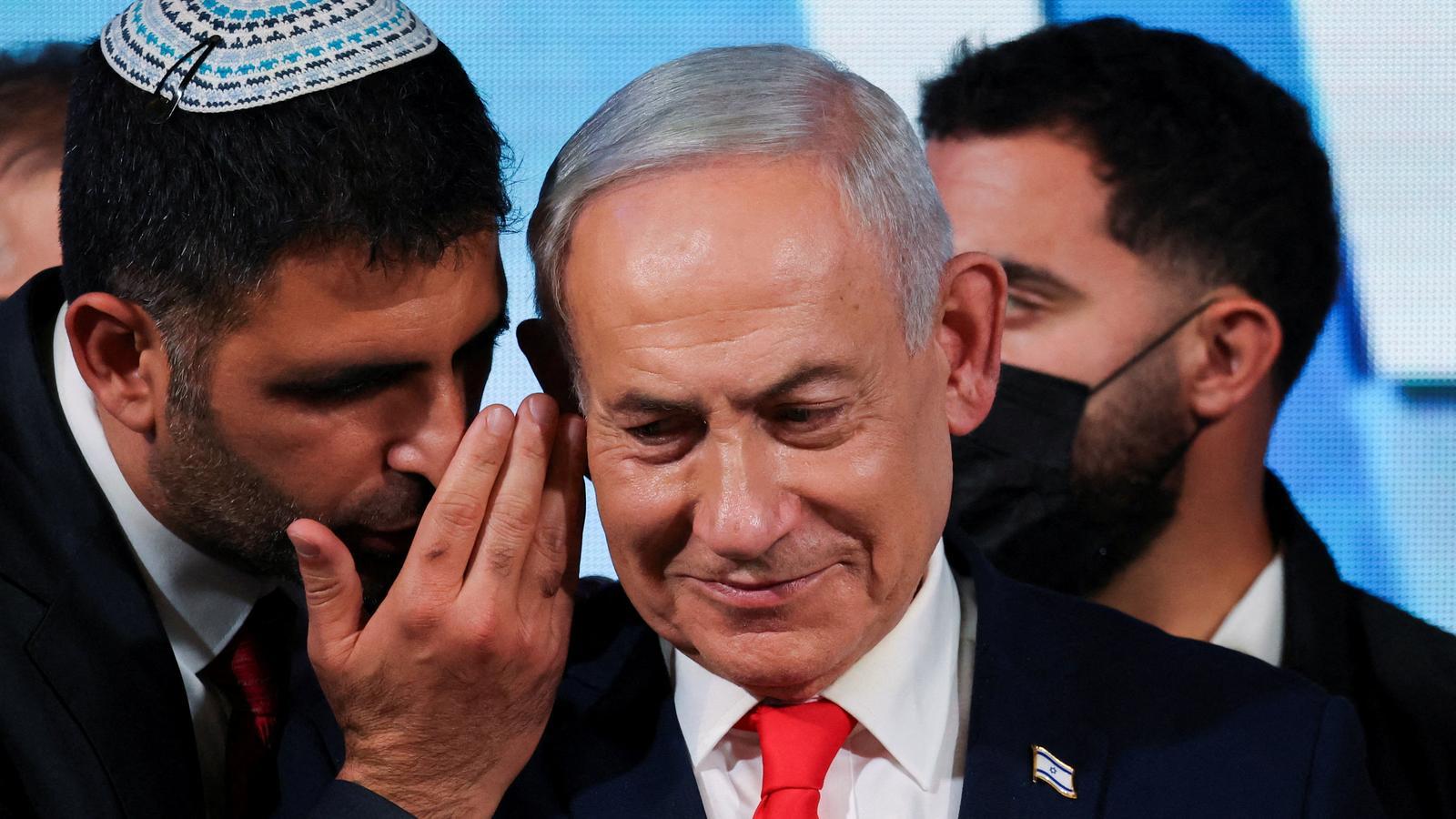
The other reading that was taking hold this Wednesday was that the election night that many expected would confirm the erosion of Netanyahu ended up becoming a new demonstration of his ability to resist at the helm of Israeli politics. At 3:14 a.m., the leader took the stage in front of his supporters in Jerusalem with an image that had all the ingredients of his campaign: caps with the slogan Make Israel Great Again, posters with his face next to Donald Trump's, and videos generated with artificial intelligence against his opponents. Before a rather sparse audience, he claimed the strength of his party and demanded a "strong national right-wing government." He also emphasized Israel's military successes and insisted on the need to continue confronting Iran. With Donald Trump in the White House, he said, Israel has a historic opportunity to end the Iranian threat.
In Tel Aviv, however, Eisenkot argued that the results point to a desire for change and are a punishment vote against Netanyahu. “The public has voted for change,” he proclaimed, and urged the prime minister to accept the loss of confidence and abandon political life. Naftali Bennett, leading B’Yachad which would obtain 12 seats, also considered the prime minister defeated and assured that the opposition leaders were already working to try to form a government.
In Nazareth, the leader of the Joint List, Yousef Jabareen, claimed that the results confirm that Arab citizens are a “political force that cannot be ignored” and that the party is willing to contribute to the exit of the Netanyahu government. Mansour Abbas, leader of Ra’am, also celebrated the results and promised to transform the votes into political influence. “We are here, not on the sidelines,” he told his followers.
Complicated negotiations
Israel is, therefore, facing complicated negotiations. Eisenkot could attempt to form an alternative government with the external support of Arab parties, but the differences between the factions make this path difficult. Netanyahu, for his part, seems to have opened the door to a unity government with a call to unite the Zionist majority, interpreted by many as an invitation to expand support beyond his far-right and ultra-Orthodox partners. If neither option prospers, the country could see itself pushed towards new elections.
Before that, however, the double-envelope ballots still need to be counted: the votes of people who have voted outside their usual polling station, such as soldiers at military bases or diplomats. The Central Electoral Committee estimates there are between 430,000 and 480,000. The full count is expected by tomorrow afternoon, while the final official results will be published on November 4th.
Afterwards, the country's president, Isaac Herzog, will have to entrust a deputy he considers capable of gathering enough support with the attempt to form a government. The candidate will initially have 28 days, with a possible extension of 14. If he fails to secure a majority, the country could end up calling for new elections. Today, Herzog has already asked the parties to do everything possible to avoid a new electoral call. “I hope that everyone who comes here does so with an open mind,” he said.
Across Israel, the campaign is fading from public spaces, but the negotiation is just beginning. Netanyahu has options to remain in power; Eisenkot, to open a new chapter. Neither of them, however, yet has the necessary support to form a government.

