The five men who challenge Netanyahu (and who think the same as him about the Palestinians)
The entire Israeli Jewish political spectrum supports the genocide in Gaza and does not consider the two-state solution

-
CAT -
CAST
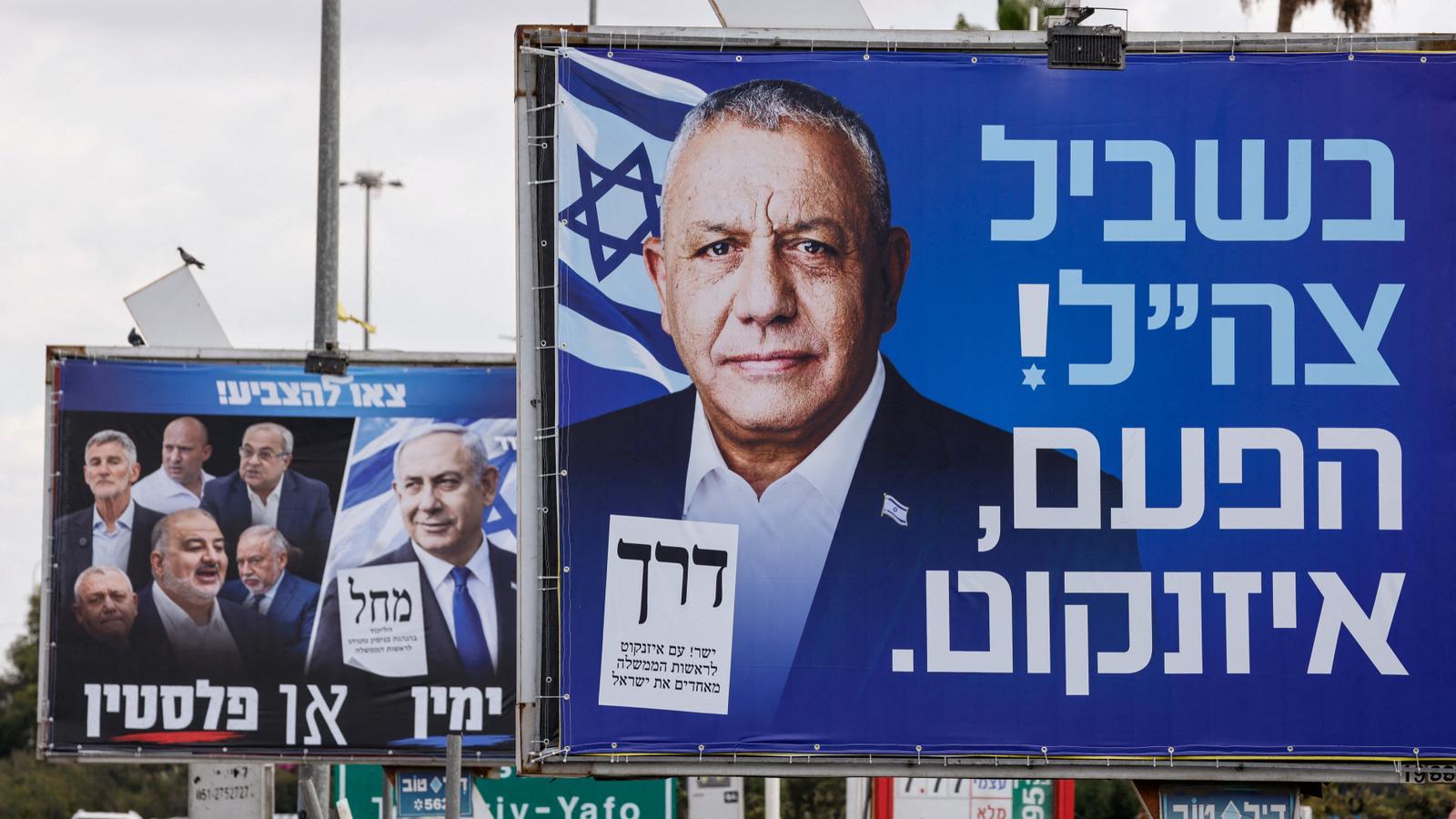
BarcelonaThe musicians change, but the score remains the same. It is a quite graphic image of Israel's political map in relation to what must be done with the Palestinians. The five men who will challenge Benjamin Netanyahu, who has dominated political life in Israel for the last 25 years, in this Tuesday's elections disagree with the prime minister on many things, but on this there are no fissures. Government and opposition share the same plan to sweep the Palestinians from their land. All five candidates signed a non-aggression pact at the end of September with the aim of unseating Netanyahu, who faces his first test after the greatest security failure in Israel's history with the Palestinian attacks of October 7, 2023. In the text of the agreement they proclaim: “Despite the ideological differences we have among us, the formation of a Zionist government, with a sense of state, dedicated to repair and reconstruction, is our great shared objective”.
It is not clear how long this pact might last or who could lead a possible coalition, but it is clear that all its signatories agree with the government regarding the war in Gaza and none of them contemplates, right now, building a Palestinian state alongside Israel. Nor does any of the opposition leaders refer to the Israeli military operation against Gaza as a genocide, even though an international arrest warrant hangs over Netanyahu for this crime against humanity, and that Israel is being tried for this crime at the UN International Court of Justice at the behest of South Africa.
Ahron Bregman, an Israeli analyst at King's College London, points out in statements to Al-Jazeera that the leaders of the Israeli opposition "are not willing to address the fundamental issue: the Palestinian question and the aspirations of the Palestinians for independence". Bregman compares them to Netanyahu, but without the corruption accusations or the support of far-right figures like the Minister of National Security, Itamar Ben-Gvir, and the Minister of Finance, Bezalel Smotrich. "Israel, as a whole, is a right-wing country," he adds. Polls show a neck-and-neck race between the government bloc and the amorphous anti-Netanyahu bloc, and the refusal of all of them to make pacts with the parties that represent the Palestinian minority with Israeli citizenship (20% of the electorate) means the balance does not tip in favor of those against the government. Let us review, then, who the main figures of the anti-Netanyahu opposition are, and what they stand for.
Gadi Eisenkot
Yashar (Honest)

He is the best-positioned candidate in the polls. Career soldier Gadi Eisenkot was the chief of staff of the Israeli army between 2015 and 2019 and is considered the author of the so-called Dahiya doctrine, which is named after a neighborhood in Beirut razed by the Israeli army in 2008: this doctrine provides for the use of “disproportionate force” and the large-scale destruction of civilian infrastructure to end the social support of groups like Hezbollah and Hamas. But his military credentials have not prevented him from being repeatedly called a “monkey” by Netanyahu's circle during the election campaign because of his Moroccan origins.
66 years old, he entered politics four years ago with the National Unity alliance of former Defense Minister Benny Gantz. After the Palestinian attacks of October 7, he joined the war cabinet established by Netanyahu, but left it in June 2024 after accusing the prime minister of not having a strategy to win the war. He is, therefore, directly responsible for the military operations that have led Israel and its leaders to be prosecuted for genocide in international courts. One of the factors that explain the support he has among the Israeli electorate is that his son Gal and two of his nephews died while they were stationed in Gaza in 2025.
Eisenkot has founded a new party called Yashar (which means honest in Hebrew), which advocates that ultra-Orthodox Jews must perform mandatory military service like the rest of Israeli citizens. He also calls for the creation of a state commission of inquiry into the failures in Israeli security on October 7. At the same time, he has criticized the government's dependence on the United States in the wars in Lebanon and Iran.
Naftali Bennett and Yair Lapid
Beyachad (Together)
Former prime ministers Naftali Bennett and Yair Lapid, who governed for a total of 18 months between 2021 and 2022, an interregnum between Netanyahu's governments, are running together in the elections. Lapid is a former television presenter of centrist orientation. For his part, Bennett defends the illegal settlements in the occupied West Bank, and had been trying for years to consolidate a conservative alternative to Netanyahu, with the aim of capturing disenchanted Likud supporters and voters from the religious Zionism sector, from which he himself comes. With the alliance with Lapid, he repositions himself towards the political center, while hoping to retain the maximum possible number of right-wing voters. Both presented their alliance, last April, as an act of national responsibility. The fact that Lapid – who is more moderate and had historically supported the two-state solution – has allied himself with Bennett, who has always advocated not yielding a single step to the Palestinians, indicates that there is no commitment in this field to seek a political solution.
Yair Golan
Democrats
Golan is the voice of the Zionist left. He heads The Democrats, a liberal party created in 2024 following the merger of the Labor Party and Meretz, a social-democratic and secular formation. He is also a former major general and former deputy chief of staff, and he played a prominent role in repelling the Palestinian attacks of October 7 in southern Gaza. He is the only one in the anti-Netanyahu bloc who has criticized the objectives of the operation in Gaza, arguing that military successes are being squandered due to the lack of a coherent diplomatic and political strategy.
Golan sparked controversy when he stated at a press conference in May 2025 that “a sensible country does not kill babies for pleasure,” and he accused government ministers of celebrating that Palestinian children were starving. Following these statements, he received countless criticisms and ended up retracting them. He has also said that the death of the supreme leader of Iran, assassinated by Israel on the first day of the joint attack with the United States on the Persian country, “was a mistake, not because he did not deserve to die, but simply because it does not serve Israel's interests”.
He is the only one who has left the door open to making deals with the Arab minority parties, but he supported the ban on Sami Abu Shehadeh, one of his candidates. According to polls, the only option for a coalition that can unseat Netanyahu involves incorporating Golan and Avigdor Lieberman, another of the candidates.
Avigdor Lieberman
Yisrael Beiteinu (Israel is Our Home)
A former ally of Netanyahu, for whom he served as Minister of Defense, Lieberman left the governing coalition with the current prime minister in 2018, because he considered him to be too soft on Hamas in Gaza. Since then, he has become one of his fiercest critics.
His party was founded in 1999 to represent conservative Russian-speaking immigrants, but it has expanded its support and has a loyal electoral base. He is an important player in Israeli politics. He argues that “in Gaza no one is innocent,” and accuses the government of “funding Hamas” for allowing the entry of humanitarian aid into the Strip, even though it is a very small amount. He has always supported Israeli military operations against Gaza, and also advocates for the invasion of Lebanon. Lieberman is in favor of secularization, and rejects military service exemptions for the ultra-Orthodox.
