Netanyahu gambles his power pressured by the security failures of 7-O and the management of the wars
Polls draw a fragmented Israeli Parliament and predict difficult negotiations to form a government

-
CAT -
CAST
JerusalemIsrael is holding parliamentary elections this Tuesday that could mark a turning point after the Hamas attacks of October 7, 2023, and three years of war and political crisis. Benjamin Netanyahu aspires to remain in power, while the opposition attempts to turn his attrition into a viable alternative. Turnout by midday was 16.68%, according to the electoral board, one of the highest in the last decade.
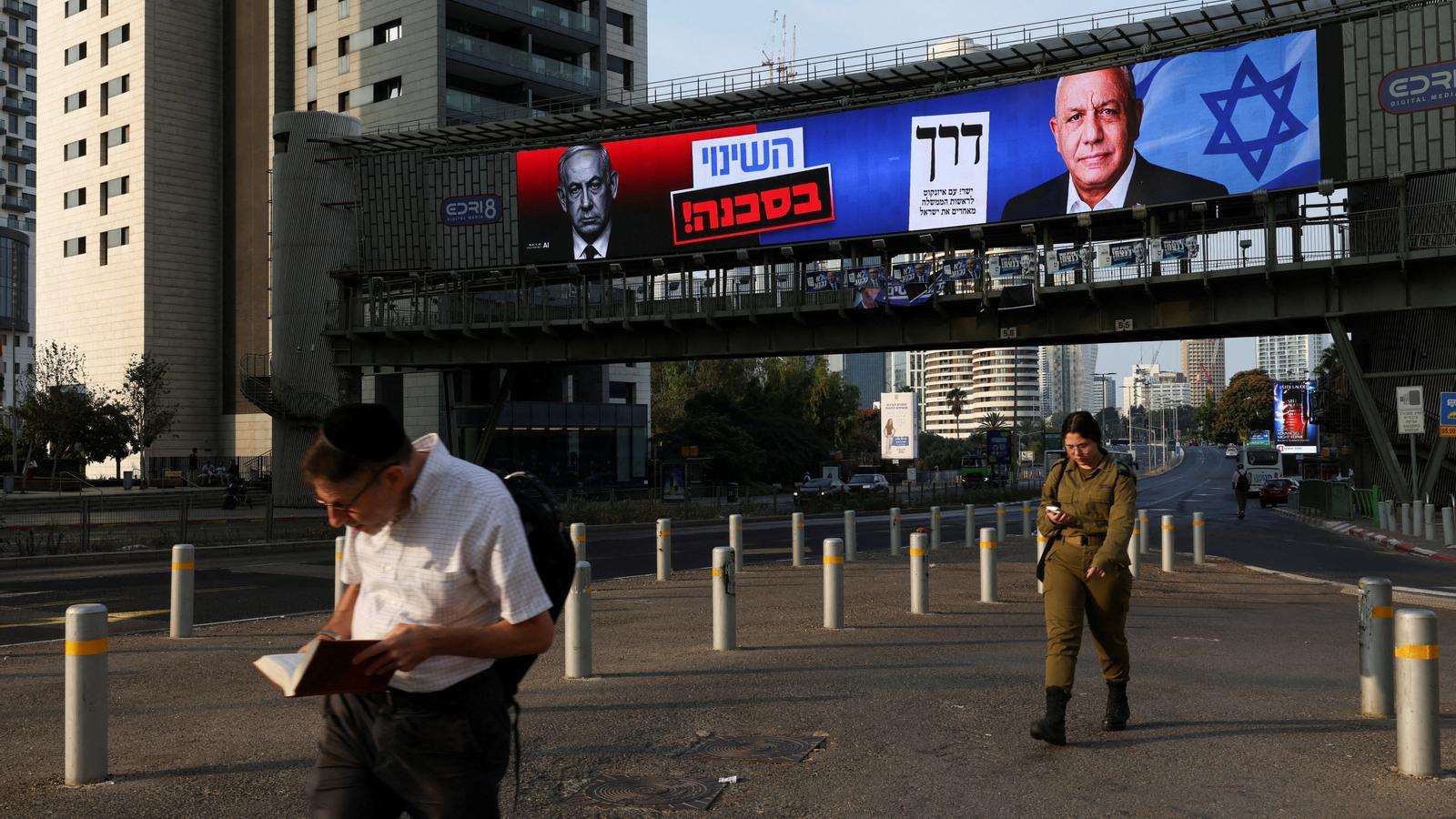
The intensity of the campaign is evident in the streets, where giant banners of the candidates follow one another along the roads and cars display support stickers. On phones, electoral messages and calls have also given no respite until a few hours before the vote. The feeling is that the country is experiencing decisive elections for its political future.
Despite this mobilization, the final polls, published on October 23rd, do not draw a clear winner. Gadi Eisenkot, former Chief of Staff of the army and leader of Yashar, would be slightly ahead of Netanyahu's Likud, with 22 seats compared to the 20 of the Prime Minister's party. Neither bloc would have a guaranteed majority: the government side would obtain 50 seats and the main opposition formations would total about 54, both below the 61 needed to reach a majority in the Israeli Parliament.
Netanyahu, the prime minister who has held office the longest in Israel, with more than 18 years accumulated in three stages, faces the elections pressured by the security failures prior to October 7th, the management of the wars in Gaza and Iran, and the corruption trial, opened in 2020. Also weighing in are the refusal to promote an independent investigation into the Hamas attacks, the military exemptions for the ultra-Orthodox, and the rising cost of living.
In this context, his continuity depends, in part, on maintaining the alliance with the ultra-Orthodox parties Shas and United Torah Judaism, which would obtain about seven seats each, and with the ultra-nationalist factions of Itamar Ben-Gvir and Bezalel Smotrich. Ben-Gvir, leader of Otzma Yehudit, promotes repressive policies against the Palestinians and would stand at around eight seats. Smotrich, of Religious Zionism, defends the expansion of settlements and Israeli control over the West Bank and would obtain about seven seats. This alliance allowed Netanyahu to return to power in 2022 and has driven the most radical, nationalist, and religious government agenda in recent years.
At the head of the alternative is Gadi Eisenkot, leader of the centrist party Yashar with a profile focused on security and military experience, who is trying to attract voters dissatisfied with the prime minister, especially those demanding an independent investigation into October 7th. The candidacy promises more accountability, but does not represent a break with the Israeli security doctrine. Eisenkot formulated the Dahiya doctrine, linked to the use of disproportionate force and the destruction of civilian infrastructure in conflicts with groups like Hezbollah and Hamas.
The opposition includes Naftali Bennett and Yair Lapid, grouped in B’Yachad, a moderate center and right-wing alternative; the Democrats of Yair Golan, who defends a more progressive agenda, and Avigdor Lieberman, leader of Yisrael Beiteinu, who represents a secular right that rejects the privileges of the ultra-Orthodox.
No major changes in sight
A change of prime minister would not necessarily imply a radical shift in Israeli policy. A good part of the opposition shares the rejection of the immediate creation of a Palestinian state and defends a hard line on security matters, both towards the Palestinians and before Iran and other regional adversaries. The discrepancies focus on more concrete issues such as the settlements and a possible annexation of the West Bank: Netanyahu's most radical allies are in favor of it, while B’Yachad and the Democrats oppose it. Yashar's position is less clear.
The differences between the parties are more evident in other areas, such as military service exemptions for the ultra-Orthodox. Both ultra-Orthodox factions want to maintain them; Likud has tried to limit measures against those who do not join the army, and the majority of the opposition demands that they fulfill mandatory service. The opposition also demands an independent commission to investigate the security failures of October 7, but Netanyahu and his partners have resisted promoting it.
Winning does not guarantee governing
Israel functions as a single national constituency: 7.3 million voters are called to vote for party lists and the 120 seats of the Parliament are distributed proportionally. This system, combined with an electoral threshold of 3.25%, facilitates the representation of small parties and has meant that no formation has ever achieved an absolute majority on its own. For this reason, small parties can be decisive, including Arab formations: the Joint List and Ra'am would obtain about nine and six seats. Ra'am, led by Mansour Abbas, was part of the Bennett and Lapid coalition in 2021, the first to incorporate an Arab party, but which only lasted 18 months.
In this electoral model, surplus vote sharing agreements can be decisive. These agreements allow votes that were not sufficient for a party to obtain an additional seat to contribute to favoring an allied formation, provided that both have exceeded the electoral threshold. Eisenkot has made an agreement with Golan; Bennett and Lapid, with Lieberman; and Netanyahu, with Smotrich.
The vote also presents territorial particularities regarding the right to vote. While the majority of Israelis residing abroad must return to the country to vote, in East Jerusalem, considered occupied Palestinian territory by the international community, the situation is different: some 350,000 Palestinians have permanent residency there, but not Israeli citizenship and, therefore, cannot participate in the elections. In contrast, Israelis living in the settlements of the West Bank do have the right to vote.
Polling stations will close at ten o'clock at night, local time, and the count will last throughout the night and the following day, partly due to the processing of votes from military personnel deployed at bases, prisoners, and hospitalized individuals, which are tallied using a double-envelope system to verify that they have not voted more than once. The official confirmation of the results is scheduled for November 4.
The elections put to the test the continuity of Netanyahu and the power of the religious and ultranationalist right. With no bloc close to a majority, pacts, including a possible alternative government where the support of Arab parties is vital, could decide who governs or once again plunge Israel into the political deadlock that between 2019 and 2022 led the country to the polls five times.

