Morocco and Israel tighten ties amid the crisis in Ceuta
The two countries agree in a meeting in New York to raise their diplomatic missions to the rank of embassies, appoint ambassadors and expand direct flights

-
CAT -
CAST
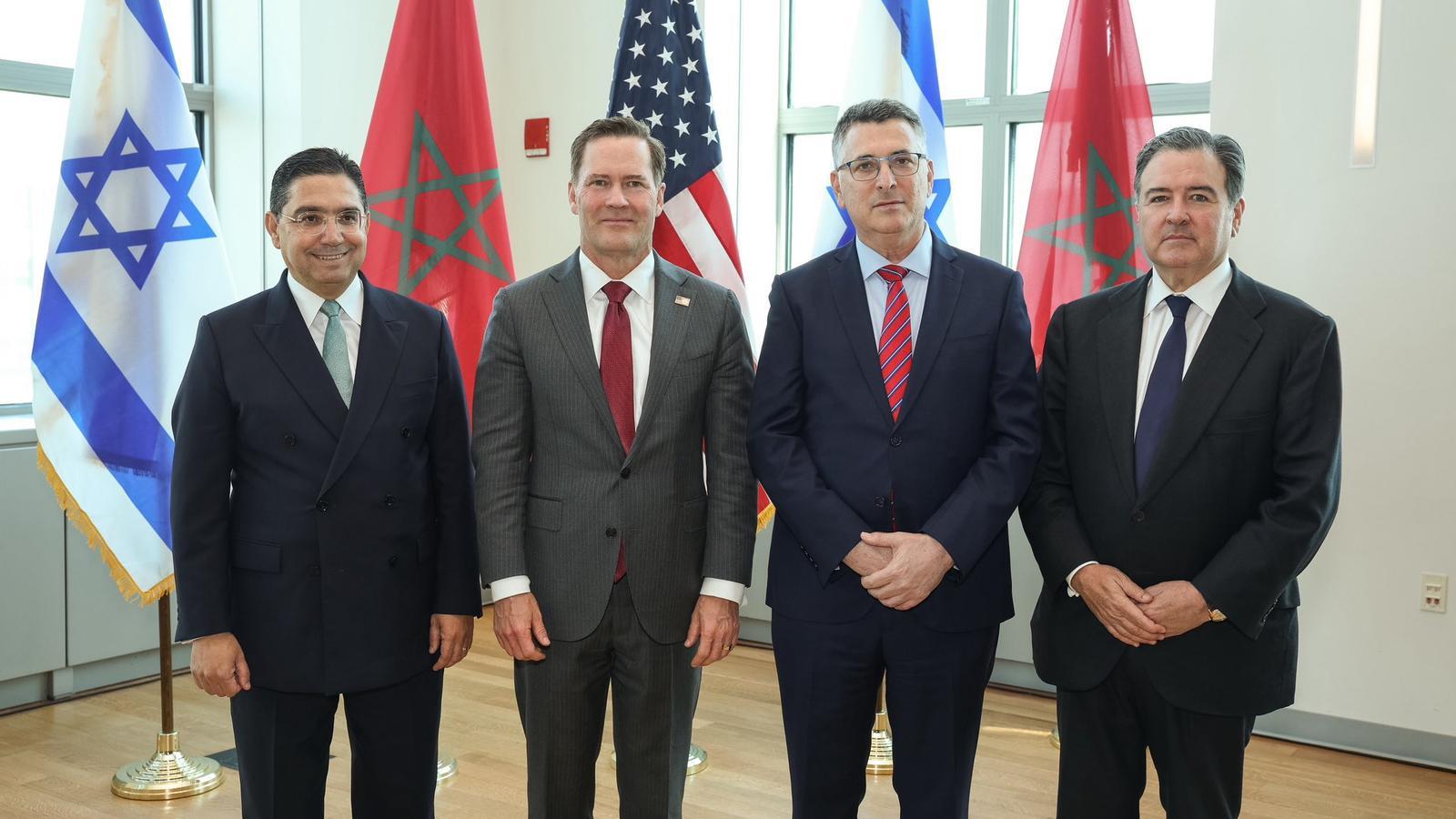
Israel and Morocco have agreed to take a new step in the diplomatic rapprochement initiated in 2020 and elevate their diplomatic missions to the rank of embassies, with the commitment to appoint ambassadors in both countries. The meeting in New York between the Israeli Foreign Minister, Gideon Sa’ar; his Moroccan counterpart, Nasser Bourita, and the United States Ambassador to the United Nations, Mike Waltz, took place one day after the sixth anniversary of the Abraham Accords, the framework promoted by the Donald Trump administration that allowed for the resumption of relations between Israel and several Arab countries.During the meeting, the three governments reaffirmed their commitment to these agreements and announced a series of measures to deepen the ties between Rabat and Tel Aviv that go beyond the opening of embassies. Among these measures are the expansion of direct flights between Israel and Morocco, operated by Israeli and Moroccan airlines, and the establishment of two agreements on investment protection and the avoidance of double taxation, with the aim of boosting commercial and business exchanges. Both measures are expected before the end of 2026.“The friendship between the Moroccan and Jewish peoples has deep roots and a rich history,” stated Israeli Minister Sa’ar after the meeting. “The declaration we signed today establishes practical paths to elevate relations between Israel and Morocco for the benefit of both peoples, and we will work to implement it,” he added. In a statement issued by the American mission to the UN, Washington, Rabat, and Tel Aviv have argued that deeper regional integration, built on this foundation, can contribute to “more peace, stability, and shared prosperity in the Middle East and beyond”.One more step towards the normalization of relations
The New York announcement formalizes a relationship that, in some areas, has already deepened considerably since 2020, when Morocco resumed relations with Israel within the framework of the Abraham Accords, promoted by the US administration. At that time, in exchange for the rapprochement between Rabat and Tel Aviv, the Donald Trump administration recognized Moroccan sovereignty over Western Sahara. Previously, Rabat had broken off relations with Israel in 2000 following the second Palestinian Intifada.Now, the United States and Israel have once again expressed their recognition of Morocco's sovereignty over this territory of the Sahara and their support for the Moroccan autonomy proposal as a basis for a solution to the conflict. For Morocco, Western Sahara remains one of the main axes of its foreign policy. Therefore, the maintenance of American support and the strengthening of relations with Israel have a strategic dimension that goes beyond diplomacy and commercial exchanges and which are developing as solid bilateral relations in various areas, such as military cooperation. “Defense collaboration is especially important in this context and has favored it,” explains Intissar Fakir to ARA, director of the Middle East Institute research center and specialist in Moroccan politics. “This cooperation has developed to include sophisticated exchanges, strategic arms acquisitions, and close bilateral cooperation that has reinforced Morocco’s capabilities and provided Israel with an important partner in North Africa,” adds Fakir. For the expert, although the United States has been vital for the establishment of this relationship, the bond between Morocco and Israel has developed its own solid foundation for the future.The New York announcement comes at a particularly delicate moment for relations between Morocco and Spain, following the Ceuta crisis and the accusations by the Spanish Prime Minister, Pedro Sánchez, against Israel for having contributed to spreading and amplifying disinformation regarding Spanish migration policy during the episode. Israel denies these accusations, while Rabat rejects that the Moroccan authorities planned the massive entry into Ceuta and accuses certain Spanish political sectors of using Morocco as an argument in internal politics.

