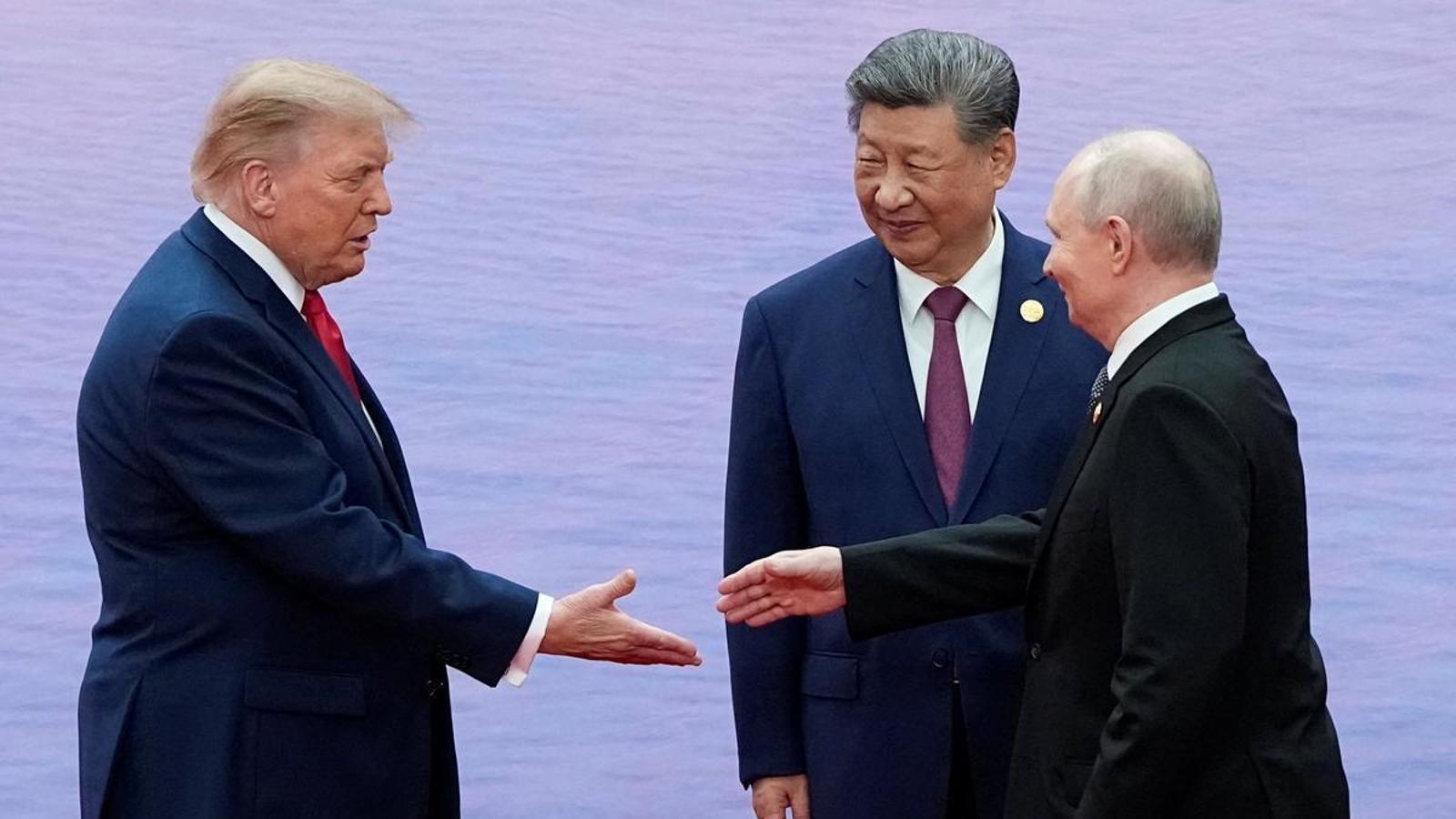
Xi and Putin exhibit good harmony before the trilateral meeting with Trump
The Chinese president shows total harmony with Putin and they defend a free trade that clashes with the protectionism that the American leader claims

-
CAT -
CAST
BeijingThe Chinese city of Shenzhen has become a scene of high-level diplomacy this Wednesday: the leaders of the three great world powers have met under the same roof in the framework of the Asia-Pacific Economic Cooperation (APEC) forum. The presence of Donald Trump, Vladimir Putin and Xi Jinping eclipses the regional summit and puts the focus on geopolitics. All three will hold an unprecedented meeting this Thursday, at the end of the summit, which has raised such expectations that it has already been dubbed "Yalta 2.0", in reference to the 1945 meeting between Roosevelt, Churchill and Stalin.
At the welcome banquet hosted by Xi Jinping for all participants, the three leaders appeared chatting and smiling. The Chinese president treated his guests to a menu of Cantonese specialties and Chinese wines.
Donald Trump was the last guest to join the APEC summit. He arrived from the Philippines, and Xi Jinping had the courtesy to receive him at the foot of the stairs of Air Force One, where he greeted him with full honors and where they embraced in a friendly manner. This is an unprecedented event for the Chinese president, who always holds meetings in official places. With this gesture, Xi highlights the importance he gives to relations with the United States and reciprocates the same courtesy that Trump showed him during his visit to Washington.

He did not show the same deference to Vladimir Putin when he arrived in Shenzhen. However, this Wednesday both leaders showed their good rapport in a bilateral meeting. The message was clear: their bond is stronger than ever. “Relations between China and Russia have remained firm as a rock in the face of all adversities and continue to be so today. They have broad prospects for the future and are not affected by short-term changes in the global situation,” said the Chinese president, according to the transcript released by the Russian agency TASS.
The Russian leader, for his part, pointed out that Moscow and Beijing are adopting a “constructive approach” to build a “fairer multipolar order,” in the midst of a “difficult geopolitical climate.” “Coordination in foreign policy between Russia and China remains stable and is moving in a positive direction,” assured Putin, who added: “We will work, as you like to say, back-to-back for the benefit of the peoples of Russia and China. We are very happy to be here, among friends.”
In the fourth personal meeting that the two leaders have held this year, Xi has insisted on the potential of bilateral relations and Putin has highlighted the increase in trade between the two countries. Both agree on betting on a multipolar world and criticizing tariffs and sanctions. This shared position clashes with the “America First” policy defended by Donald Trump, armed with tariff hikes and other protectionist measures.
Putin, on the other hand, has been inflexible with the Western sanctions imposed for the invasion of Ukraine, has described them as “instruments of economic dominance,” and has rejected policies based on “isolation” and “ultimatums.” The Russian leader arrived in Shenzhen on Tuesday, after suffering a significant setback due to the Ukrainian attack that destroyed the bridge connecting Russia with Crimea. It is a humiliating loss for Moscow, and Putin has been harsh in his speech, asserting that Europe is in a “humiliating decline” and that its sanctions have failed to sink the Russian economy.
The Russian president highlighted from Shenzhen his country's interest in increasing economic ties with the Asia-Pacific region. The decision to submit Russia's candidacy to host the APEC summit in 2035 confirms the confidence he has in continuing to play an important role in the region.
Defense of multilateralism and free trade
On the eve of the long-awaited trilateral meeting, what has been seen, for the moment, is that the defense of free trade shared by Xi and Putin will clash with the protectionism advocated by Trump.
The Chinese president has inaugurated the Asia-Pacific Economic Cooperation forum with a firm defense of multilateralism and free trade. Before the representatives of the 21 economies that account for practically half of global trade, Xi has insisted on maintaining the stability of global industrial and supply chains.
In his speech, he warned that “unilateralism and protectionism are gaining more and more strength” and that it is necessary to support a trade system based on the rules of the World Trade Organization. He also advocated for accelerating the creation of the Asia-Pacific Free Trade Area and moving towards greater economic integration in the region.
Xi also took the opportunity to highlight how the city of Shenzhen has transformed into an international center of innovation and a symbol of the development of the Asian giant. It has become a center for technological operations, especially in the field of artificial intelligence and robotics. The summit from this city allows Xi to present China as a reliable and open partner for technological development, in the face of an approach from the United States that protects its companies.
Xi Jinping offers China as a stable partner in the face of the aggressive protectionist policy of the United States. This message may appeal to many countries of the Global South represented at the APEC summit.
The embrace of free trade contrasts with the reality of the Chinese market, which places many obstacles for foreign companies. Especially, Europe criticizes the dominance that Beijing has over supply chains and the subsidies it gives to the manufacturing sector, which floods its markets with products. China has achieved a trade surplus of more than one trillion dollars in the first three quarters of the year.
The APEC forum meeting has also led to the first visit to China by Japanese Prime Minister Sanae Takaichi since she took office. Relations between Tokyo and Beijing have become very strained after Takaichi's statements in which she said that Japan could intervene if an attack on Taiwan occurred. Both leaders greeted each other but did not hold any conversation.
