Macro-prayer in Washington: "God uses Trump to bring Christ back to this country"
Thousands of people gather on the National Mall for the call convened by the White House with the aim of "consecrating the USA as one nation before God"
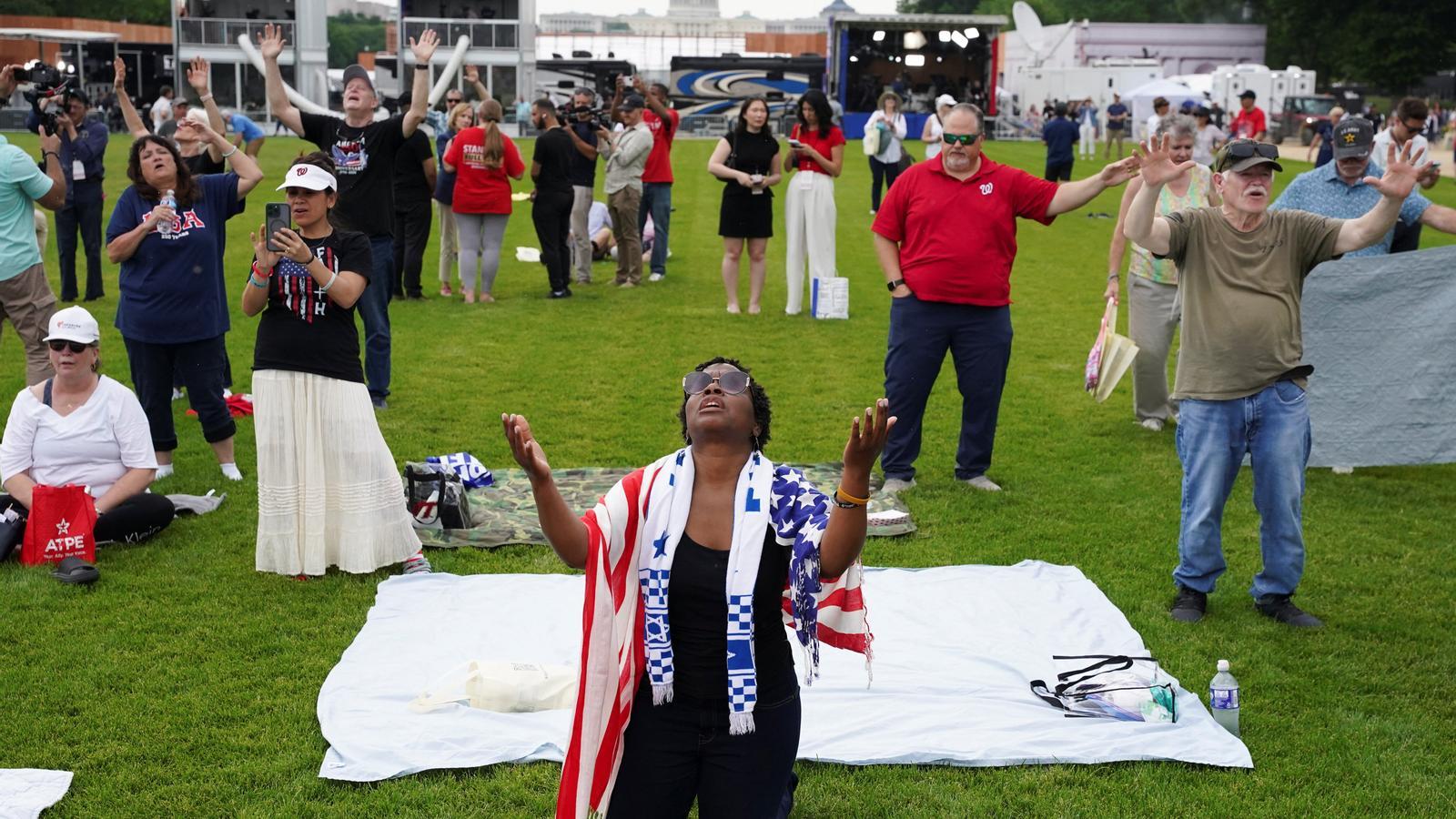

WashingtonFrom afar, the kilometer-long queue surrounding the National Mall lawn looks like that of a 2024 campaign rally. Red caps of Make America Great Again" among American flags. Many of the outfits recall the existence of rural America in the capital of ties and polished shoes. The only nuance is the name screen-printed on most t-shirts: references to Trump have today been displaced by "Jesus". An evangelist pastor walks up and down the row, shouting "Hallelujah" at the top of his lungs for those who are still a little sleepy. People like Kelly, who has come from Richmond (Virginia), got up at four in the morning to participate in the macro-prayer called by the White House this Sunday.
to pursue alleged "anti-Christian" biasThe messianic rhetoric, the Bibles edited by the magnate, and the photographs with evangelical leaders translate into real and concrete actions on the ground. During this year and a half, the Republican has created an office of faith, which has its office within the West Wing of the White House; he has promoted a "commission for religious freedom," which is basically composed of conservative Christians; and he has signed an executive order to prosecute alleged "anti-Christian" bias. According to the government website, today's religious day is part of the events to commemorate the 250th anniversary of the US independence. In this case, the objective is "to consecrate our country as one nation under God." Hence, the official name is "Reconsecrate 250" (Rededicate 250).
Show of force
The image of thousands of people praying on the National Mall esplanade is once again a show of force for conservative Christianity, which has been gaining ground within the president's inner circle. The administration does not explicitly state it, but it does not hide its communion with white Christian nationalism. Of the fifteen spiritual leaders who have participated, fourteen are Christian and the other is an Orthodox rabbi. Furthermore, of the fourteen Christians, seven are evangelicals.
But the headliners are not the pastors, but the Secretary of Defense, Pete Hegseth, the Speaker of the House of Representatives, Mike Johnson, and the actor Jonathan Roumie, known for playing Jesus in the series The Chosen [The Chosen]. "I'm really looking forward to hearing Roumie speak, I loved his role in the series," comments Ethan, who is 20 years old and has come from Canada. Despite living on the other side of the border, the Messianic church he follows is in Minnesota. It is there that he met Simon and Henry, two brothers aged fifteen and eighteen respectively, who have also come with him. They have driven seventeen hours from their home to be here today.
Simon, who is wearing a MAGA hat, says he is also particularly excited to see Hegseth. The three young people believe that thanks to this administration, being Christian is no longer seen as a "negative" thing, and the two brothers declare themselves fans of the president. However, their smiles break into grimaces of disgust when I mention the meme that Trump published on Truth Social in which he showed himself as if he were Jesus. "It was a big mistake. I don't think he did it with bad intentions, and besides, he deleted it afterwards. Nevertheless, I still think he is a great leader," replies Simon, who defends the importance of this new administration to "revive" Christianity.
The idea of a Christian "revival" is constantly repeated in each of the conversations. In any case, none of the dozen or so people interviewed by this correspondent say they have recently converted to Christianity. On the contrary, they have been active in their faith for years and come from religious backgrounds. Matthew D. Taylor, a researcher specializing in white Christian nationalism, explained a few weeks ago to ARA that this feeling of religious revival is a mirage behind which lies a process of radicalization of people who were already Christian.
The logic with which Simon evaluates Trump also aligns with Kelly's, who downplays how the magnate behaves in his private life. "What he does in his personal life doesn't affect us; we're interested in what he's doing for the country, which is what affects us later. Besides, as Christians we know we are imperfect individuals, including him. But he is restoring faith, something other administrations haven't done," the woman defends. This logic of seeing Trump as a means to a higher end is repeated in many of the people in line.
Martin Nolan, a 42-year-old Baptist Christian, also values the Republican from this pragmatic perspective. "It's not that I love everything he does, but we are here to pray and that's what matters." The man is in charge of the youth group at his church. The boys are dressed in jeans and polos; the girls wear a type of head covering to hide their hair and 19th-century dresses. They are all between fifteen and twenty years old, but Nolan is the one who approaches to answer questions. When I address one of the girls, the young woman limits herself to responding with monosyllables and a shy smile. Nolan explains that the girls wear head coverings because "there is a part of the Bible that says so."
