Kramatorsk, the city where only drones are heard
The last great Ukrainian bastion in Donbas resists Russian swarms as evacuations of those who have not yet fled continue
-
CAT -
CAST
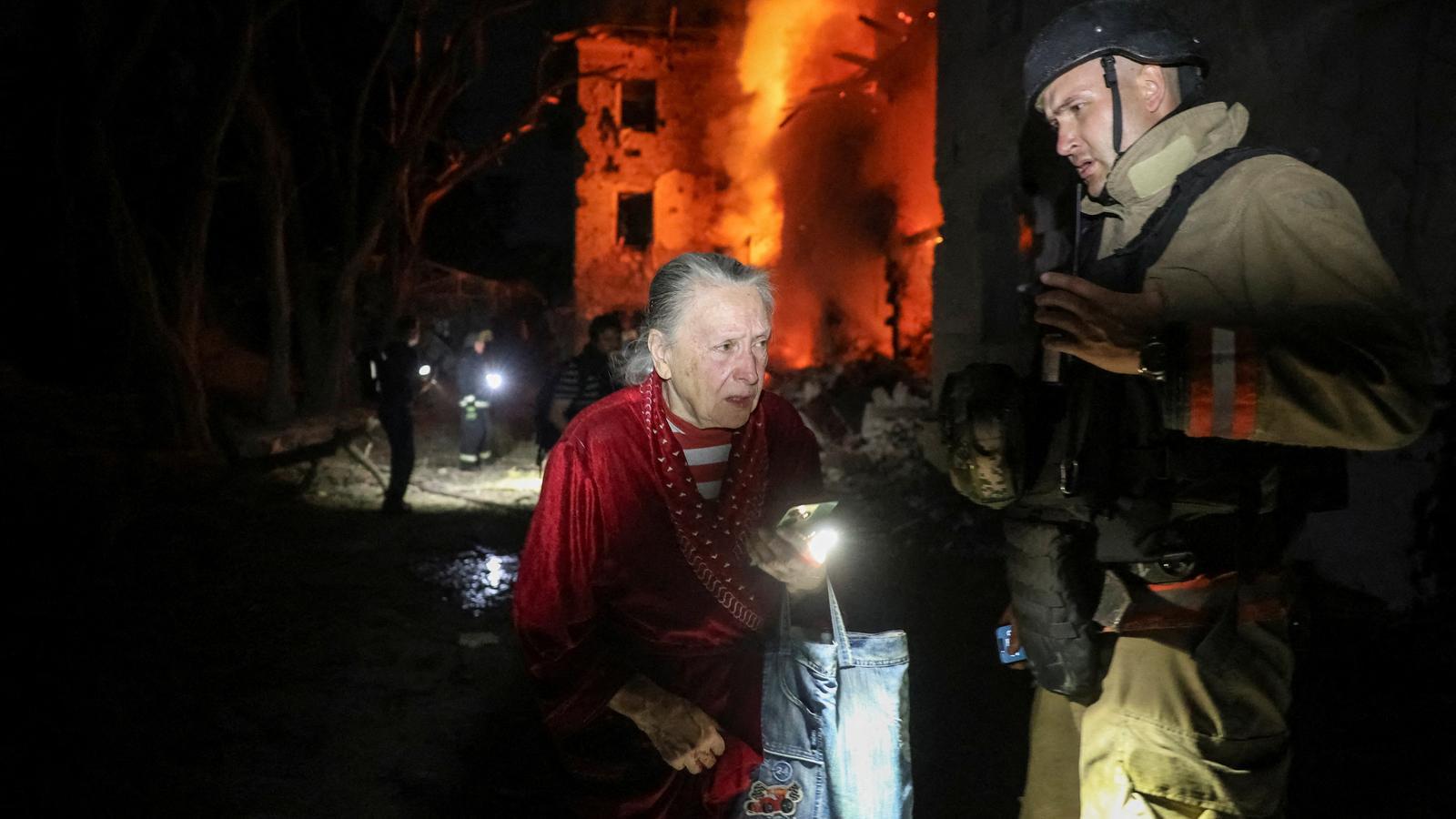
Kramatorsk (Ukraine)Only drones can be heard! There is only darkness and the hum of the small drones' engines, interrupted from time to time by an explosion when they find a victim. There are others, much larger, that make no noise. Only the detonation is heard. "It's terrifying," Andrei, one of the few remaining inhabitants of Kramatorsk, tells me. Most have been evacuated by government order.
The police have a specialized unit that goes to the homes of the few residents who still occupy apartments in practically deserted buildings. The rest have already fled. This unit is made up of three officers. They use a van which, seen from the outside, is not very different from those you might find in any European city. The interior, however, is completely covered with an artisanal armor: steel plates protect the entire cabin and two sliding doors – one on the side and the other at the back – give access to it.
"It depends on the drone," one of the officers replies when I ask if this armor would be able to withstand an impact. The fact is that many officers have already died trying to evacuate people from other cities, despite these protections. Only military vehicles can withstand the impact of some drones, and not even all models.
Mechanical procedure
The evacuation procedure is always the same, almost mechanical. Depending on whether there are drones flying over the area or not, the operation is carried out more or less quickly. Today it's a fourteen-story building, without an elevator because there is no electricity. There are also water outages. The mission is to evacuate a family of five, including the 91-year-old grandmother, who needs help going down the stairs. All five take a few personal belongings with them.
They get into the van, which heads towards an indeterminate point in the city, where other vehicles, some armored and others not, both from the police and local NGOs, are arriving. They are transporting more evacuees. A police officer takes a photo of each one and notes their names on a list. These are the people who will finally board a bus destined for a safer place. Behind them, they leave a whole life of memories and a home to which they do not know if they will ever be able to return.
The police officers are taking the road back to the city. It is close to seven in the evening. At eight o'clock, Kramatorsk will be plunged into absolute darkness. The last major Ukrainian stronghold in the Donbàs literally transforms at this very moment. The city has gone from about 200,000 inhabitants before the war to 58,000. Those who still live there – mostly military and essential civilian personnel – disappear from the streets as the shutters of the establishments that remain open are lowered, basically cafes and some restaurants that have survived the bombings.
The large supermarket in the Town Hall square presents an apocalyptic image. Most of the glass has shattered and disappeared. The building opposite shows direct hits, and next to it is Kramatorsk's hotel, now literally split in half by a bombing. Presiding over the large square is the majestic Town Hall building, without windows, replaced by wooden planks, and with numerous shrapnel impacts from the bombing of the restaurant located just in front.

In the surrounding streets, the nets that serve to stop the smaller suicide drones have already been installed. But only a very small part of the city has this protection. A few streets further up, Nicolai points to a half-destroyed building, just opposite the apartment we rented. "This was two days ago," he says. Lately, all attacks have been concentrated in this area of the city. There isn't even the light from the traffic lights left to suggest any trace of life in this ghost city. There's no one in the streets. The few cars circulating do so at high speed. The rest are hidden under bushes or trees, as if they could protect themselves from the drones. They have been installed to stop the smaller suicide drones. But only a very small part of the city has this protection. A few streets further up, Nicolai points to a half-destroyed building, just opposite the apartment we rented. "This was two days ago," he says. Lately, all attacks have been concentrated in this area of the city. There isn't even the light from the traffic lights left to suggest any trace of life in this ghost city. There's no one in the streets. The few cars circulating do so at high speed. The rest are hidden under bushes or trees, as if they could protect themselves from the drones.
At night, no one leaves their homes. Everyone covers the windows with cardboard and tarps, hoping that the light from inside won't betray them as targets. However, many drones already use thermal detection systems. Under conventional bombing, there is always an element of chance; with drones, this component practically disappears.
Priority targets
Social networks are full of videos that both sides have published showing victims in the final moments of their lives. Terror is reflected in their faces. They are endless seconds in which they know they will die. Then, the drone's antennas impact the body and the explosive charge detonates.
"We are priority targets for the Russians because drones have changed the balance of the war," explains Dimitro. He is an engineer by profession and is in charge of speaking to the press. He shows me the latest model of ground drone his company manufactures. It's a kind of six-wheeled cart capable of transporting logistical supplies to the front line. "This model costs a sixth of what the equivalent made in Europe costs." It is an autonomous system that makes its own decisions, although it can also be controlled manually. The same applies to aerial drones. They are now fully autonomous. That is, they use artificial intelligence, although –they always insist– the final decision remains in the hands of a human operator.
There are all sorts: from simple suicide drones, which barely cost $800 and are mostly made with 3D printers and Chinese components, to others capable of intercepting enemy drones of different sizes. These latter are responsible for defending cities when Russia sends a swarm of drones. There are also larger ones, capable of traveling long distances to reach their targets.
In the end, it's all a matter of numbers. All air defense systems have a limited capacity. You just need to overcome it. Therefore, the key ends up being who can manufacture more drones at the lowest possible cost and, at the same time, adapt more quickly to the technological countermeasures that both Russia and Ukraine are developing.
The transformation caused by the war marks a turning point for future conflicts. It has been demonstrated that the sophisticated and very expensive traditional air defense systems of the great powers are obsolete and insufficient against technologies that evolve at breakneck speed.
Ukraine has positioned itself at the forefront of drone manufacturing and has been able to turn an initially asymmetric war into a conflict that can even affect Moscow, as demonstrated by the recent attack by hundreds of Ukrainian drones against a refinery located in the Russian capital itself. After that attack, Vladimir Putin had to admit that "his country is going through a difficult time," while Volodymyr Zelensky seems to have finally found a certain strategic balance: "If Ukraine burns, Moscow burns." On Thursday morning, Kyiv burned fiercely. A devastating attack with more than 500 drones caused at least 21 deathsseems to have finally found a certain strategic balance: "If Ukraine burns, Moscow burns." On Thursday morning, Kyiv burned fiercely. A devastating attack with more than 500 drones caused at least 21 deaths.
