Trip to Tyre, the historic city in Lebanon that Israel has left in ruins
Despite the truce, life in the south of the country has not resumed due to uncertainty about the future
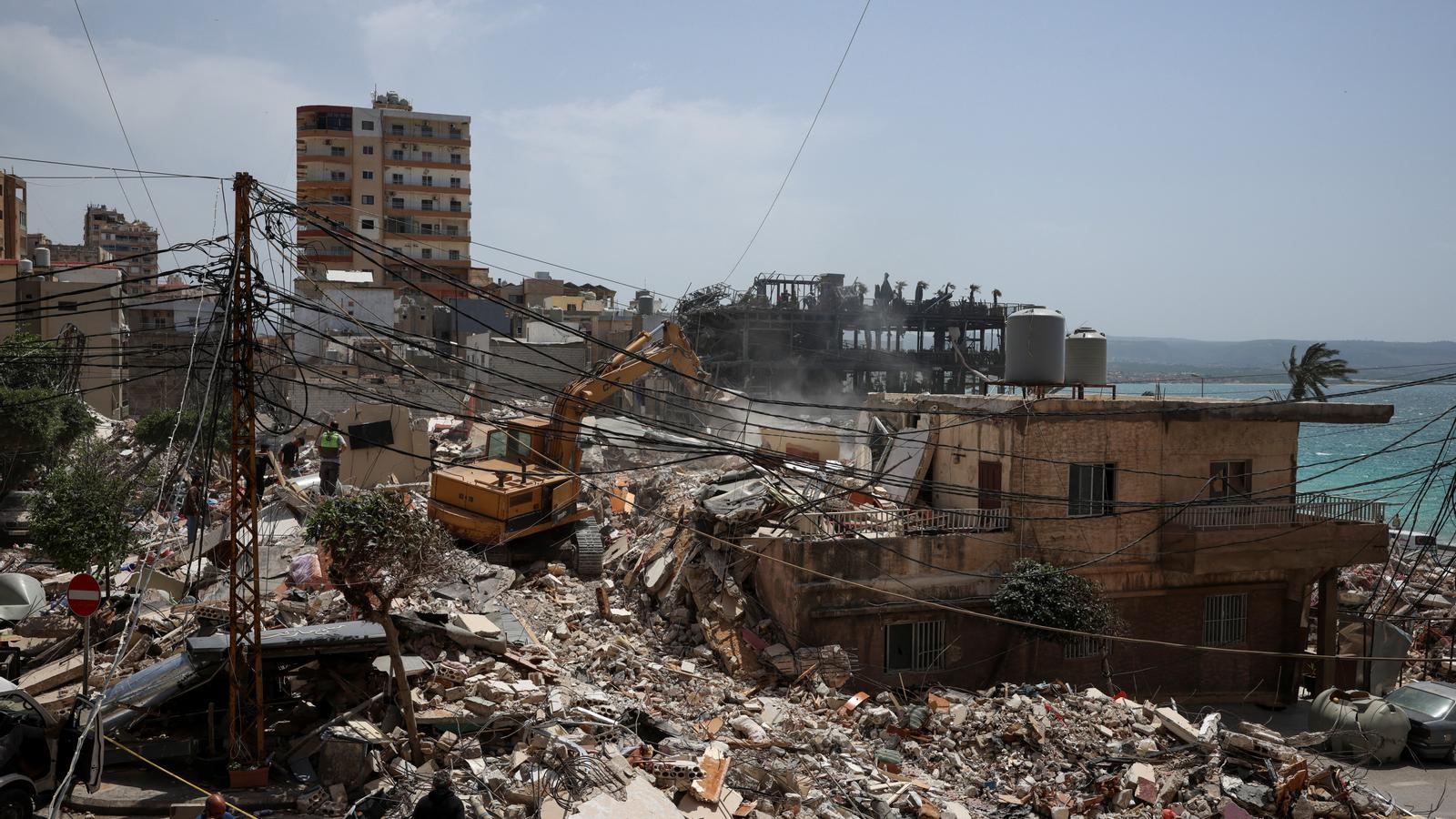

Tyre (Lebanon)Mohamed Hijazi says it's like being buried alive. On April 17, in the early morning, an unexpected call changed his life forever. It was his cousin. He gave him the worst news: his little sister, his three nephews, and his brother-in-law were among the nineteen victims rescued from under the rubble of the Hijazi building, opposite the Tyre promenade. There were only a few minutes left until the ten-day ceasefire came into effect when Israeli planes bombed the building. The explosion tore through the neighborhood at the exact moment the silence was supposed to begin. The truce arrived amidst screams, cries, and rage.
"Why? Why?", repeats Mohamed, his voice broken. Beside him, a rescuer standing on the pile of rubble hands him fragments of his life: dusty photographs, torn clothes, stained objects. "I still can't accept what has happened... I feel like it's a nightmare," he says, and begins to cry.
A few meters away, Reda Abbas Hijazi salvages what's left of his café. Among the debris, glasses, saucers, spoons, the account book... The roof, by chance, held up. He and two customers survived. "We were commenting that the ceasefire was close, and suddenly, we heard the metallic sound of the planes. Then the explosion. We threw ourselves to the ground," he recalls. He pulls up his trouser legs and shows the wounds left by the glass fragments.
"I have stayed here throughout the war. There is little work, but I have no other way to live. We want the army to take control and stop killing civilians." He pauses, as if measuring the weight of what he is about to say next. "God has not yet wanted to take me with him. My brother, on the other hand, did not have the same luck. He had left the hospital two weeks ago after heart surgery. Israel killed him."
In southern Lebanon, the city of Tyre has never been completely emptied. Some have stayed there despite the Israeli offensive, and have lost everything in the last few days, just before the truce. The destruction is not uniform: there are buildings standing next to others ripped open, stairs that lead nowhere, facades that reveal rooms suspended over the void.
A historic port, at a standstill
Tyre is one of the oldest inhabited cities in the world, with more than four thousand years of history, and was one of the great centers of Phoenician civilization, from where trade routes departed throughout the Mediterranean. Its identity remains anchored to the sea. The port, heir to those two ancient Phoenician ports, is not just a place of work; it is also memory, economy, and landscape. Here, generations of fishermen have maintained an activity that still sustains thousands of people today. But the war also caused the water to become empty.
For weeks, the boats remained moored in a silent port. Unused nets, silent engines, empty boxes. The sea continued to be there, but it was inaccessible. Fear and restrictions imposed by the Israeli army pushed fishermen to stay on land or a few kilometers from the coast, under constant warnings. With the truce, some have returned, but without certainty.
Ali prepares his small wooden boat. The engine coughs before starting. He looks at the horizon, but does not move away. "There is no work. We go out and come back with almost nothing. We cannot go far. We have to keep an eye on the sky," he says while adjusting the net. He points to the water, calm, almost still. "Before we knew where the fish were. Now we don't know anything. We have lost the season. Who will compensate us?"
Disappearance of tourism
Near them, other fishermen mend nets or clean hooks. Some haven't even gone out again. Mohamed Amin, captain of a tourist boat, observes the empty pier, where fishermen and visitors used to mingle. "The sea has been completely calm. Not a single boat has gone out. My boat is for tourists, but no one comes. We've been idle for weeks," he laments.
In normal times, the port of Tyre is also a meeting point, a place for tourists and locals to pass through, with restaurants, nets spread out in the sun, and boats painted white and blue. Today, this rhythm is barely noticeable. The twenty-day extension of the ceasefire has provided a minimal margin of stability, but has not changed the perception on the ground. The truce remains fragile, punctuated by recurrent violations in the form of incursions, shootings, or the passage of planes and drones. No one considers it guaranteed.
In this vacuum between what has been agreed and what is happening, southern Lebanon is moving in a suspended normality. The dead are buried, the rubble is cleared, attempts are made to resume work, but reconstruction remains out of reach.
While negotiations take place in Washington, the violence has not disappeared, it has only become intermittent. This instability fuels uncertainty and conditions every daily decision, from returning home to going out to fish. For now, the truce is nothing more than an unstable pause. In Tyre, the sea is still there, as always. But calm has not returned.

