Israel already occupies 60% of the Gaza Strip
The new orange line further corners the Palestinian population
-
CAT -
CAST
Jerusalem“In Gaza, right now, we no longer control 50%, but 60%”. With this sentence, uttered during the weekly cabinet meeting in Jerusalem, Israeli Prime Minister Benjamin Netanyahu publicly voiced what various humanitarian organizations, geospatial experts, and Israeli media had been denouncing for months: Israel is consistently changing the map of Gaza despite the ceasefire brokered by the United States in October 2025.
The statements confirm a progressive occupation of the Strip that goes beyond what the truce agreement stipulated. When the ceasefire began, the Israeli army controlled approximately 53% of the Strip. The army established a kind of military border which it dubbed the “yellow line”, separating the area controlled by Israeli troops from the areas where the Palestinian population could continue to live. According to the initial terms of the agreement, Israel was to withdraw behind this line. But on the ground, reality has evolved in the opposite direction.
In recent months, various media outlets and human rights organizations, both international and Israeli, have documented the appearance of a new demarcation: an “orange line”. This new border would advance approximately 11% beyond the yellow line and leave nearly two-thirds of Gaza under direct or indirect Israeli control.
In January, the Israeli newspaper Haaretz published a report describing the westward shift of the yellow line. Gaza residents recounted waking up to discover that the line had moved overnight and their lands were now considered fire zones.
The new orange line
In March, another Israeli media outlet, The Times of Israel, explained that the army had discreetly sent new maps to humanitarian organizations present in Gaza. The documents showed a new restricted area marked with an orange line. The area located between the two lines was subject to mandatory military coordination with Israel for any humanitarian movement. In January, Israel forced major international NGOs to withdraw their foreign personnel from Gaza.
“In practical terms, this further reduces the available space for Palestinians and limits the possibility of returning to homes or land located within these areas,” Dr. Julie Norman, a researcher with the Middle East and North Africa program at the international think tank Chatham House, tells ARA.
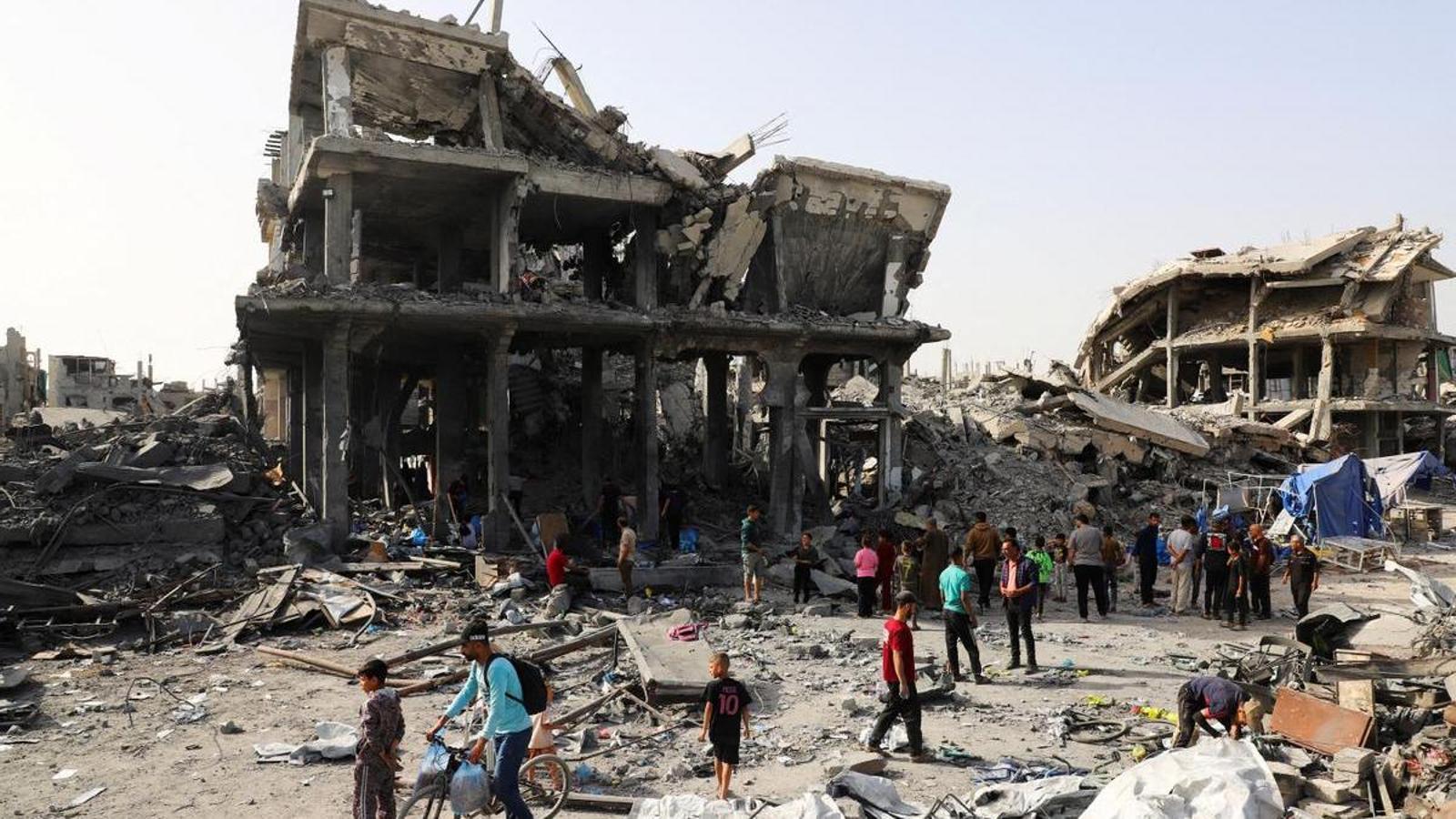
For the expert, the expansion of the control lines is pushing the Palestinian population “towards an ever smaller portion of Gaza”, where more than two million people live concentrated in humanitarian conditions that “are worsening day by day, with diseases, infestations, and a constant deterioration of living conditions”.
Norman believes that these transformations will hardly be reversible in the short term, even if Israel presents them as temporary measures. “I do not expect a significant withdrawal before the Israeli elections, and even afterwards it would be very difficult to reverse this situation”, she assures.
Israel defends these areas as buffer zones intended to prevent future attacks like Hamas’s on October 7, 2023. “We know exactly what our mission is, and our mission is only one: to ensure that Gaza no longer poses any threat to Israel”, Netanyahu said during the same meeting.
In this context, according to the expert, Israel conditions any debate about a withdrawal from Gaza on the disarmament of Hamas, but the group “is not interested in that right now, especially in a context of ceasefire violations and in the absence of real negotiations on a political solution or Palestinian self-determination”.

Meanwhile, the humanitarian situation in the Strip continues to deteriorate. According to Doctors Without Borders, nearly 90% of Gaza's water and sanitation infrastructure has been destroyed or damaged. The NGO denounces attacks on tanker trucks, destruction of wells, and a growing scarcity of essential medicines. Many families are forced to dig holes in the sand as makeshift toilets while diseases and malnutrition increase. During the first months of this year, 383 children have been admitted to Doctors Without Borders' nutritional centers, 35% of whom suffer from severe acute malnutrition.
Furthermore, according to data collected by The Times of Israel, at least 870 Palestinians have been killed in Israeli attacks since the ceasefire began, while four Israeli soldiers have died in Gaza during the same period.
On paper, the second phase of the agreement promoted by US President Donald Trump foresaw a wider Israeli withdrawal and the start of Gaza's reconstruction in exchange for the disarmament of Palestinian factions like Hamas. But on the ground, what is emerging, for now, is another reality: a fragmented territory, delimited by mobile military lines that progressively reduce Palestinian space, while Hamas has no incentive to lay down its arms.

