The Balearic PP president who became an independentist
Cristòfol Soler already felt "mistreated" by the State as Minister of Economy of the Balearic Government

-
CAT -
CAST
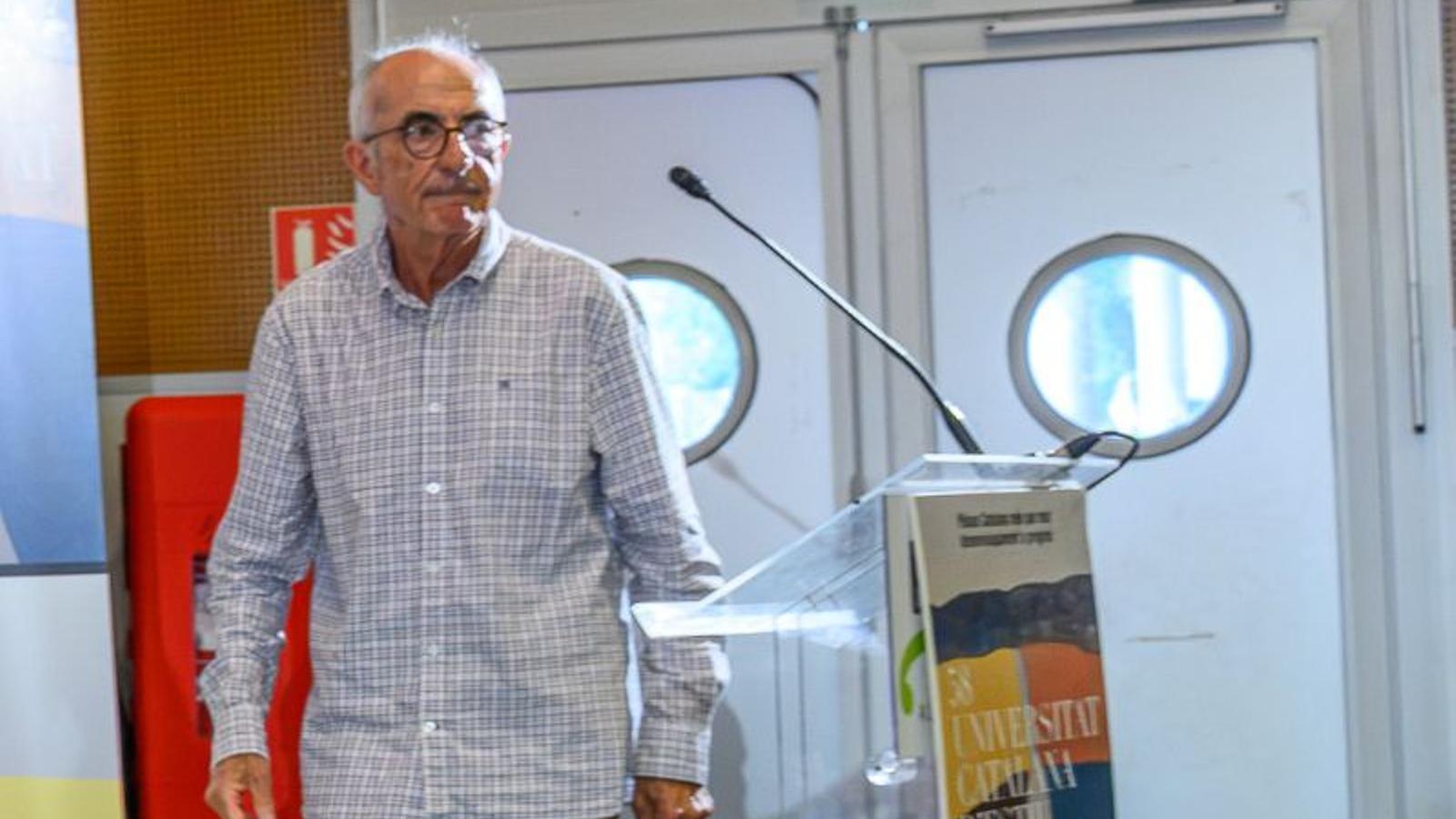
Prada of ConflentCristòfol Soler was a very young deputy with the PP, at only 26 years old, in 1982; he later became the Balearic Minister of Economy, President of the Parliament and, finally, President of the Balearic Government, but he only held the position for ten months, between 1995 and 1996, the shortest in history. He replaced Gabriel Cañellas and lasted very little, but the most surprising thing was when, in the midst of the Process, he declared himself an independentist and presided over the Sovereign Assembly of Mallorca, of which he is still a member. From Prada de Conflent, where Soler attended a round table at the Catalan Summer University, he speaks to ARA and warns that "there are no regionalists left in the PP". In his opinion, what is being done by the executive of the popular Marga Prohens would not be regionalism at any time, despite the autochthonous legacy that from the Balearic PP they say they defend.
"That they want to touch the Language Normalization Law says it all," he states, and also regrets the consultations in classrooms about the choice of the language for primary education. He was from the regionalist sector of the PP, but in the midst of the anti-Catalanist José Ramón Bauzá's era, he tore up his membership card and completed the move towards independence. "I don't believe in regionalism. I am clear that what I want is independence," he reiterates.
But when did he make the change? He explains that when he was in government with Cañellas, he already began to become aware of the core of the Spanish problem: "I saw how things worked. When competences were negotiated, it was very difficult for us. I was the Minister of Economy in the first government, they didn't treat us as they should have –he explains–. I saw that senior officials had a lot of power at the time when Felipe González had the absolute majority, and it was they who managed things.
Disenchanted with Aznar
The disillusionment multiplied with the PP in government: "We expected that with the PP things would change, but it was worse. Aznar had a good first term [by pacting with CiU], and a second one that was fatal." "During the first term, the linguistic normalization law was passed, it went very well, it gave leeway, now it would be impossible. Ask yourself if it would be possible to pass a linguistic normalization law like the one from the first term, and it's impossible," he concludes. But the Balearic people voted overwhelmingly for the PP, which still captures regionalist voters, and leaned on the far-right Vox. Despite everything, Soler believes that the Balearic people can eventually wake up: "When the Procés happened, the Sovereignist Assembly of Mallorca was created and what we defend is being maintained. But now everything [the Procés] is stopped, although we are trying to continue," he asserts.
Despite this, the consultation in schools for parents to choose the first language of schooling leaves some data to be analyzed, such as the 53% vote for Catalan in Ibiza in contrast to the 78.5% general vote in the Balearic Islands. "Ibiza is worrying. And we must take one thing into account: in Mallorca, 40% are Mallorcans [by origin]," he assures. Regarding the demographic challenge, however, he has no solution for a complex issue, although he does see tourism as one of the main problems. One of the parties that is raising its voice is Coalició per Mallorca, a new formation with an anti-immigration discourse that regroups all center-right regionalists, and regarding which he still has "no opinion" because he wants to see "how it evolves".
