Iran prepares state funeral of Khamenei as a declaration of victory
The supreme leader of Iran, dead on the first day of the attack by the United States and Israel, will be bid farewell during six days of ceremonies
-
CAT -
CAST
BarcelonaIran is preparing for the massive funeral celebration of Ali Khamenei, the supreme leader who died on the first day of the joint attack by the United States and Israel against the Islamic Republic. It will be six days of a ceremony that has had to be delayed and which finally arrives with a taste of victory that the regime will strive to exhibit as a demonstration of strength. Khamenei decided the political and spiritual destinies of Iran for 36 years and has risen to the rank of martyr.
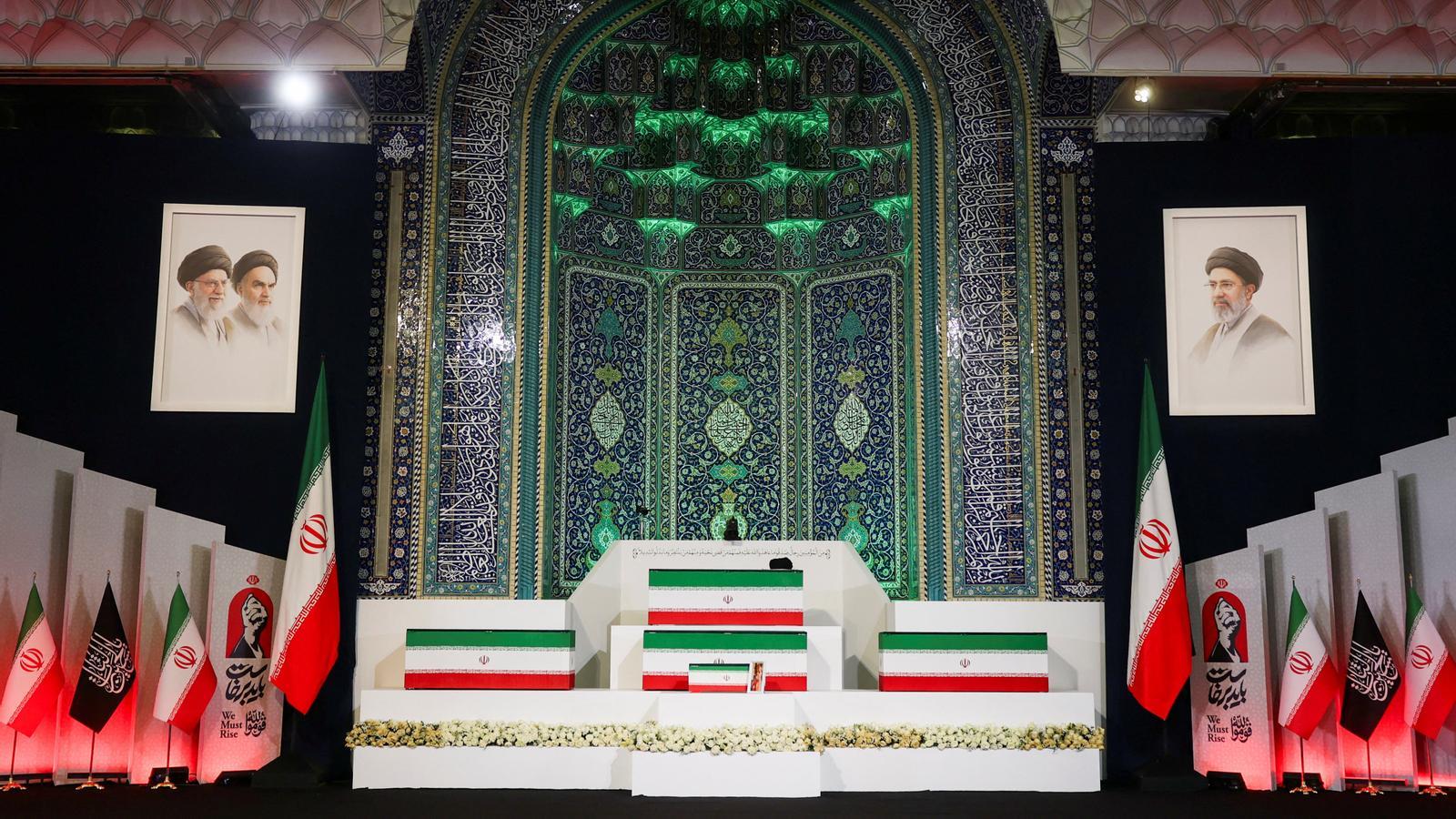
The Iranian regime, a survivor of the attack by a Donald Trump who had threatened to wipe Persian civilization off the planet, will take the opportunity to make an epic display seeking reaffirmation. The motto chosen for the funeral has a phoenix-like ambition: "We must rise." The iconography borrows the symbolism of the left's anti-imperialism: a raised fist and red flags.
The official events began this Friday with a private ceremony for leaders; this Saturday there will be the first demonstrations of mourning in Tehran, with the remains of the supreme leader at the Mosalla mosque, and on Tuesday Khamenei will be buried in Mashad, where he was born, the second largest city in the country and one of the seven holy cities of Islam. Coincidence or not, Tehran has chosen the same day that the United States commemorates the 250th anniversary of its Declaration of Independence to bid farewell to its assassinated leader.
The regime has promised "the most important event of the century" and the most massive display of crowds since the 1979 revolution, and will spare no resource to achieve it. To cast its shadow over Shiism, the remains of Khamenei – the only leader known by 60% of Iran's 90 million Iranians – will also be paraded through the Iraqi holy cities of Karbala and Najaf.
Where is Mojtaba?
Khamenei died in a bombing claimed by Israel on February 28, along with his daughter and son-in-law. Shortly after, the regime appointed his son Mojtaba as successor. Mojtaba's wife and daughter, aged 14 months, were also killed in the same attack and he was injured, according to the official account. The new supreme leader has not appeared in public since then and his health status is unknown. We have only seen written statements, one of which distanced itself from ongoing negotiations. The regime has sought to alleviate this void by filling the streets with images of father and son, along with the first supreme leader of the Republic, Ayatollah Ruhollah Khomeini, staging institutional continuity. Mojtaba is not expected to appear for the first time at his father's funeral. The Israeli Defense Minister, Israel Katz, has again threatened this week to kill him.
With temperatures exceeding 40 degrees, a procession is scheduled for Monday in Tehran that will cover the 10 kilometers separating Imam Hussein Square and Liberty Square, in which the city's mayor has announced the participation of about 20 million people. On Tuesday, Khamenei's remains will be transferred to the holy city of Qom, where there will also be a parade. Wednesday will be the day for ceremonies in Iraq, and on Thursday the former supreme leader will finally be buried in Mashhad.
Show unity in negotiation
The funerals had been planned for early March, but the war forced the regime to postpone them. The 60-day ceasefire signed on June 15 has made the celebrations possible, but the truce is very fragile, especially due to Israel's refusal to commit to a ceasefire in Lebanon as stated in the understanding agreement signed between Washington and Tehran. Negotiations continue with great tension – last week there was another exchange of attacks – and Tehran wants to use the funerals as a demonstration of strength and unity to obtain more concessions. Iran continues to pressure to strengthen its control over the Strait of Hormuz with some kind of transit toll, something the United States wants to prevent at all costs.
But at the same time, the mass mobilization is also a very risky decision due to the danger of provocations or scenes of chaos. The government has declared the closure of all public and private offices between Saturday and Monday, and there are severe traffic restrictions that will strain the metro network. Airspace will also be closed on Monday, and fighter jets will be patrolling the sky to prevent an attack from Israel.
During the funerals of Khomeini in 1989 or those of Qasem Soleimani, the commander of the Islamic Revolutionary Guard assassinated in an attack ordered by Trump in Iraq in 2020, human avalanches with several deaths occurred, in a context of much greater internal and external solidity of the regime.
Khomeini's remains were also taken to the Mosalla mosque, and when the body was to be transferred to the burial site, the crowd of people who wanted to touch the coffin got out of control. The coffin ended up being transported by helicopter, after falling to the ground and breaking. Ahmad, Khomeini's son, was injured, as were thousands of people, and an official death toll has never been provided. At Soleimani's funerals, 56 people died crushed at the security barriers. Now the Iranian authorities want to show that they are in control and have planned carefully prepared processions to ensure that the funerals of Iran's longest-serving leader, assassinated by Israel, are remembered not as a moment of chaos but as a demonstration of strength and a state challenge.

