Rare earths are neither earths nor rare
At the Valentí Masachs Geology Museum I learn the difference between fluorescence and phosphorescence, and many more things
15/08/2026 - 00:00 h

-
CAT -
CAST
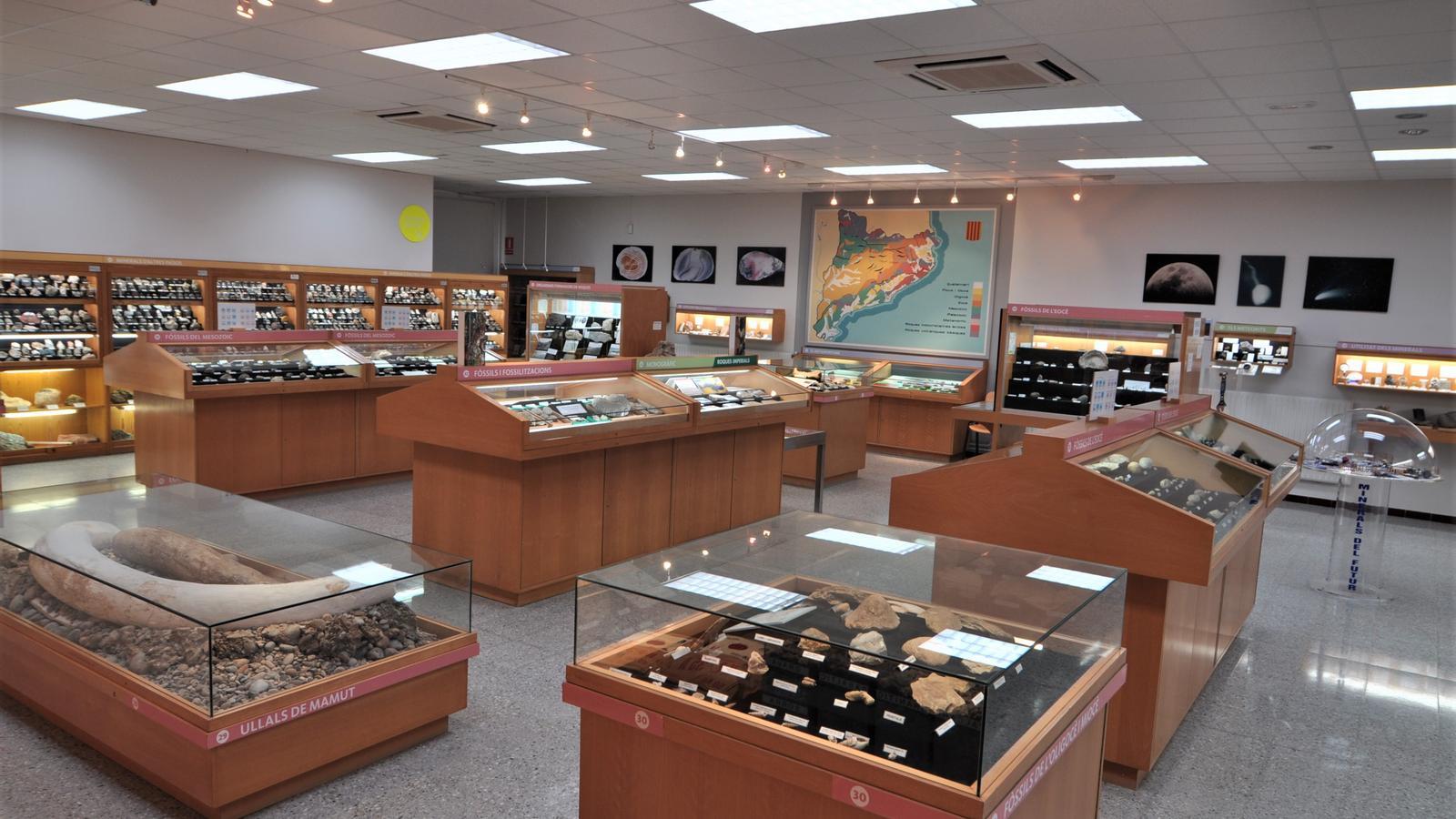
The traffic light we are waiting to turn green contains LED lights made with rare earths. When we call dad or waste time watching videos on social networks of boys falling –and getting hurt, but in the background you can hear people laughing, without any empathy– we use a mobile phone that is made, in part, of rare earths. When we have an X-ray, rare earths are involved and save thousands of photographic films. If we need to have prostate surgery, the laser (thanks to rare earths) does the job.What are rare earths, however? They are a series of chemical elements essential for today's technology. "They belong to the group of critical minerals, the market of which is mainly controlled by China. They have high economic interest and are in a situation of supply risk," explains the curator and former director of the Museum of Geology Valentí Masachs, Joaquim Sanz. "The first rare earth element to be discovered was yttrium, in the 18th century, and the last, promethium, in 1945. Before, all minerals were called earths and these chemical elements rare earths because their usefulness was not known and they rarely appear concentrated in deposits, which complicates their exploitation," emphasizes Joaquim. Now we do know what they are for. And they have so many uses! So, they are neither earths nor rare.This is one of the many things learned in this magnificent geology museum located at the Escola Politècnica Superior d’Enginyeria de Manresa. It is the UPC's geology museum. Students and professors of the degree in mineral resources engineering and their recycling are fully involved. They conduct workshops and guide school visits, and exhibit the results of their research.Pedagogy is part of the essence of the museum. Professors who bring students there, from 5 years old to university age, find it easy. Worksheets also help –for different ages– which are available to everyone at www.geomuseu.upc.edu."If the consumption of non-renewable resources continues to grow indefinitely, these resources will run out, and future generations will have nothing profitable left on Earth," states David Parcerisa, a doctor of geology and museum curator. "We need to investigate how to improve the recycling rate of minerals. For example, copper, whose recycling is not 100% efficient, and we still need to extract it. Copper is used to make electric cables that light bulbs, for our car to run... It's one of the most prized metals, also by thieves and the military industry (bullets are made from it)," says Joaquim Sanz when we are in front of radioactive minerals –uranium, thorium, and radium. They are found inside a display case protected to prevent them from being exposed to radiation. On the other hand, you can touch a meteorite the size of a hand. It is the so-called Toluca meteorite; it was found in this locality in Mexico. David invites me to bring a magnet close to it. And it certainly attracts it! This meteorite is 93% iron.The most successful room in the museum is tiny. It has two display cases where a few minerals, rocks, and fossils are exhibited. I press a switch and the samples appear illuminated, thanks to a long-wave ultraviolet lamp that I just turned on. Of course, they are fluorescent minerals. The calcite from Franklin, for example, is dressed in a reddish hue.Next I press another button and... How beautiful! The Mexican calcite takes on an intense pink color thanks to the short-wave ultraviolet light I have turned on. And when I turn it off, the light continues to be seen for a few seconds. It is phosphorescent.At the museum, also find minerals that have fallen into disuse. For example, mercury, which was once the king of thermometers. It is prohibited to use it due to its toxicity. "If it is thrown into the sea, the fish –who don't know it's toxic– they eat it, of course. And we, by eating fish, ingest small doses of mercury," says Nor Sidki Rius, a mining engineer and curator of mineralogy at the museum, who also accompanies me.The museum is not just about minerals. It is also about paleontology, which is actually also a discipline of stones: fossils. The most spectacular element in this area is a large fossilized mammoth tusk. "This tusk was discovered in 1957 during quarrying work on the Manresa hill of Puigberenguer. The extraction work was carried out by Valentí Masachs, a geologist recognized who years later would make this museum a reality and would be its first director", explains Josep Biosca, curator of paleontology. I leave the museum enriched with a few experiences, such as having seen the difference between phosphorescence and fluorescence. Don't miss the opportunity to visit it; it's very different from classic geology museums!Beyond the exhibition halls
The activity of the Valentí Masachs Geology Museum goes beyond the exhibition halls. It organizes visits where geology is the protagonist, not only in the field but also in the city of Manresa itself. The museum has designed an itinerary that allows you to know what rocks some of the building facades in Manresa are made of; it explains what type of stone they are (sedimentary, magmatic...), their origin... Some even have fossils embedded in them (in the limestones of Sant Vicenç de Castellet). Some come from Finland or Brazil. In addition, many school visits combine a visit to this museum with other visits, such as the Manresa Museum of Water and Textiles, the Can Font Water Centre, or the Cardona salt mines.

