Five years of the Taliban: journey to an increasingly frightening regime
The Taliban, who from the outside seem like a retrograde and improvised movement, have shown that they have financial and management capacity

-
CAT -
CAST
Special correspondent in KabulThe arrival at Kabul airport was always chaotic: long queues that moved slowly as the officials on duty checked passports, pushing and crowds of passengers to pass luggage through the mandatory scanner before leaving the terminal, and spontaneous individuals who took over all the trolleys to carry suitcases and asked for money if you wanted to use them. This time, however, everything was much more agile: different queues for men and women for passport control, and efficient and fast officials. Smoothness in passing luggage through the scanner. And dozens of trolleys available for suitcases, without the need to pay.
Access to the airport has also improved: a waiting area with a roof that protects from the sun has been set up, and a new road to facilitate the exit of cars. It is not the only thing that has changed. Kabul is also unrecognizable. There are buildings under construction everywhere, some up to fifteen floors high. New avenues have also been opened, countless streets are being repaired, and solar panels have been placed on the roofs of many buildings to guarantee the electricity supply in a city where power outages are daily and last for hours. Even the color of the taxis has changed: they used to be yellow and now they are blue.
The Taliban, who from the outside seem like a retrograde and improvised regime, have the financial and management capacity to transform a city. They are more competent than we think. This August 15th will mark five years since they regained power in Afghanistan, a particularly significant anniversary because their first regime lasted exactly that, a lustrum: from 1996 to 2001. Now, far from losing strength, they are gaining more power. And, apparently, it will only increase. It is frightening. Even though we in the West live with our backs to what is happening in Afghanistan, such an extremely fanatical regime will eventually affect us, whether we like it or not.
Construction fever
In Kabul, there is a construction fever. Never before has so much been built since the international troops arrived in Afghanistan in 2001 and the city was rebuilt after years of war that left entire neighborhoods devastated. "It's the business that now yields the most profit," assures the representative of a local construction company who prefers to remain anonymous. According to him, most are Afghan investors who have found a vein to make money this way. Now that the Taliban no longer commit suicide attacks in the city and, consequently, there is a certain security. In addition, housing is urgently needed. More than six million Afghan refugees have been forcibly deported from Pakistan and Iran in the last three years, according to data from the United Nations High Commissioner for Refugees (UNHCR), and many have ended up in Kabul.
However, the objective of this great urban growth does not seem to be to guarantee housing in the face of population increase. The few who can afford to buy an apartment do so, in most cases, to sell it later at a higher cost. A genuine real estate bubble is being created, which has contributed to skyrocketing prices. If before the rent for a three-bedroom apartment in Kabul was 10,000 afghanis per month (about 128 euros), it is now double, in a country where the average salary ranges between 200 and 415 euros per month.

"Our company was created two or three years ago by an Afghan living in London. Since then, we have already built four blocks of eight apartments each," continues the construction company representative. According to him, they only take three or four months to erect a building. "On the concrete beams, we put three steel bars, instead of the eight that would be needed. Everything is of very poor quality," he admits. The aim is to invoice, invoice, and invoice. The only thing that takes them longer is obtaining the construction permit from the Taliban regime, for which they have to pay thousands of euros and, often, resort to bribes to speed up the process. The Taliban are undoubtedly also filling their pockets with all this.
There are other drawbacks. Kabul is a city where the lack of water has always been a problem. Now the situation is getting even worse. If before to get water it was necessary to drill to a depth of 120 meters, now it is necessary to do so at two hundred, says the builder. The United Nations has already warned of the risk of all this.

Besides the construction of buildings, new streets are being opened. And this is indeed what the Taliban regime is doing. However, their method is completely expeditious. "They came and told us that we had to leave our homes within two months. They paid us 8,000 dollars, but that's a tenth of what it was worth because the land was also ours," laments Abdul Hakim, who is one of the many residents forcibly evicted in Kabul. In his neighborhood alone, a thousand houses have been demolished. In their place, there is now a huge expanse of wasteland, where a new avenue is supposed to be opened. The same scene is repeated in other parts of the city.
"How can we complain? They are the Taliban, no one can do anything against them," the man replies when asked if they at least tried to raise their voice, to do something to prevent it. In fact, fear is what best defines the current situation of the Afghan population. Afghans, who used to talk a lot and easily explain their lives, now measure their words and do not want to speak with foreign journalists. They are afraid that someone will hear or see them.
Surveillance cameras
In some streets of Kabul, surveillance cameras have been installed. There are also check points throughout the city, where the Taliban, dressed in brown uniforms, as if they were a professional security force, compel vehicles to slow down to check who is traveling inside. There is also the morality police, known by the acronym PVPV, in reference to the peculiar ministry to which it belongs: the Ministry for the Propagation of Virtue and Prevention of Vice, created by the Taliban in 2021 and whose name is already significant enough.
Morality police are easy to identify: they are Taliban dressed in a kind of white coat as if they were doctors, who patrol the streets to check that the population complies with what they consider to be the precepts of Islam. Men must wear beards and pray five times a day. Women must cover their faces and heads so that not a single hair is visible.
In fact, there are billboards in the city reminding the population to be good Muslims. “It is the responsibility of the government and the people to protect Sharia,” says a billboard in the center of the capital. “Please observe the hijab,” says another sign in a Kabul restaurant, with a drawing of a woman completely covered with a black niqab that only reveals her eyes. In the restaurant there is a reserved area for men and another for women. The women's area, furthermore, is subdivided into small compartments with wooden boards, so that diners at one table cannot see those at the next table. This same distribution exists in other establishments.

It is also striking that, contrary to what one might think, women in burqas are not seen in Kabul. Instead, there are many who wear the peculiar niqab of the Gulf countries, which is neither typical of Afghanistan nor had it ever been used in the country before. It is the long, black veil that covers the forehead, mouth, and nose, leaving only a small slit for the eyes. Even on television programs, some women dress this way.
Qatar and China
Perhaps it's a coincidence, but the color of Kabul's taxis has also changed and, curiously, they are now the exact same color as those in Qatar: sky blue. It may seem like a minor detail, but it isn't, considering that all the capital's taxi drivers have obeyed the order and invested in changing the color of their vehicles, despite their limited economic resources. It's another example that in Afghanistan, no one dares to say a peep.

Qatar is also building a residential complex west of Kabul, which includes three buildings of 96 floors each, a mosque and two schools, and which it will hand over to the Taliban Ministry of Urban Development and Housing as soon as it is completed. The works are quite advanced. From a distance, workers can be seen working.
Not far from there, China is building an entire neighborhood: 56 blocks with a total of 1,500 apartments, which it will also hand over to the Taliban government. More than half of the buildings are already built, but the finishing touches are missing. The project has involved an investment of 71 million dollars, according to data released by local media.
Likewise, all the solar panels that currently visibly cover a good part of the roofs and rooftops in Kabul are of Chinese manufacture, and they have become a lifeline in a country where the sun always shines, even in winter, and electricity outages are constant due to the destruction of the electrical grid by decades of war. Panels that, surprisingly, were not considered for installation during the twenty years of Western presence, despite the billions of euros that arrived in the country then.
American armament
“The Taliban are stronger than ever,” says Colonel Noder, 57, who served in the Afghan army until the radicals took power in 2021. He does not shy away from studying and openly curses the previous Afghan government for having left the population to its fate. As he assures, the military received orders not to fight the Taliban, to let them enter Kabul without firing a single shot, and to allow them to appropriate all the armament that the then Afghan security forces had at their disposal. “M4 rifles, M249 and M240 machine guns, unmanned aerial vehicles…,” he enumerates part of the American-made material that ended up in the hands of the Taliban. However, he opines, this does not make them professionals. "Terrorists are terrorists," he states.

Colonel Noder's family is an example of what has happened in many Afghan homes. He, logically, did not return to work at the Ministry of Defense. Now he makes a living as a taxi driver. His wife, Pashtoon, 53, also found herself jobless overnight. She was the financial director of a public-private company dedicated to the production and sale of low-cost bread in Kabul.
During the first two years of the Taliban regime, she was able to work without problems. But in 2023, coinciding with the Persian New Year, she was called by phone to be told not to return to the office anymore. The fourteen women on the staff, out of a total of 131 employees, were all dismissed at once. In her case, after 27 years at the company. "I don't work now. Where should I go? There are no opportunities anywhere," she laments without being able to hold back tears, even though she has been jobless for over three years. Her position was taken over by a colleague from the company: a man, of course.
His daughter can work, but not in her profession: Diba is 22 years old and is a midwife. She was lucky enough to finish her studies in 2024, when the Taliban were already in power, but unfortunately she could not take the graduation exam because that very year the radicals prohibited women from taking exams. Therefore, she has not obtained the degree, nor can she practice as a midwife. That is, the Taliban's obsession against women's education is so great that currently they cannot even graduate to help other women during childbirth. Diba works as a receptionist in a private hospital.
"For five years now, not a single woman has graduated in medicine. It's a disaster," says her brother, Dr. Ayar, who is also a doctor and, as a man, was able to graduate and now works in a public children's hospital in the capital, Indira Gandhi. According to him, the supposed economic prosperity that can be deduced from the construction of new avenues and buildings in Kabul, is nowhere to be seen in the hospital.
"There's a shortage of doctors, medicines, everything. Families have to pay for treatment and medicine, and there aren't even enough beds: two or three children in the same bed," he summarizes in a few words. It is difficult to verify this because the Taliban prevent journalists from accessing public hospitals. According to the doctor, the number of patients has not increased compared to previous years, but what has changed is that previously NGOs or international organizations financially supported public hospitals. The International Committee of the Red Cross did so until August 2023. Now, no one finances them.
Faisal Asefi, head in Kabul of the Afghan charity organization Asefi, also assures that the number of people going to the association for help has increased. "Before, twenty people used to come. Now we can serve seventy," he estimates. According to him, the Taliban detain anyone who begs on the street, which is why there are fewer people begging now. "Perhaps there is work for laborers, but not for people with training," he adds. A diagnosis that many people repeat.
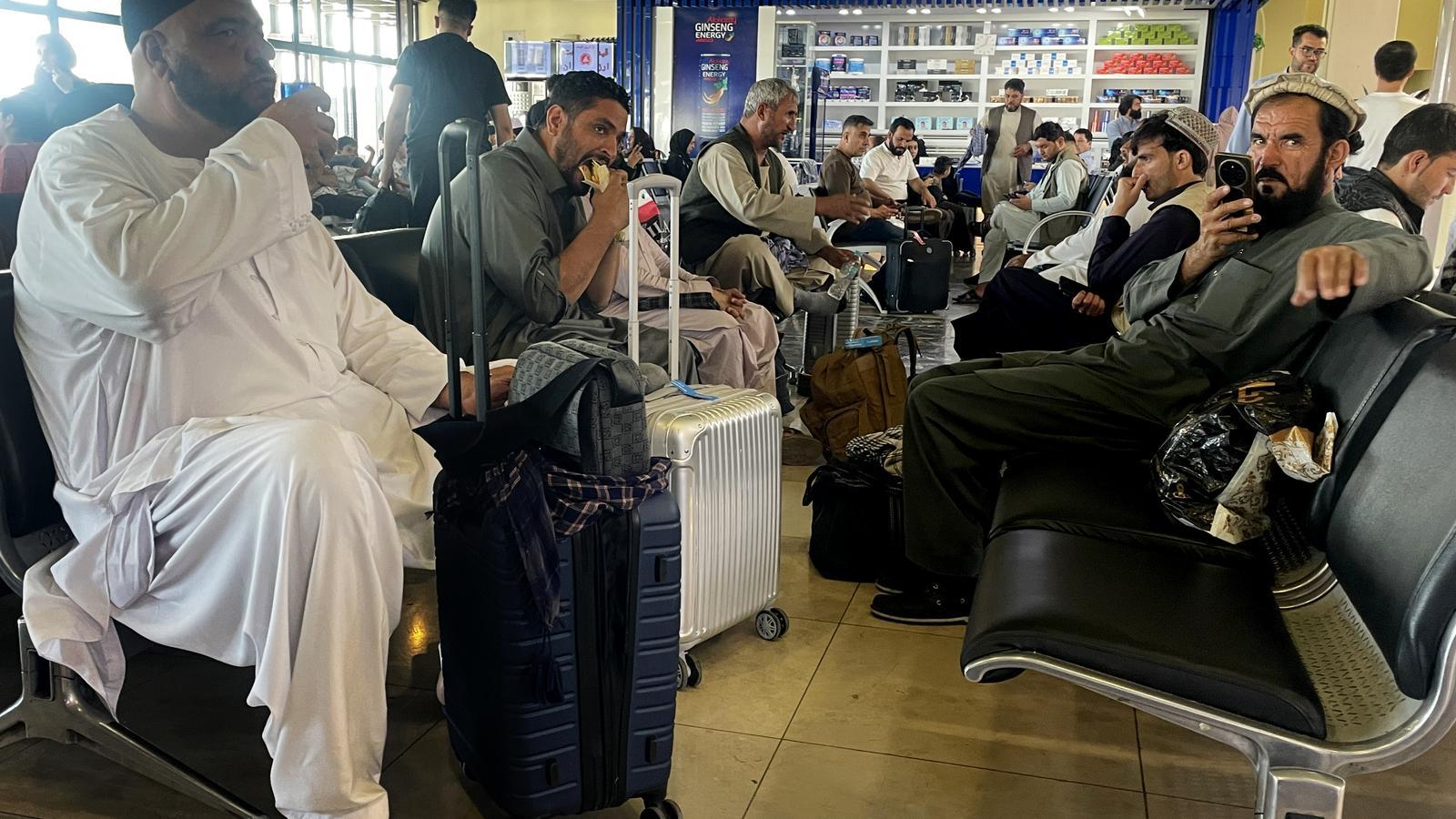
The departure hall for international flights at Kabul airport has also improved a lot: new shops with eye-catching souvenirs and traditional products have opened, and there is even a restaurant now. The logo of the Taliban Ministry of Transport is everywhere to make it clear that, even though the international community has not recognized the Taliban regime as the legitimate government of Afghanistan, they are the ones who govern the country and have the upper hand.
The majority of those waiting to board are men. Foreigners can be counted on the fingers of one hand, and two are Chinese. The few women waiting have their heads covered and, some, also part of their faces. Despite this, once they board and the plane takes off, most of them remove veils and masks, leaving their faces and hair exposed. They are already far from the Taliban yoke.
