Michael Ignatieff: "In some way, a world war is already underway"
Canadian writer, academic and ex-politician, winner of the 2024 Princess of Asturias Award for Social Sciences

-
CAT -
CAST
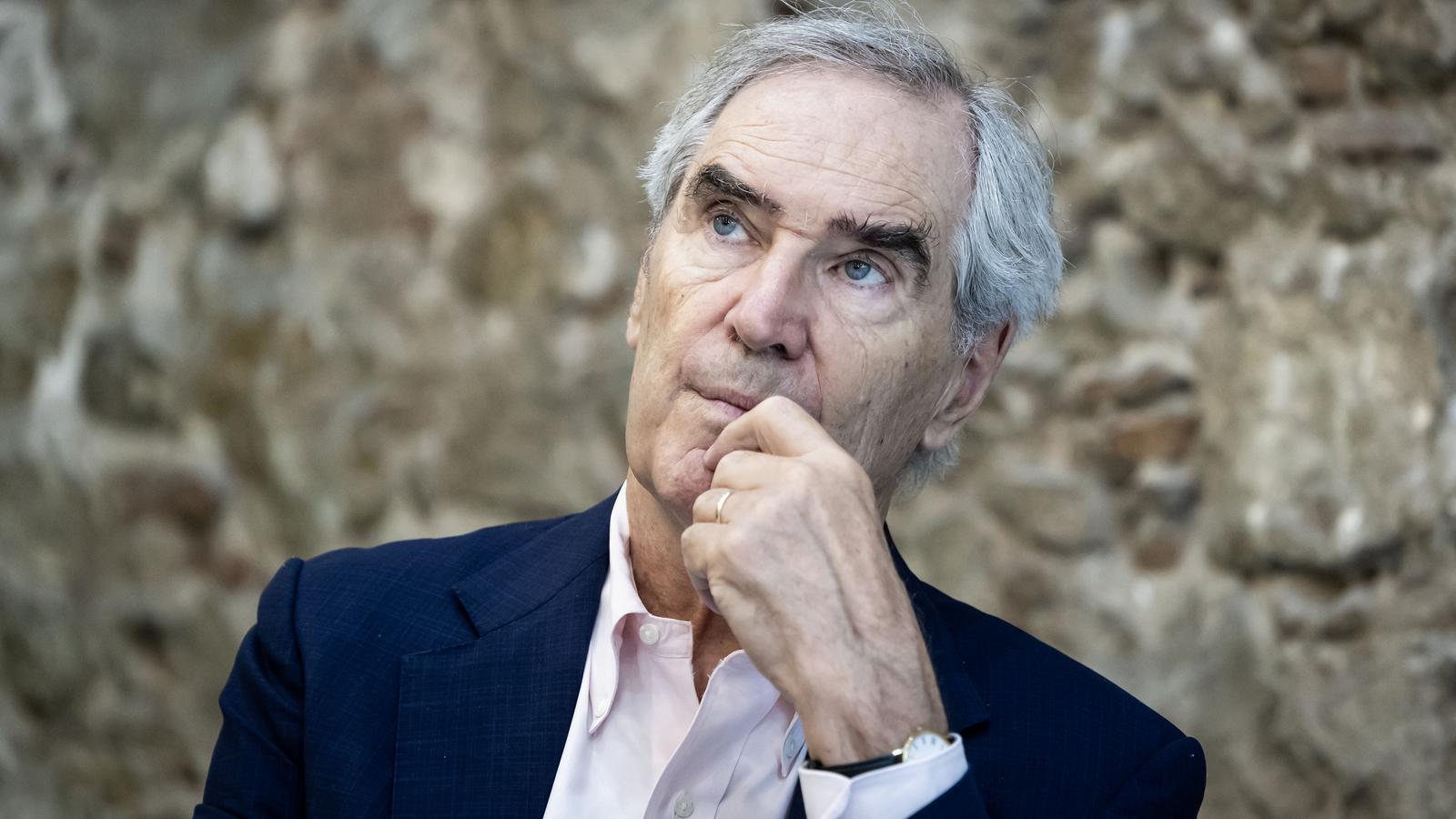
BarcelonaMichael Ignatieff (Toronto, 1947), an intellectual specializing in human rights and democracy, was also the leader of the Liberal Party of Canada, a country currently in vogue in Europe and threatened by Donald Trump. Winner of the 2024 Princess of Asturias Award for Social Sciences, he is also the author of an honest book about his failed stint in politics, Fire and Ashes. He has now been in Barcelona for the presentation of the Cidob International Yearbook. Ignatieff speaks clearly, highlighting the grave moment the international landscape is experiencing. And he insists on one idea: we must wake up.
We agree that democracy does not defend itself, that it needs citizens and institutions that defend it every day. What does this imply, concretely?
— It implies that people go out into the street. Let me give you an example. When the terrible and enormous terrorist attack was committed in the eighties in which they placed a bomb in a supermarket, I happened to be in Barcelona for the first time in my life. We left the station and ended up on the street, in the city center. Suddenly, a huge demonstration passed in front of us. Completely silent, with flags lowered. It was one of the most powerful demonstrations I have ever seen, and I have seen many. And I felt it conveyed a very powerful message: we oppose this. It took a long time, but finally, the terrorists lost the argument. Another example is in Minneapolis. ICE agents enter Minneapolis, terrorize and frighten newly arrived immigrants, and forcibly expel them. Then, citizens try to photograph what is happening to provide a public record, and two of them are murdered. And the city of Minneapolis says: "This must end." And they removed ICE from Minneapolis because the citizens said enough. These are two examples where peaceful public protest made a difference. And democracy depends on people not feeling powerless, but rather feeling that there is something they must do because what has happened is wrong.
Today, can democracy offer a future instead of just limiting itself to resisting its enemies?
— We are suffering a crisis of the future. We have had summers in which the temperature reached 42 degrees and fires spread, directly threatening our future. We have technology that has already taken off its mask. The threat of AI is here today, and we do not have national or international regimes to control AI. And I believe the third crisis is that democracies have trouble getting things done. We have so many veto points within the democratic system that it is often difficult for democracies to do difficult but necessary things. Sometimes money controls power in a way that makes us unable to do anything. And this is another crisis, which means we do not have a project. We are trying to make it to tomorrow morning instead of thinking about 2040 or 2050. Europe was the project for Europe, the construction of Europe, and now Europe is stalled. What now? Where is Europe going? Can it stay united? Can it face the AI challenge? Can it face the climate challenge?
Is Europe having a painful awakening to the limits of its global power?
— It has 5% of the world's computing capacity. It can do wonderful things in decarbonization, but if the Chinese continue to produce non-stop, this will not necessarily make the difference you need. If you want to be competitive in the AI battle, you must listen to Mario Draghi, who says that you cannot have 28 national banking systems, each defending its own banks. You must be able to pool capital so that Europe can do big and ambitious things together. This is not happening and the clock is ticking. And, right now, the veto points in the system are making it very difficult for the European project to move forward.
Let's talk about predators. Peter Thiel says that freedom and democracy are not compatible. Is this becoming the ideology of the tech elites?
— Yes. Well, Peter Thiel is wrong about many things and especially about this one. You don't like democracy? Spend some time, Peter, in China. Let's see if you like it... Spend some time in North Korea. Spend some time in Russia. Let's see how you find it there. And stop saying so much nonsense. I am tired of rich people giving me lessons when, in reality, they have no idea what they are talking about.

What role do you think the free press continues to have in protecting democracy when trust, truth, and the public sphere are under attack?
— I think the free press is too pessimistic in a way, but this is where I see a problem. Since I am a middle-class, educated person with an income, I spend $2,500 a year, maybe $3,000 a year, on paid journalism. And it is fantastically good. I mean thatthis is, in reality, the best information system in the history of the world. But it is elite journalism, and its financial viability depends on subscriptions. The problem is that then we have a whole other media world, which is simply the flow of digital data that reaches everyone for free, or that is basically financed by advertising. And part of this is a dangerous swamp.
Is it a dangerous swamp because there is no regulatory control?
— It is a world where the basic currency of democratic politics—"he said this and I agree or I do not agree with it"—has been compromised. We simply do not know what on earth we are reading in this media space that is not protected by subscriptions nor is it curated, and that is a danger to democracy. And problem number two, equally dangerous, is that the professional middle-class elites live in one digital world and most of the world lives in another. Therefore, there are two information worlds that have fewer and fewer points of contact. And part of this social hatred towards the elites is hatred of our informational privilege. And part of the hatred of the elites towards those below us is the informational privilege expressed like this: "These damn citizens do not know what they are talking about; I do, and they do not".
How can one defend immigration and secure borders at the same time?
— If we do not defend the need for secure borders, we cannot defend immigration. My formula is: high wall, wide gate. And not only a high wall and a wide gate, but also the repatriation of illegal immigrants when necessary. To send a message that says: do not play with the Spanish state, do not play with the Canadian state. We must have border security to maintain the legitimacy of a multicultural society. Without border control, you cannot do it. Trump was wrong about everything and I detest him, but to the extent that he stopped illegal border migration in the United States, he did the right thing. I am firmly in favor of migration. My father emigrated from Russia to Canada, and I am a beneficiary of migration. But you cannot maintain a multicultural society if people feel that Spain has lost control of its borders. And Ceuta conveys a feeling of loss of control. We must say two things that are interdependent: we want migration, but we want to control who comes, and we want to close the borders to illegal migration.
Do you believe that a Third World War is now a real possibility?
— In some way, a kind of world war is already underway.China is supporting Russia with essential technological components. Therefore, there is an alliance between the two predators to violate the sovereignty of a European state. Those are two powers. And then there are two more: North Korea is supplying troops and ammunition, and Iran is supplying drones. Therefore, you have four powers conspiring together to violate the sovereignty of Ukraine. And on the other side you have an alliance of 27 EU member states providing crucial budgetary support and military support to the other side, with the United States which, apart from weaponry, continues to provide intelligence for the targeting of Russian objectives. But look at what is happening here: NATO is providing intelligence and assistance to the Ukrainians, who are attacking targets, logistics centers, factories and airports of a state with nuclear weapons. This goes a bit further, and a moment could come when Putin says: "One more attack against a crucial Russian facility inside Russia, in which target selection has been provided by the Americans and the technology has been provided, let's say, by the British or the Germans, is an attack against the territory of Russia. And we will respond with a military attack against a NATO state". I do not want to alarm anyone, but that is where we are right now. I am one hundred percent in favor of European support for Ukrainian freedom, and so it must be, but we are very close to a real problem. And Europe is drastically underprepared if Putin goes further.
What is holding Putin back?
— The rules of deterrence are working. For example, there is a huge logistics hub in Poland, near the railway line to Ukraine, where military equipment for Ukraine is concentrated before being transported. Russia knows where it is and could attack this target, but it does not do so because NATO's deterrence is credible. The Russians cannot predict what we would do if they destroyed that ammunition depot. Therefore, deterrence works, but it had better work. In the Baltic countries, the Russians violate their airspace every day of the week. And every day of the week NATO scrambles jets to intercept them. You have seen the photographs and I have seen them too, with Russian planes ten feet—three meters—from a NATO plane. Imagine how easy it would be for those wingtips to touch and a Russian plane to fall. Russia could interpret that as the downing of a Russian plane. Therefore, we are very close to a really serious problem, and I believe the democratic public in the West, especially in Spain and Catalonia, does not really appreciate how close we are to the edge. And we need a lot of wisdom, and we need a few phone calls to Moscow saying: "We will resist your attempt to suppress Ukrainian freedom, but we do not want to start World War III". And we are on the threshold of World War III, if you then extend it to the Strait of Hormuz and all the other current flashpoints.
And China?
— It is crucially Chinese support for Putin that keeps him in the war. Therefore, this is not simply a battle between Russia and Ukraine; it is a global conflict that involves all the major military powers of the world, and we must understand it. And we must wake up.
Are we witnessing the decline of the American empire?
— Without a doubt, it seems so. When empires cause systemic damage to themselves, it is a warning sign. The self-inflicted damage here is tariffs that will not restore the American manufacturing industry, but rather destroy alliances. An empire that does not understand the value of alliances and the need to give and take within alliances is an empire that is losing power. Because the great strategic advantage of the United States in its battle with Russia and China has been the strength of its alliance systems in East Asia, in Europe, and its connections in Latin America. Trump has shattered all these relationships over the last two years. Therefore, this is self-inflicted damage that leads to imperial decline; there is no doubt about it.
What do Putin, Xi and Trump have in common? Perhaps vanity?
— Yes. It surprises me to what extent Trump admires raw power and cruelty. He envies the power of Putin, he envies the power of Xi, and that is not the right mentality. You would want an American president to think: "Democracy is a good thing, freedom is a good thing, and these men do not have that, while I do, and that is my strength." I believe that what we have not yet really assimilated is to what extent Trump is incompetent, the destruction he has caused to the American foreign policy system. He has weakened the State Department, he listens to no one, except opportunists and mediocrities who tell him what he wants to hear. And this is terribly dangerous, and it is producing one incompetent error after another. There must have been—and there were—many generals, many military personnel from the air forces, many CIA agents who would have told him: "Do you know, Mr. President, that 30% of the world's oil supply passes through the Strait of Hormuz? If you get into a shooting war with Iran, it will close the Strait of Hormuz, it will mine the Strait of Hormuz and, let me tell you, Mr. President, that solving this problem by military means is almost impossible." It is incredible. And that is why Canada, Europe and all these people must unite and try to assume that this—not only that the United States has become a predator, but that they are the worst type of predator, that is, an incompetent predator—is the world in which we live.
Why have United States citizens voted for Trump twice?
— One of the untold stories of United States international relations, of its alliance structures and its relationship with Europe, has been the slow disintegration of the domestic social base that supports the commitment to Europe and the world. And it is a very long story. I think that, in fact, it begins in Vietnam. 58,000 boys do not return home. And in households across the US people thought: "What the hell were we doing there? My son did not return. Why were we there?" And the feeling of futility was redoubled in Afghanistan. Some 4,000 or 5,000 Americans died there, some 150 Canadians too, and for what? It simply ended in a chaotic withdrawal, and that sank the Biden presidency and was one of the things that caused Trump to be elected. But it is a very deep issue. I think that what I would criticize the United States foreign policy leaders for, the liberal internationalist elite, of which I was a young member, is that we never paid attention to the erosion of the domestic social base that all this entailed. Meanwhile, our real wages are stagnating, our jobs are being sent abroad, our real incomes are not growing, the opportunities for our children are not increasing. The rich are getting richer and the poor are getting poorer. We are not moving forward, and this damn government is wasting our taxes trying to fix Iraq, Afghanistan, or some shitty place I can't find on a map.
