France repositions itself after the outburst of anger: "It is the sunset of Macronism"
The number of detainees in yesterday's protests rises to 1,800 and several mayors denounce "lack of means" to contain violent acts
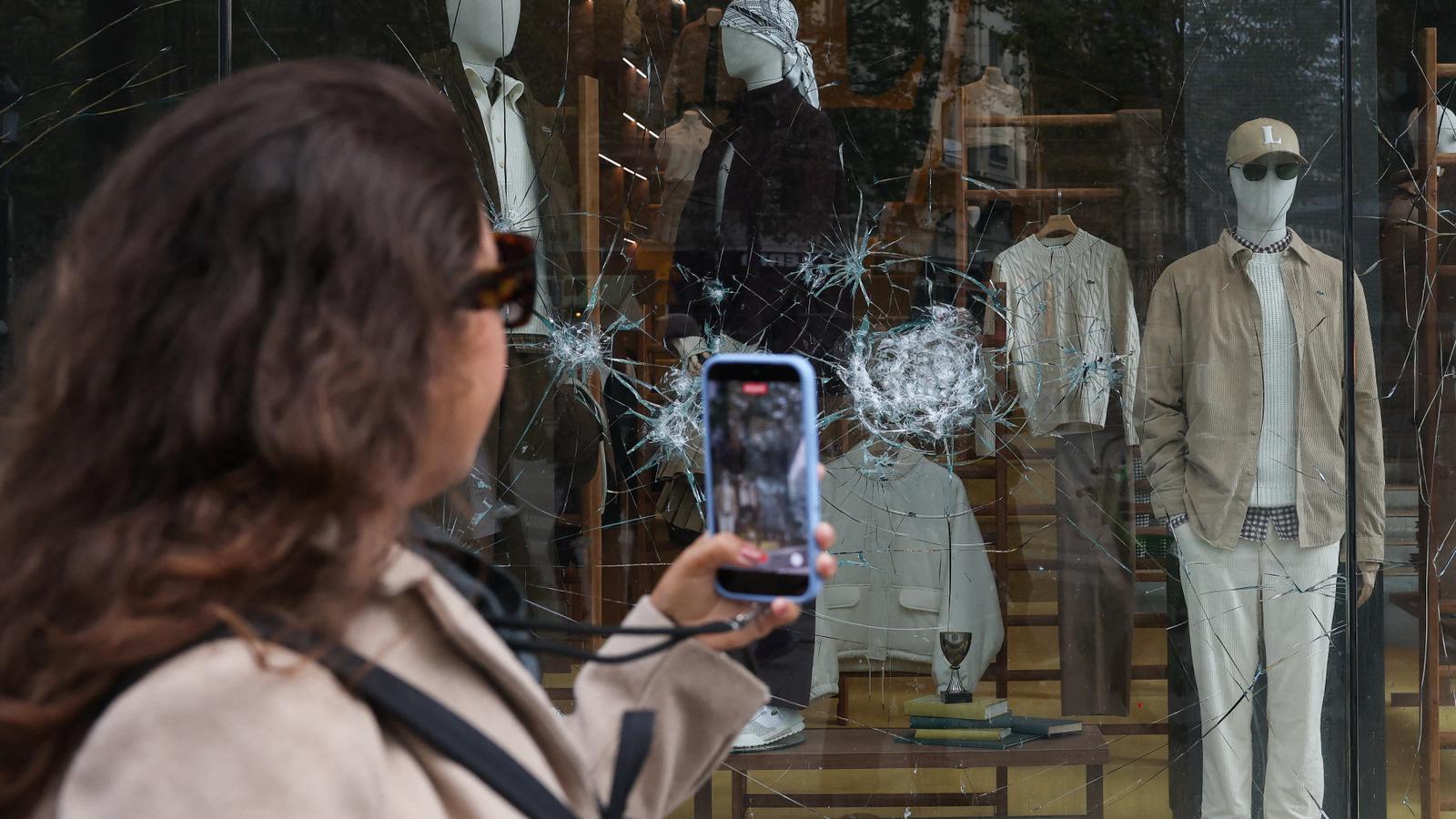
Barcelona"Law enforcement was overwhelmed yesterday". This is the assessment made this Sunday by the deputy mayor of Paris, Lamia El Aaraje, regarding the police response during this weekend's day of protests in the French capital. "There was a level of violence that I don't think we've ever seen before," she added. Between 550,000 and 800,000 people took to the streets this Saturday across France to protest against the rising cost of living, in protests where riots played a central role. Chaos spread to several cities in the country, with public buildings vandalized and shops looted, and the day of protests ended with 1,800 arrests nationwide.
The President of the Republic, Emmanuel Macron, has announced that he will address the French people at 8 p.m. this Sunday, while the Minister of the Interior, Laurent Núñez, has defended the police's actions. Agents have been under scrutiny for days for several episodes of violence against protesters in the student protests that have been going on for a month. During Saturday morning, several protesters complained in statements to the international press that the police were encircling and pushing back the gathered crowds almost before the protest began. A few hours later, in many parts of France, the situation changed completely, and it was the protesters who seemed to take control of the situation by burning urban furniture and throwing cobblestones and all kinds of objects. Faced with the scenes witnessed yesterday, several mayors denounced this Sunday a "lack of resources" to contain the violent acts.
The unrest of thousands of French people thus crystallized on the streets across the country. "We are taking to the streets to demonstrate to defend public services and all the social struggles we currently have open in France: do not touch the pension system, lower the price of gasoline, stop the elimination of hospital beds...", explains Adri to ARA, a young man who has participated in the student revolt of the last few weeks. He finished his studies a year ago and now works in the renewable energy sector, and like other people, he has joined the protests to show his rejection of Macronism's policies.

Thomas Piketty, a French economist specializing in economic inequality, stated yesterday in an article in Le Monde that the student revolt of the last few days marks "the twilight of Macronism". Yesterday, the protests were no longer just led by students. Thousands of workers and adults responded to the call originated on TikTok to protest against the rising cost of living in a demonstration that ended up being, as expected, an outburst of rage.
The levels of violence this Saturday have caused several leaders and political representatives to question the purpose of some scenes. Jean-Luc Mélenchon, leader of La France Insoumise, who in recent weeks has encouraged young people to protest, has distanced himself from gratuitous violence: "Those who share our struggle have nothing to do with vandalism and looting," he wrote on X, in a message in which he asks to avoid "actions that have no political meaning".

In Lyon, where protesters burned the tourist office yesterday, the mayor, Grégory Doucet, from the Green party, has requested "concrete responses at the highest level of the State", has shown himself to be "shocked by the violence" and has pointed to the polarization of French society as an element that has added fuel to the protests: "Every political expression feeds and accentuates this polarization, which hinders de-escalation and pacification", he stated.
"Permanent crisis"
A few days ago, the Prime Minister himself, Sébastien Lecornu, acknowledged that the country is going through a "permanent crisis". "Wars, uncertainty regarding purchasing power and inflation [...] It is evident that we are going through a moment of fatigue in the country. I perceive it deeply," he asserted. Facing this situation, Lecornu has promised reforms, but warns that they cannot all be immediate.
His executive is trapped in a dilemma similar to the one other European countries are facing: he promises more investment in public services and, at the same time, must meet the objectives for increasing military spending required by NATO, as well as, through an austerity budget, bring the fiscal deficit closer to the 3% limit set by the European Union. And all of this is taking place with only a few months left until the presidential elections, with Marine Le Pen's far-right leading the polls and the alternative left of La France Insoumise on the rise in the surveys.
