Via Veneto, the restaurant that has an emblem: warm luxury
We discover the inner workings that explain the way of working of the front-of-house and kitchen team of the restaurant on Ganduxer street in Barcelona

-
CAT -
CAST
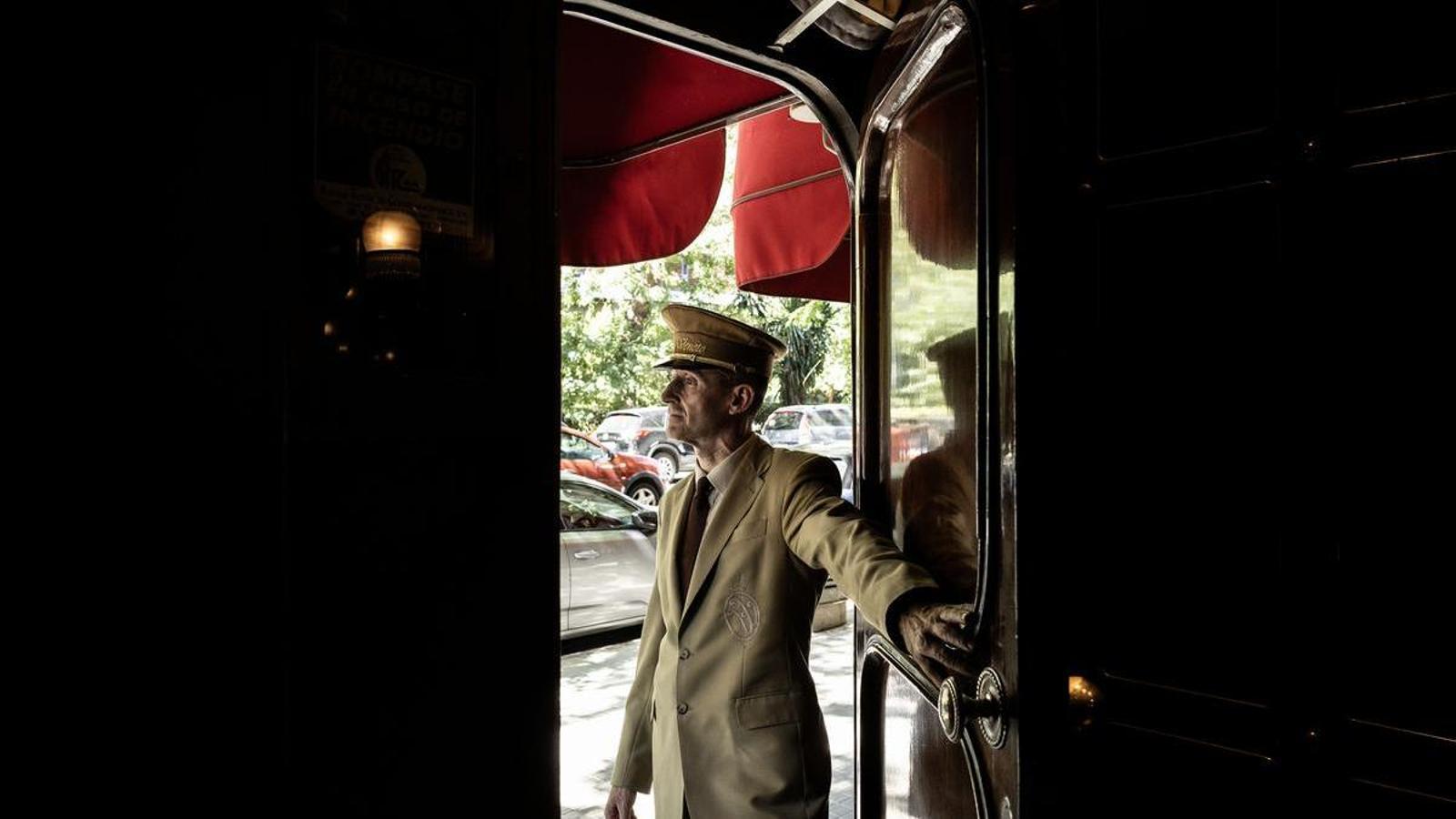
BarcelonaLet's start with a comparison. The feeling of a diner stepping onto the red floral carpet of the Via Veneto restaurant in Barcelona (c. Ganduxer, 10) must be similar to what a football player feels when entering a historic stadium. Respect. And it is not because of the bellhop who took our coat and opened the door for us, Carlos Fernández. It is not because of the carpet, always spotless. It is not because of the greeting we will receive from the manager, Pere Monje, who will lead us to our table. Nor because of Xavier Regàs's modernist decoration, with that elliptical glass that allows one to observe who is in the dining room from the lobby. Nor because of the elegant white curtains with ruffles in the room. It is not just because of all that. It is because we find ourselves in a unique place, where fifty people work who seek to serve hours of happiness with the finest tableware, those that are not measured by a clock. Seated at one of the tables, with the waiters and maîtres dressed in tuxedos, we will forget the coordinates of space and time. You enter Via Veneto thinking about your daily chores, and you leave grateful to life for the hours spent. In between, there is a family of owners and a team that we have interviewed so they can explain the inner workings of a restaurant that will turn sixty years old next year.

“We don't have a no in our vocabulary,” explains Pere Monje, son of Josep Monje, the owning family. When you have a vocation for service, you don't deny anyone anything, so if someone goes there to eat and there isn't a dish on the menu that appeals to them for whatever reason, David Andrés, the chef at Via Veneto, asks them what they would like. “We encounter clients who are traveling, and who, after eating away from home for many days, ask us for an omelet on a plate, because they find it to be the most comforting thing,” explains Pere Monje. So they will make it for them even if it is not written on the menu or the tasting menu. And whoever says an omelet, also says steamed vegetables or a consommé. The exact opposite can also happen. Someone who wants to eat a very special dish, which is part of fine cuisine, such as lobster Thermidor, which consists of removing the meat from the shellfish shell and mixing it with a sauce made with béchamel, mustard, brandy, and grated cheese, so that it can then be gratinated in the oven. “A client asked us for it in advance, and we experienced it with excitement because it allowed us to get involved in what made them happy, a lobster Thermidor, and we were able to serve it to them,” continues Monje.With the principles of the Catalan inn
For the owning family, never refusing any request from clients is to recover the spirit of the Catalan inn, where people stopped to eat and sleep. “We feel like heirs to it and we are delighted; furthermore, we believe we live in a world that seeks standardization, but Via Veneto is not like that”. Pere Monje also alludes to an English word, very much in vogue, to refer to the service they offer, which is hospitality, hospitality. That is to say, Via Veneto makes you feel at home with a warm luxury.We have described two unique requests, an omelette on a plate and a Lobster Thermidor, which, observed in perspective, one might think were not that difficult to make in a restaurant dedicated to cooking. Well, let's add another one. During Holy Week, specifically on Good Friday, a group of people asked them if they could go to dinner at Via Veneto at three in the morning, the time when their prayers for the death of Jesus would have ended. You read that right. At three in the morning. “It was a special request from a large group of people, and we understood that, for them, it was a special and important night, so we accepted it, and we opened the restaurant at three in the morning to offer them dinner.” At this point, faced with the disbelief in the eyes of the person writing these lines, Josep Monje, father of Pere Monje, asserts that they work to fulfill the wishes expressed by their clients. “When Salvador Dalí came to eat here, he would ask me for polvorones from Estepa, and I didn't think twice; I called the mayor of Estepa and, by train, they sent them to me, so the day he returned, as soon as he asked for them, I brought them to him.” We can imagine the joy the surrealist artist must have felt. The same joy he felt when he asked for raw sausages to make necklaces for the friends who accompanied him to the restaurant. But we are not here to remember Dalí as if he were a special client of Via Veneto, because for the team and the Monje family, everyone is. If Dalí asked for sausages and polvorones from Estepa, there are other clients who ask them for meat from the Vall Fosca or a specific French Armagnac. “We go buy them and bring them to offer them when they come to eat,” says Pere.

Another phrase from the restaurant's philosophy is that of responsibility. They feel responsible for the service they offer to customers. Also for their cars. "One evening, it must have been in the early 2000s, a customer came who parked in a double row on Diagonal, entered the restaurant, and from the door we saw how the tow truck took his car away." During dinner, the team managed to pay the fine and recover the car, so that when he left, nothing would have happened. Today he perhaps still does not know that that night the Monje family recovered his car from the municipal vehicle depot. Nobody told him because the dinner had to end as it had to end: by returning to sit in his car.And from responsibility we move on to anticipation. The dining room and kitchen team, which meets punctually every day at twelve noon to review the reservations they have for the day, anticipates the requests the clients will make. They know that there are some who like certain specific dishes, which they don't always have planned on the à la carte menu or the tasting menu. By studying the reservations, they decide to prepare them. They anticipate them, but they also take a chance, because there have been days when clients haven't told them about the dish they always like. "It happens to us with the escudella, which we prepare because we know there are specific clients who like it a lot, but there have been days when we've found that they told us they didn't feel like it," comments Pere Monje. It is a risk they assume, which they define as part of the job, and they prefer to have it done just in case rather than not have it. They won't throw away that cooked dish even if the client who always asks for it didn't want it that day. "Our desire is to always offer a service, and when you understand this vocation, anticipation works well," says Pere Monje, who adds that Via Veneto is "a restaurant where you can go to eat every day for a long time and you won't always eat the same thing." For this reason, there are groups that make weekly or monthly reservations. "For years, we have had a group of business people who come once a month, and we have never repeated a single dish for them; they value our effort, and we enjoy it, because it is what we are always looking for, not to standardize the lived experience."
Since Via Veneto is a restaurant for its customers, what it achieves is to build their loyalty. And it does so with dishes that always surprise, and that are based on the season and the produce, and with a dining room team that the customer considers part of their environment. “They often see us at an important moment in their lives, and then a dialogue begins that continues meal after meal,” says Pere Monje, who is grateful when customers ask him about his father. So much so that Pere claims he does not remember what he has eaten throughout the day, but, on the other hand, he would know how to say what the tables he has served have tasted and the circumstances they have experienced. “I like customers to feel the dining room is their own, which is why we know the preferences of the tables.” Sitting in one's favorite spot is one more way to feel at home, with that idea of warm luxury.The restaurant's other door
We continue with the inner workings of Via Veneto. It is a restaurant where people go to be seen. It is that whole "people watching people" thing, which means you go there to be seen so that everyone knows you are where you are supposed to be, just as it must have been done in the Roman agoras, but sometimes you might not feel like being seen. Or you might not feel like sitting next to someone else. A restaurant that seeks to make its customers feel good, which is exactly how protocol is explained, would never seat anyone next to opposing sports or professional management. "We take note of allergies, preferences, intolerances, and also other circumstances," comments Pere Monje, who adds that he appreciates it when a client trusts him enough to share a complaint. "We thank them and we will resolve it; a resolved complaint can add value and build customer loyalty." With sixty years of history, however, the Monje family and their dining room team, led by Javier Oliveira and José Martínez, know their guests who book a table well, and therefore they think about their well-being in every sense. If they know that someone the client does not want to see is sitting in the main dining room, they will take them to another room, all with different names, such as the blue, the golden, or the rose room. It may also be that someone does not want to be seen, that they want to go unnoticed (for whatever reason), they will not have a problem. The restaurant has another door, which is not the one on Ganduxer Street, through which they can enter and go directly to a lounge without anyone having seen them. Probably because of this good distribution of spaces, lounges, and doors, Via Veneto is one of the restaurants chosen by celebrities or those who lead parallel lives. And we should not imagine this labyrinth of doors and lounges for not being seen as an exceptional event, but rather an almost daily one. They will never tell.

To finish, the last piece of inside information. Perhaps it is not the most surprising, but it is the one that best describes what the kitchen and dining room team is like. Internally, the team addresses each other formally, especially the dining room staff with the owners and the kitchen staff when they step into the dining room. “When I joined, this practice was already in place, and we have kept it,” points out Pere Monje. Addressing each other formally among colleagues is not seen as an anachronism between the interlocutors, but rather as the distance required for everything to go well. “Our work has pressure and nerves at specific moments; addressing each other formally when we are in those moments forces us to always maintain a safety distance, a limit we do not cross,” says Pere Monje. And in this sense, Manuel Carreras Fisas, author of the Macarfi guide, explains that it is one of the values he highlights about the establishment, this formal way of addressing each other, which is not an old-fashioned way of speaking but a gesture of politeness. There is one word that also explains why the Monje family and the dining room team (especially) address each other formally: respect. It is the word that explains the devotion and vocation for the craft. The same sentiment that a football player probably feels when stepping onto a historic football pitch. Respect because we have entered a unique place.
