Josep Anton Vendrell: "There are winegrowers who are selling grapes at 12 cents per kilo to not lose the harvest"
President of the Association of Penedès Winegrowers

-
CAT -
CAST
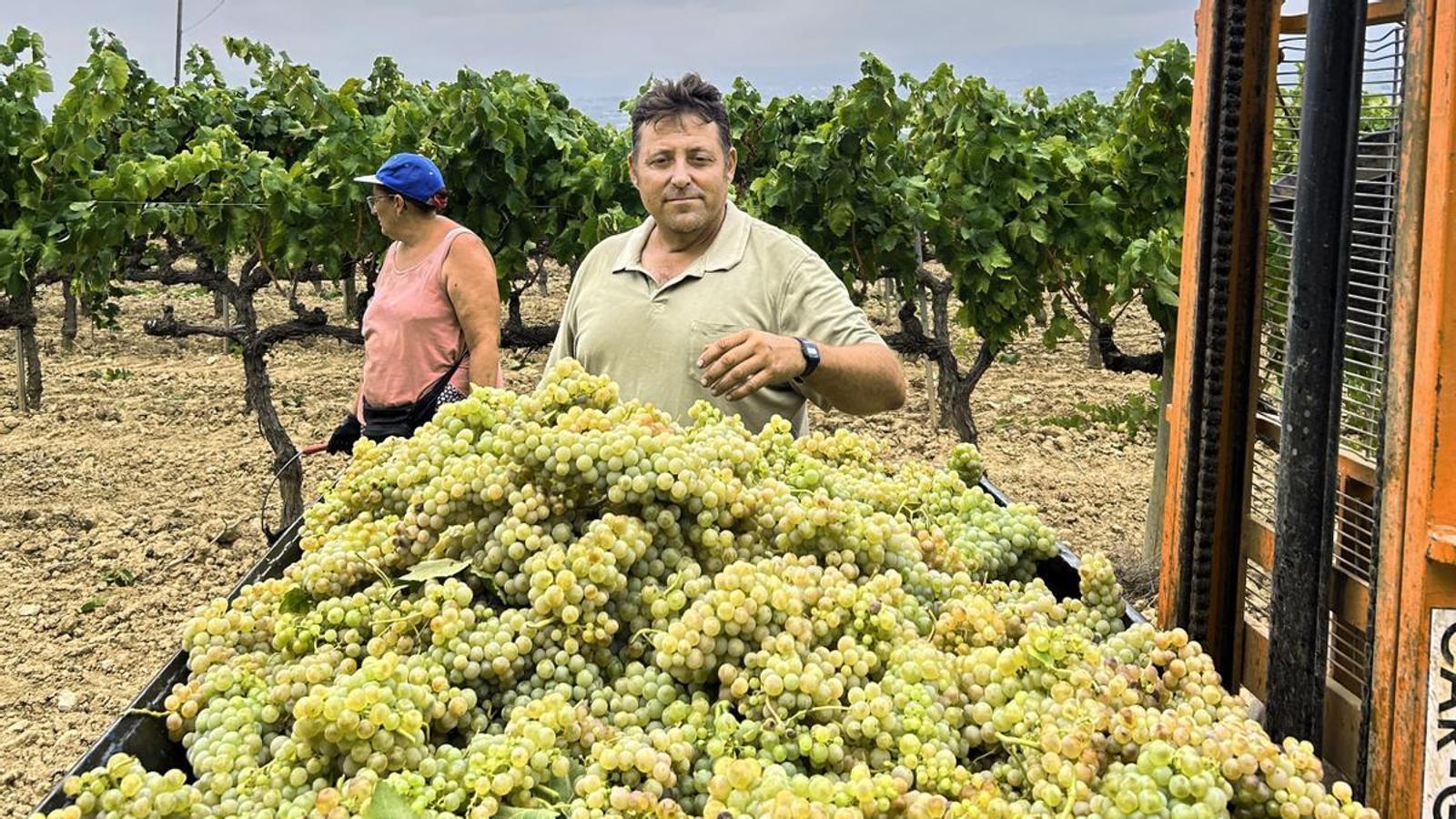
ClimbersWe interview Josep Anton Vendrell (Subirats, 1974), winegrower and president of the Association of Winegrowers of Penedès, at his estate, owned by the family since 1374, Masia La Bardera, in Subirats. From the macabeu vineyards he harvests, there is a privileged view of the countryside with Montserrat in the background. He tells me to observe it well because this green landscape could be lost one day. This year, the farmers are crying out to the heavens against the abusive prices they are being charged for the kilo of harvested grapes. They have been doing this for years, but this year they consider that the three press releases issued by the DO Cava have angered them.

The DO Cava issued a statement on August 5th saying that the harvest forecast would be very good.
— And he also assured that he would inject, that was the verb, one hundred million euros to the six thousand winegrowers of the DO Cava. The letter only mentioned the municipalities of the DO Cava of Catalonia. Do you know what happened? That the fellow farmers from Almendralejo, Requena and Logroño called me and asked how we had managed to get the subsidies that they would not receive.
Therefore, the statement should have included all municipalities of the DO Cava, including regions outside of Catalonia.
— Of course, I already told them that we did not receive any subsidy, that these figures must have been for the entire DO Cava, which is Spanish. And besides, we say more things, because we assume it is the value of the grape harvest of the DO Cava, and we check that if we harvest 200 million kilos of grapes, with the injection of 100 million euros that the DO Cava was talking about, it turns out that they would pay us 0.50 euros per kilo.
This year's forecast for the DO Cava is around 300 million kilograms, according to an agricultural group and the DO Cava itself.
— Our forecast is 230 million, with an excess in last year's sales of 40 million kilos. So, let's do the math again. Since the forecast is this, if we divide it by the famous 100 million from the DO Cava statement, we find that the figure per kilo of grapes is 0.43 euros.
The DO Cava assured in its statement that they would maintain last year's prices.
— We have it. If for us, with our operations, it turns out that we should be paid 0.43, and they say they are keeping the prices, then what they pay us is between 0.12, 0.25 and 0.40. Twenty years ago, winegrowers sold grapes to the DO Cava at the same price.
Currently, your associate colleagues must have already told you at what prices they are selling the grapes.
— Yes, I know them. The official prices from producing wineries are between 0.25 and 0.30 euros in four wineries, those that produce millions of bottles. There are grape growers who are selling their grapes for 12 cents to avoid losing the harvest.
Can they be denied?
— What is the alternative? Let the grapes spoil in the vineyard? Psychologically, it is very hard to let the grapes go to waste, because we have been taking care of them all year. Now we cannot let them rot and dry out, because it is the effort of a whole year. I admit that we winemakers are a strange collective. If we were economists, there would be no winemakers left. Look at us: here we live in the farmhouse, surrounded by vineyards. It is our life. My three children, as babies, slept among the vines while we harvested. We love the land.
Is it true that there have been wineries that at the last minute told you they weren't buying grapes?
— Agreed. Twenty-four hours before harvesting it, with the contract made, they called us and told us they don't want it. This is what is currently happening. They make excuses that can be incorporated into the contract so that they get their way.

What excuse?
— We have been told that the vines had shoots, that if true it would not affect production, quality, or anything. If the vines have shoots, it is only more work to prune them; nothing more. The quality of this year's grapes is unbeatable. This year we have exceptional grapes.
I'm back with the contract that you tell me the wineries are breaking twenty-four hours in advance. Can the winegrowers not report it?
— How do you want us to do it? We are tied. If we report them, next year we won't be able to sell them the grapes.
What else does the contract that the wineries make you sign say when they do buy your grapes?
— It says that we sell the grapes above the production cost of each winemaker.
How?
— The contract we sign has abusive clauses that ensure we are selling the grapes above the cost price. And we sign it because, if not, we lose the grapes, we don't sell them. If the contract were to be signed in January, we would have six months to plan the expense to increase the harvest or negotiate the price, but they give us the documents days before the harvest, and you don't have time because, if not, the harvest is lost.
Which wineries include this clause?
— Many. I must say that the two large wineries, Freixenet and Codorníu, make triennial and biennial contracts, and they are fulfilling them. Freixenet makes a triennial contract with us, according to which last year they paid us 0.50; this year, 0.55 and next year, 0.60. At Codorníu, the contract is biennial, and for both years they have maintained the price for us, which is between 0.51 and 0.59. The price varies depending on whether it is 'guarda' or 'guarda superior'. Another winery, Vallformosa: they maintain last year's prices, but buy 30% less grapes, therefore, if they buy 70% of what they bought last year from us, it comes out to about 0.38. Now, they can say that this year they pay the kilo of grapes at 0.49, hand-picked; and 0.47, machine-picked, but we know that the reality is that they buy 30% less grapes from us than last year and, therefore, the reality of the data is another. All these figures I give refer to the three major varieties of Penedès, macabeu, xarel·lo, and parellada.
Do you bring grapes to Corpinnat?
— Yes, I have brought some, because my grapes are organic, hand-picked, and they pay very well for them. The minimum they pay is 0.94, but it's a minority market. Corpinnat producers have their own vineyards; most of them are self-sufficient, they don't need us. Corpinnats and superior aged cavas are a limited segment of the market because the population, in general, cannot afford to pay 20 euros for a bottle of bubbles. They are the tip of the pyramid, of great value, but at the base are the products that most people can buy, the large volume, and that doesn't mean they should have rock-bottom prices. The other day, they sent me a photo of a shop in Japan where a bottle of cava made in our area was being sold for 1.35.
What price should a bottle of cava, one of these large ones you mention, have for the farmer to make ends meet?
— Six euros. From six euros we can talk about it so that the whole chain is sustainable and everyone can make a living.
In the market there are cava bottles for under six euros.
— They have been below six euros for many years. In addition, you have to add that the number of bottles has decreased. Freixenet removed millions of bottles from the market due to a market decision.
The DO Cava has many proposals to face the times to come, as well as climate change.
— Some are not acceptable. During the electoral period, Marta Vidal's candidacy said they could accept reducing the aging months for cava. Going from the current nine months to fewer. Currently, there are already wineries that release cavas onto the market after eight months and one day, which technically is already nine months. Well now, they say fewer months. I myself have informed the Ministry of Agriculture that there are wineries producing more bottles than their own production capacity.
And what did the Ministry tell you?
— They are responding that they are controlling it, which means they are aware of it. Since no one else is saying anything, because as I said we are tied, then it is being done.
How do you see the future?
— Bubbles have a great future worldwide. In Penedès, we have a dry land territory that has no cultivation alternative. We want to work to have succession and continue investing in the territory. We are not asking for the minimum 0.94 that Corpinnat pays, which we would like; we are asking for a minimum of 0.60 per kilogram harvested.
You have a board member of the winegrowers' association on the board of the DO Cava, you will be able to work to achieve it.
— Did you know that the colleague you mention, Juan Colomer, didn't even find out about the press releases issued by DO Cava? He didn't know until I told him. And what's more, as vice-president there's another winegrower, David Sendra, from Unió de Pagesos. And yet another, Fernando Medina, from Requena. And with three winegrowers on the board, DO Cava issues three press releases that do not reflect the reality of the sector or of DO Cava.
