The rigatoni that are the most requested dish in the history of Hotel Almadraba in Roses
The cook Jaume Subirós learned to make them in the city of Lugano (Switzerland), and has immortalized them in the Empordà establishment, facing the sea

-
CAT -
CAST
RosesIt's Monday at noon, and on the terrace of the dining room of Hotel Almadraba in Roses, the wooden cart with wheels where rigatoni, the iconic dish, is prepared, moves from one table to another. Perhaps it is one of the most well-known dishes of the Subirós family, or perhaps it is because everyone wants to watch their dish being prepared in front of them. If one table orders it, be sure that the ones next to it will too. "It all started in the city of Lugano, in Switzerland, on the trips my father made with the Almadraba team to work in the winter," recalls Lluís Subirós, the youngest son, who says he must have been nine or ten years old when the Almadraba cooks went there.
Jaume Subirós saw it made in the Swiss city, and upon his return, he made it his own. In forty-seven years of work between the Motel and the Almadraba, it's clear that there are many dishes of his making. And rigatoni are one of them. With an added success: "It's a generational dish, which appeals to both young and old at the same table," explains Lluís. For him, as well as for David Huguet, the head waiter, and for the waiters, the preparation offers a moment of calm to interact with the clients: "We can talk to them on a personal level, because the dish allows us to ask them how they like it spicy, whether a little or a lot, and it's a way to converse," adds Lluís. He himself remembers the time when they made the dish in the restaurant dining room and not on the terrace. Back then, the smell of the dish, which included sofrito, garlic and parsley, and chili pepper, reached the reception through the air conditioning, and from there many clients would already make their reservation for lunch or dinner. "It's the dish we've made the most of all since the eighties; more than rice," comments Lluís.
Sauces, essential
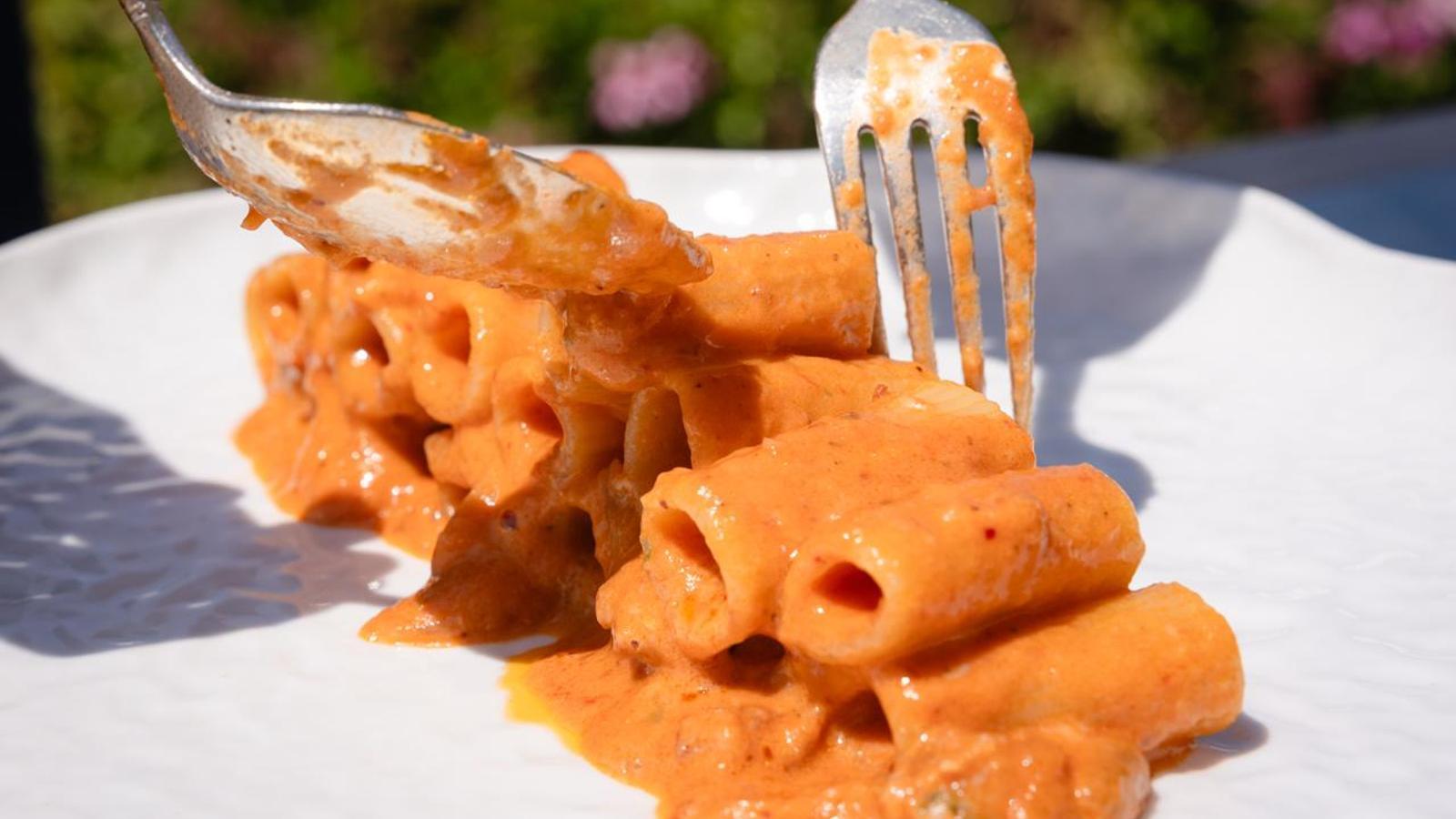
And how do they make them exactly? For starters, they boil the rigatoni al dente in the kitchen. Then, at low temperature, they prepare the all'amatriciana sauce, that is, fried tomatoes with bacon, parmesan cheese, and black pepper, in the Almadrava version. Jaume Subirós points out that they prepare it every day at eight in the morning. Afterwards, on the terrace overlooking the bay of Roses, the waiters prepare four extra sauces as accompaniments that contain the following ingredients as a base: garlic, parsley, chili pepper, and cream. Also butter. They can add more or less of each according to taste. There is still one more ingredient, which is orujo, the splash of orujo they throw in to flambé all the rigatoni. This is also the signal that marks the synchrony with the rest of the dishes that the diners have ordered: “Just when I flambé the rigatoni is when the waiters who see me do it press a button on the small table connected to the kitchen, so that the dishes the diners have ordered start coming out”. Regarding the orujo they consume, he adds: “The winery that serves it to us, in Galicia, tells us that we are the ones who buy the most, and it may well be because we know how many rigatoni we prepare each season,” comments Lluís Subirós.

With the dish made, the anecdotes begin. Lluís recalls the first day he prepared them. He must have been nineteen years old, and he made them for Lluís from the restaurant Els Pescadors. He had each of my older brothers beside me guiding me. Fortunately, it turned out well, but he felt the pressure of the first rigatoni well. In recent years, the dish has been refined, he assures. They have changed the tableware they serve it with, which is from La Bisbal, the way they plate the rigatoni, in the shape of castles one on top of the other; and they have added a sample of the sauces on the side. “It is a dish that I also really like to eat, and it is at night when they ask for it the most.”
And almost always at night, when demand is highest, they have to adapt to the weather conditions. We are in Empordà, the tramuntana can blow, and the stove on the wooden cart must have a constant flame for the dish to finish cooking in front of the diner. “We have designed the cart to open the carburetor and have a flame if the tramuntana or the garbí blow; we have strategies planned to be able to avoid the wind, because it is clear that the most spectacular is the flame we make with the orujo.”
Rigatoni are not the only dish they prepare in front of the diner: they also make steak tartare, crêpes Suzette, and all this with only two carts. “It requires good management of the kitchen and dining room team when so many dishes are requested that require a single waiter in front of the diner.” They have calculated the minutes needed for each dish. Even with strong tramuntana, then the rigatoni will need eight and a half minutes.
To finish, about the carts that move up and down the dining room of Almadraba there is a beautiful story, linked with artisans from Figueres. The first carts were made by the carpenter Sayó, and he made them for Josep Mercader. “After years it broke inside and we commissioned two new ones from the grandson of the same carpenter,” says Lluís Subirós, who comments that they are robust; they withstand the comings and goings well.
Memories of Lugano
Jaume Subirós recalls that in winter, with the team, he would take business trips to work in restaurants in Switzerland. "We would let our clients know they could find us there when the Almadraba closed," he says. This was in the late 70s, 80s, 90s, and up to the early 2000s. They would spend three weeks in one restaurant; three weeks in another. In Switzerland, they cooked Almadraba's dishes, and the team was happy because they worked in January and February, when the hotel in Roses was closed. "It helped us motivate the staff, and also to see new things that we wouldn't have seen if we had stayed home." It was during one of these stays in Switzerland, in Lugano, at the Gambrinus restaurant, that they saw the dish being made. It was 1981, and the following summer, in 1982, they prepared it at the Almadraba, filtered through Jaume Subirós. "At Gambrinus, which has since closed, they prepared it with grappa; I preferred orujo," points out Jaume Subirós, who assures that what he liked most was being able to make it in front of people. "The rigatoni are also more subtle, the sauce is delicious, and children can eat it because the alcohol evaporates when we flambé it."
