Montse Molla Comas: "The name 'red wine' is from the Franco era, when they didn't like to say 'vinos rojos', but in Calonge we have always called it 'vi vermell'"
Oenologist
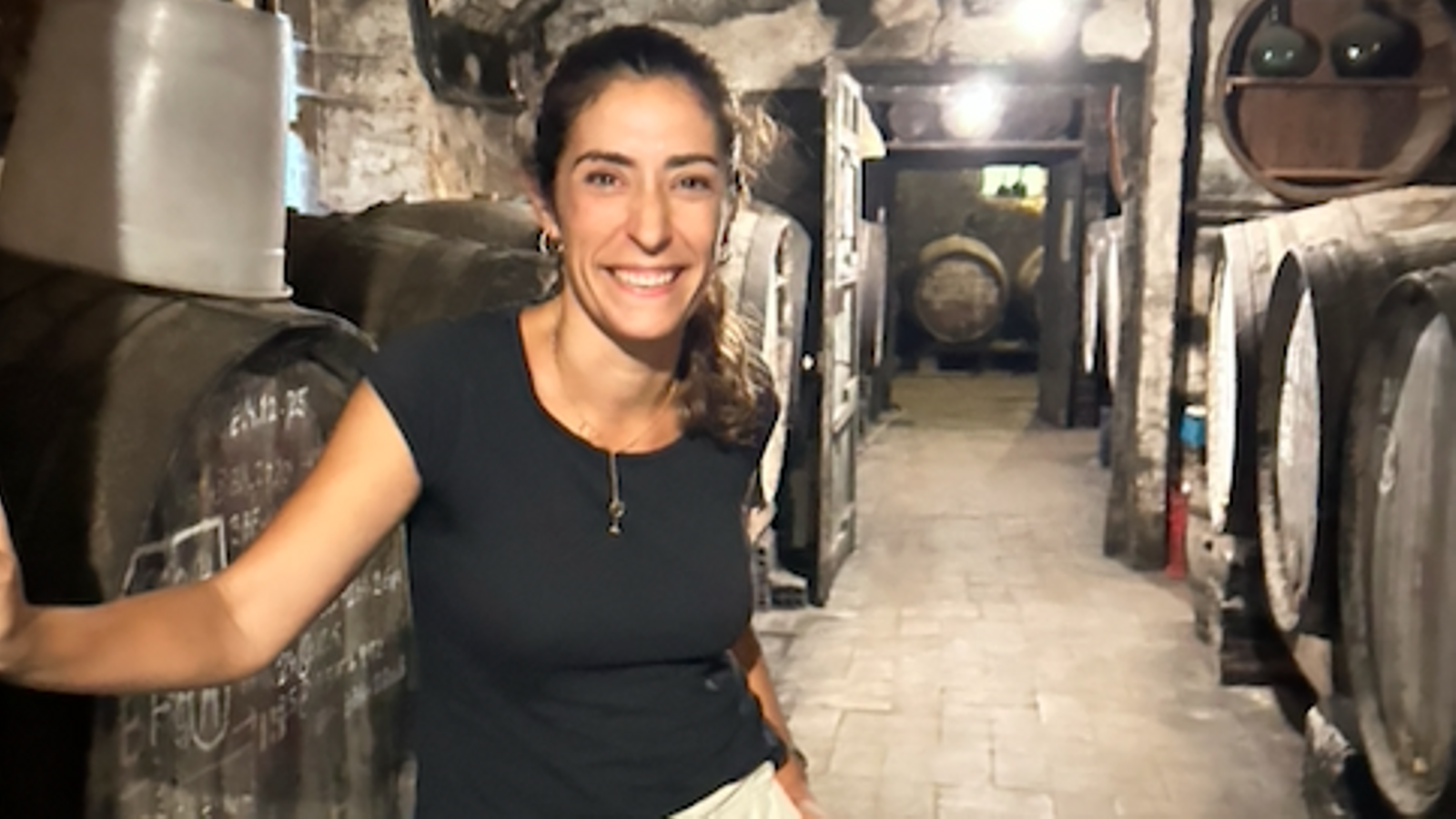

CalongeI interview Montse Molla at the family farmhouse, at Mas Molla, in Calonge. She is harvesting claudia plums and, soon, grapes, now at the end of August. They have given a guided tour to a group of Dutch people that ends with tastings, which her mother has prepared. At Mas Molla, everything is running smoothly and they are calm after the scare they had at the beginning of July. The Gavarres fire made them suffer like never before. They saw it start themselves, the three sisters, while they were picking peaches. Montse's sister, Núria Molla, went viral with a video that 3Cat broadcast in which she explained that “the Gavarres are a powder keg, that everything is dry and abandoned, that it is a shame”. She also asked that we change our way of life, that we must live like our grandparents, simply.

Has lived in Mas Molla de Calonge your whole family?
— The oldest document we have is from 1338, meaning we go back to the Late Middle Ages, with the relative Arnau Molla de la Riera. They were remença peasants, which means they were not landowners, but rather used the land and had to pay a portion of it to the lord. Specifically, we depended on the cathedral of Girona.
Is there a moment when everything changes?
— Our ancestor fought in the War of the Remences to change this situation. We know this because the document of the revolt is preserved in the Girona archive, and he appears there as a rebel. The Remences were the first syndicalist organization, and the archive document is a World Heritage Site. The war changed the established order and the way of organizing; it ended in 1458 with the arbitral sentence of Guadalupe, which gave freedom to the peasants to work and sell their products. We know of other farmhouses that have not remained in our family's hands; ours has. We continue to be farmers here and we continue to do direct sales.
What do you sell at the farm?
— Fruit: cherries, apricots, peaches, and now a Claudia prune. With the grapes from the vineyards, we make natural wines. Look, over there you see our press. We harvest the grapes. We have old, Catalan varieties that are little known.
Now what?
— These are names you may not have heard of. We have aveller grape, ximoi, picapoll, moscatell, beba, black moscatell, roig, molí. The black moscatell we have is very special. We conducted a genetic study with the Rovira i Virgili University and the University of La Rioja and identified a total of fifty-six different varieties, fifteen of which are unique. We are therefore talking about enormous biodiversity.

Why do you think it happened?
— Because we have always stayed at the farmhouse, because we have always done the same activity as our ancestors. We have not entered any designation of origin, no one has told us that we had to uproot vines, nor have they recommended that we plant any others to have more quality. We have continued doing what our grandparents did.
Do you know how great-grandparents and grandparents worked the vineyard?
— They took the best-adapted plants and grafted them again. They made an intuitive selection: they reproduced the prettiest vines again. So when we talk about our xarel·lo, we are talking about a xarel·lo that is two hundred or three hundred years old. Think that Mas Molla is seven hundred years old! We haven't had to go to the nurseries to buy vines, because we have had them forever.

At the farm, we make natural wines.
— I studied enology and learned to make a technically perfect wine. You learn to control it, to know what is happening at all times, to intervene if necessary. On the other hand, I am doing the exact opposite of what they taught me. Wines are made in an interventionist way, in the sense that everything is controlled, and what is not liked is adjusted. Then, the result is perfect, by-the-book wines that go on the international market. I know how to do all that, but at home we want to do the exact opposite.
How is natural wine made?
— We pick the grapes. You see we have the vineyards next to our house; we press them, put the must into the demijohns, and once it is there, it ferments spontaneously. I don't control the yeast, which is the first thing they taught us in enology school. In our studies they taught us to add sulfites, to inoculate a yeast. We put it in the demijohns and the must ferments on its own.
The wine is made in the sun, then?
— Yes. I have the temperature controlled, the bungs, I have no need to complicate my life. If I have a yeast that naturally self-selects and works well for me and makes good wines, why should I do it any other way? If it had gone wrong, I would have changed the way I do it, but I've been doing it for many years and it always turns out well.
How old are you?
— As many barrels as I can fill. The resulting wine from each barrel is different. In one barrel, fermentation can last thirty days; in another, forty. The one that ferments for more days will consume all the sugar, it will be dry. The one that does it for less will be sweeter. Depending on the vintage, everything also changes. Heatwaves, rain, make the grapes different, and the entire subsequent process, too.
What do all these names I see written on the boots mean?
— They are the names of the people who come to buy wine from us. I put them there because they would come and say to me: "I want the same wine that I bought the other day." They didn't know which barrel, so the method is to write it with chalk on the same barrel. All of this comes from my father's time, when they would say to him: "Save me a wine just like the one I bought." Then we write it down so we know which barrel it is from. It can also happen that we taste the wines together, and they tell me: "This is the wine I like; save me fifty bottles." So I write their name on the barrel.
Do you buy fifty bottles of cop?
— Or more. Look, now this boot is empty. I have everything bottled, and among the bottles I have a paper with the list of bottles that the people who told me are keeping. This is my spreadsheet; cutting-edge technology [laughs].
The wines have no label.
— No, because I give them all the information when they come to buy the bottles. The label is me.
How many bottles have you sold this year?
— I made fifty thousand; I must have sold about forty thousand.
Therefore, no wine stored. You must not know what the wine crisis is.
— We sell everything every year. I have noticed that before a single client bought more wine. Before people drank more wine at home; now the same quantity of bottles is bought by different people.

Is it always the same?
— It's curious; I have people from all my life, who know what country wine is, and also new clients, who are looking for zero-kilometer products. They are people who are interested in natural foods.
I'm glad to hear that because I'm very tired of hearing that wine is not drunk and why it is not drunk.
— It takes me more work to sell them because we do everything ourselves: we make them, we explain everything to them, we let them taste them, and, at the end of a day, I may have explained everything a few times, but we sell them all.
Are all the wines you make red?
— No, we make them in all colors. Whites, pinks, and reds. Because here, in Calonge, we call them red wines. The name black wine is from the Franco era, when they didn't like to say red wines, but in Calonge, in our home, we've always called them red wine, and we stick to that. Oh, and we also have ancestral wines, which I call accidental, because they have bubbles.
At what price do you sell them?
— Between two and eight, the most expensive. And we want to maintain these prices because we want wine to be on the table. If we turn wine into a luxury, then what will we have on our tables? Coca-colas? Soft drinks? Wine, olive oil, and bread should always be on the table.
At the beginning of July there was a fire in Les Gavarres. And your sister Núria made us all emotional. We have to live simply, like our grandparents, she told us. I saw the burnt mountain when I entered your house.
— We were picking peaches and we saw a small column of fire. We continued working on it, and after twenty minutes, we saw that the fire was serious, that it was reaching La Bisbal, and then we told ourselves that in no time we would have it at home. We went through a lot of nerves. The fire was approaching our farmhouse, we saw it coming, we were preparing to fight it and suddenly, a stroke of luck: the wind diverted it. But the issue is that the Gavarres are abandoned. The fault was not the spark from the grinder that escaped; the fault is of the entire system, which sees us only as a postcard image, and in this part of the country nothing is done. I know it is complicated to find a solution because nature must also have a part that is not human intervention, but before there was agriculture and livestock that lived off the forest. Now there are private property plots that even the owners would not find with a map. That is to say, there is not a single solution, there are many, but one must leave Barcelona, one must tread the territory. And we want them to listen to us, because there is a great disconnection from Barcelona with the rest of the country.
