The last titanosaurs that grazed through what is now Catalonia
The Dinosaures Fumanya Interpretation Centre, unknown and fascinating

-
CAT -
CAST
In Spanish they are called the three « h «. I write it in Catalan and you will translate it yourselves. Footprints, eggs and bones. They are the three elements of great value that have been found in the paleontological site of Fumanya, in Berguedà. It is an exceptional site. Now you will see it. "Here there were above all what we popularly call « long-necked dinosaurs «, that is, titanosaurs", explains Bernat Vila, geologist and paleontologist specialized in dinosaurs and macroevolution of the fossil record.Everything that has been found here has given us a lot of information about the sizes, how they walked, how they reproduced, how they grew, or where the dinosaurs grazed in this territory. They are the last dinosaurs that lived in Europe, disappeared due to the extinction at the end of the Cretaceous. "The approximate length of their torso, that is, the distance between the hind and front legs, has been calculated at about three meters. And they were about 11 meters long," specifies Bernat. "Counting the neck and tail quite horizontally," I ask him. "Yes." "Its foot was about seventy centimeters long and the sole of the foot was padded to support the weight of the body," he specifies. "The skull was relatively small and pointed, and they had small, pencil-shaped teeth that they used to tear up vegetation. They had front legs shorter than the hind legs. They walked by moving both legs on one side at the same time and then those on the other," explains Bernat Vila, who dedicated a lot of hours to excavating and studying this site. Today we take a trip seventy million years back. This area was a muddy plain near the sea, which stretched for hundreds of kilometers to the west, and inland there were shallow lakes and riverbeds that often dried up. Over millions of years, that sea gradually retreated. Dinosaur footprints were imprinted in the mud and, once dried, a layer of materials was deposited until they were solidified into rock.We are at the permanent exhibition of the Dinosaures Fumanya Interpretation Centre. When the building didn't exist, eggs and bones ended up at the Catalan Institute of Paleontology, in Sabadell. The most logical thing was for them to return. And so it was. To achieve this, Alba Boixader, head of the Cercs Mines Museum, to which the Dinosaures de Fumanya Interpretation Centre depends, put pressure: "I would have chained myself to the bridge of the Baells reservoir if they hadn't returned them," she says as we admire a fossilized titanosaur skin.
It amuses me that when a hailstorm falls, the weathermen say that the stones have been the size of a ping-pong ball, a tennis ball... Some experts also use it with the eggs of the beasts. Right now I have in front of me a stone egg the size of a handball. It is a fossil of a dinosaur egg found near here.

"To lay the eggs, they made a hole in the ground," explains Bernat. "How do you know?" asks my brother Bernat, who is accompanying me. Today is all about Bernats! Bernat Romaní is a writer of young adult literature and a secondary school science teacher. "Eggs have very high porosity. If they had been in the open air, they would have dried out," replies Bernat Vila. "They deposited the eggs like turtles: making a hollow in the ground and placing them together, and then covering them, letting them incubate. Some titanosaurs laid more than twenty eggs." "And the mothers left, then?" I ask him. "Yes, they left them alone; the newly hatched young of the titanosaurs came out able to walk.""Dinosaurs moved in herds of ten or fifteen. Normally, they were made up of animals of the same age, although traces of young and adults have also been found in the same deposit. They went about three kilometers per hour," explains Bernat Vila. "More or less like us, humans," I say. "Yes. But they couldn't run," he clarifies.
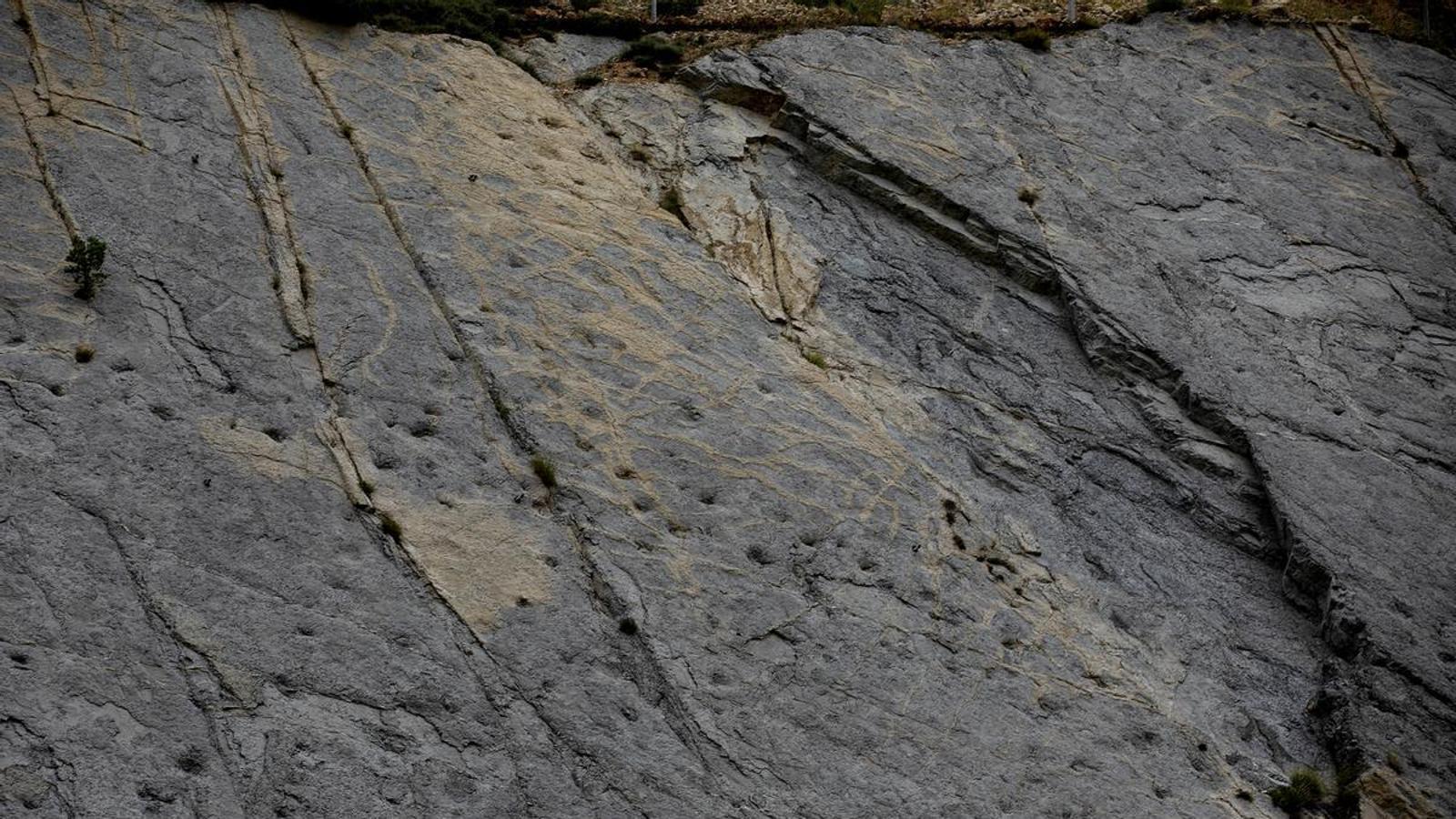
We go outside and walk to a suspension bridge. In front of us is a large, heavily inclined marl-limestone wall. It looks ideal for climbing, but it is obviously not feasible, as it contains a lot of holes that are nothing more nor less than fossilized titanosaur footprints (ichnites, they are called). "The wall is inclined because it represents a rock stratum that formed when the ground was horizontal. With the formation of the Pyrenees, the rocks were uplifted and tilted," remarks Alba. There is also a life-size reproduction of a titanosaur. It was made by Ramon López, from a family of artists (his brother is the popular actor Sergi López).We say goodbye to Bernat Vila and Alba Boixader. We set off on the way back, through a beautiful landscape – we are at 1,500 meters altitude, and here the vegetation is unrivalled–. This place in other countries would be a must-see."When I see a modest hen, I think: 'What has become of its majestic dinosaur ancestor?'", comments my brother, Bernat Romaní, who has just published the novel The Fifth Extinction, in which a pile of dinosaurs illustrated by Glàfira Smith appear. The work reflects on climate devastation, the fragility of life, and the vertigo of an uncertain future. "There is considerable consensus in believing that mammals would not have diversified so much if the dinosaurs had not gone extinct", says Bernat. "But this can never be proven", we say in unison.Birds survived the meteorite impact
It is estimated that the asteroid that impacted the Mexican peninsula of Yucatán, in Chicxulub, 66 million years ago, crossed the Earth's atmosphere at a speed of 11 km/s. The energy of the impact expelled large quantities of vaporized rock throughout the planet, along with clouds of sulfur, dust, and ash into the atmosphere that covered the sunlight for years.The Earth was plunged into darkness and the temperature plummeted, interrupting the photosynthesis of almost all plants, which almost put an end to entire food chains and affected herbivores and, finally, in turn, carnivores.The reign of the dinosaurs came to an end. There is increasing evidence that this meteoritic impact was the cause of the dinosaurs' extinction. But not all of them disappeared. A single group of dinosaurs survived: birds (which currently almost double the number of species of mammals!).

