David Janer: "A sommelier, at heart, is an actor: they have to seduce"
Actor and sommelier
-
CAT -
CAST
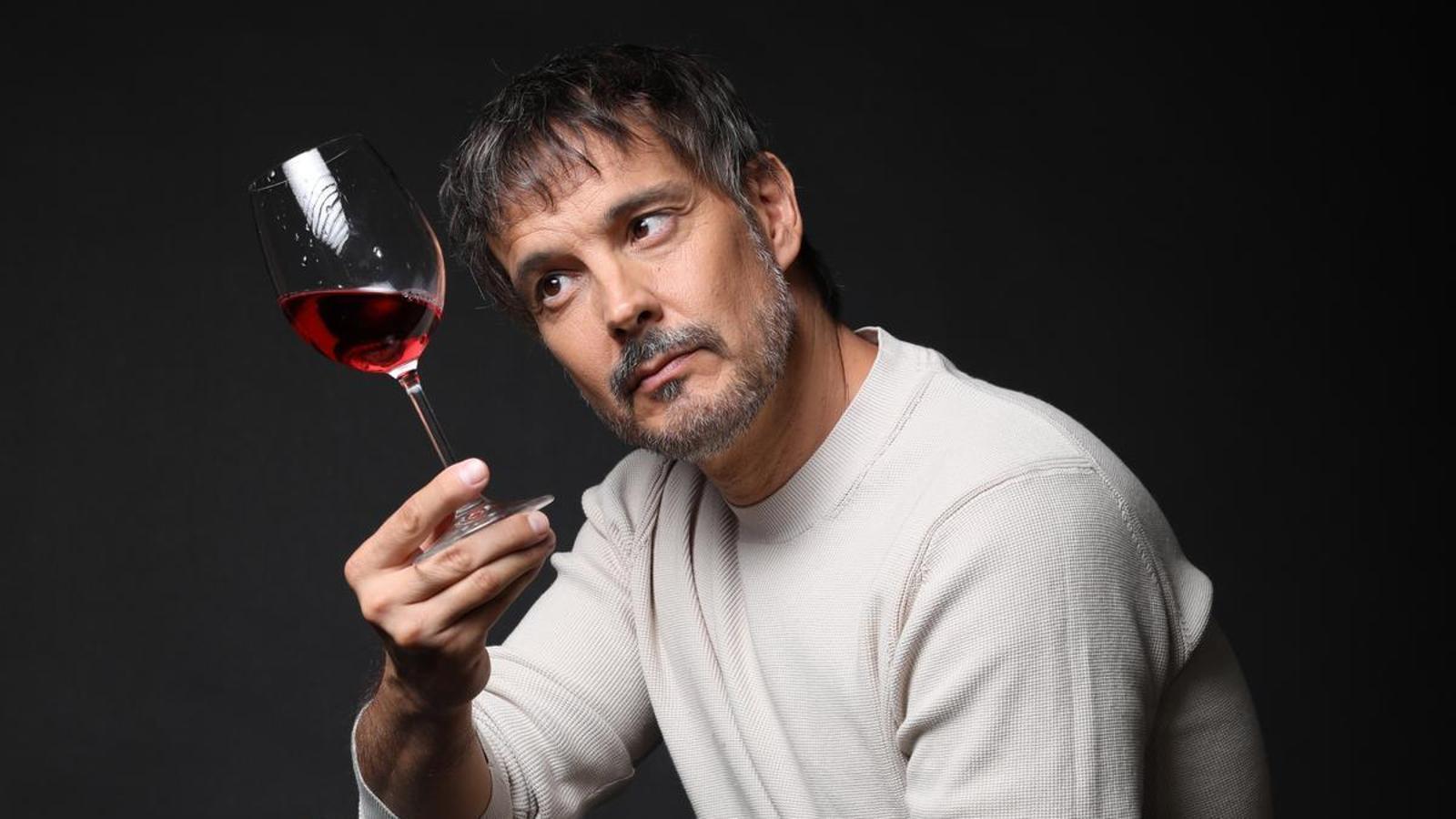
David Janer (Granollers, 1973) repeats himself: he has not abandoned his acting career. Known for his roles in Águila Roja, Amar es para siempre and El cor de la ciutat, he combines his acting vocation with the dissemination of two worlds that have passionate him for years: philosophy – especially classical – and wine, in the series Enológica, which will premiere its third season, and on his social networks. Aware of the power of union and conversation of the drink, when invited to dinner at home Janer always brings a book or a bottle of wine.
Let's start with the liturgy.
— Some anthropologists would say that almost everything we do is part of a ritual. But wine has a very visible ritual. I believe there are two ways to view wine: as a physiological act, or as a playful, hedonistic, and even cultural and intellectual act.
How does your intellectual relationship with wine begin?
— As an actor, one day you work and the next you don't, and I decided to dedicate these gaps to studying philosophy. I liked classical culture, and wine has an important weight in it: union, conversation, politics, history. Since I had the little bug, a friend suggested I sign up for the sommelier course at CETT-UB, where he taught. It was a way to combine my communicator side with the world of wine and, at the same time, with the classical world: a dialogue with the past and the present.
Who has a worse reputation, actors or sommeliers?
— There are actors and actors, there are sommeliers and sommeliers, just like journalists and journalists. Actors have a bad reputation since Rome: whoremongers, alcoholics, and liars, because they work with feelings in a very exposed way. With sommeliers, there's the idea that they always try to foist the most expensive bottle on you… But a sommelier, deep down, is an actor: they have to seduce. I don't just show the bottle; I like to put philosophy, morality, the connection with the theater, with the gods in it...
Dionysus…
— He is a good friend of mine.
Come from the East?
— This is what has often been said, but recent discoveries do not confirm it. Tablets have been found in Crete, in Linear B, which already speak of a Dionysus, before the classical era, related to wine, and who would have deeply Hellenic roots. I am writing about this and it is the vision I am left with.
A book?
— Between philosophy and wine. It is a book that I write thinking about the book I would like to read. It is also an excuse: I am an actor, not a sommelier who is in front of the public every day. Writing is the only way I have not to lose what I have learned and I am learning every day about these two worlds. That, and to bore anyone who stands in front of me.
Greek symposia tended towards monologue, towards "chatter".
— The symposion, in the end, was a moral test: after the third or fourth glass, everyone showed themselves as they were. Plato, in The Laws, already mentions it, and recommended that young people drink from a certain age. I have always been fascinated by how everyone has a different relationship with wine: some don't distinguish its quality, some just look for alcohol, some have a deeper relationship with it. And how each person reacts when they drink it: some start talking, some get emotional, some lose control. In fact, I used to organize symposia.
Really?
— I gathered friends and told them: "Today we will discuss the topic of love. Let everyone bring a poem or a thought." We dined and drank peacefully, and people, who were initially reluctant, began to open up. Nine out of ten times wonderful conversations emerged, with everyone on the same level, truly dialoguing —not like on television talk shows, where everyone wants to be right and no one seeks the truth.
Sitting or psychoanalytically stretched out?
— I have tried eating reclining, in the manner of triclinia, sometimes, but it doesn't work very well. Better seated.
This type of conversation requires a certain vulnerability…
— Only at the beginning. Since no one judges, shame is immediately lost, and the conversation grows with honesty, like a soufflé that puffs up. At first I tried to set the drinking pace, as the old ones did, but it's better for everyone to go at their own pace. These conversations are like an anchor. When you pull it up again, it comes up with coral, with things you didn't know you had. Asking someone what true love is for them, not the easy answer, is a way of building your own life philosophy.
He used the word honesty.
— It is proven: wine relaxes the prefrontal cortex, linked to self-control. From here comes another thing that fascinates me: the relationship with creativity. In Greece there were poets of water and poets of wine, and it seems that Google itself accepts that employees drink a little at the office. The association of ideas is not linear, but in leaps.
Digression is important. And meeting for food and drink teaches how to live with it.
— It is the education in the art of dialogue, an unfortunately lost art. You eat snails, and the aroma of the snails reminds you of another moment, and you talk with the other person about the snails, the aromas, and the memories... And with the wine, in the second glass, when it has already entered your blood, you are comfortable with the other person and have the confidence to talk. It is true that other times it seems that there are two separate actions: eating and talking, or drinking and talking, but then it means that you have left the table without having really talked.
Comes from a family that had a lot of life around the table.
— It's what I've always liked most about wine: the social, unifying part. My father was a commercial director; lunches and dinners brought us very close. There was always a flow of people at home, and wine was present, as a way of opening the door.
