It is not a mató nor a brossat: recuit is the creamy cheese with an untranslatable name that has become the great attraction of Empordà
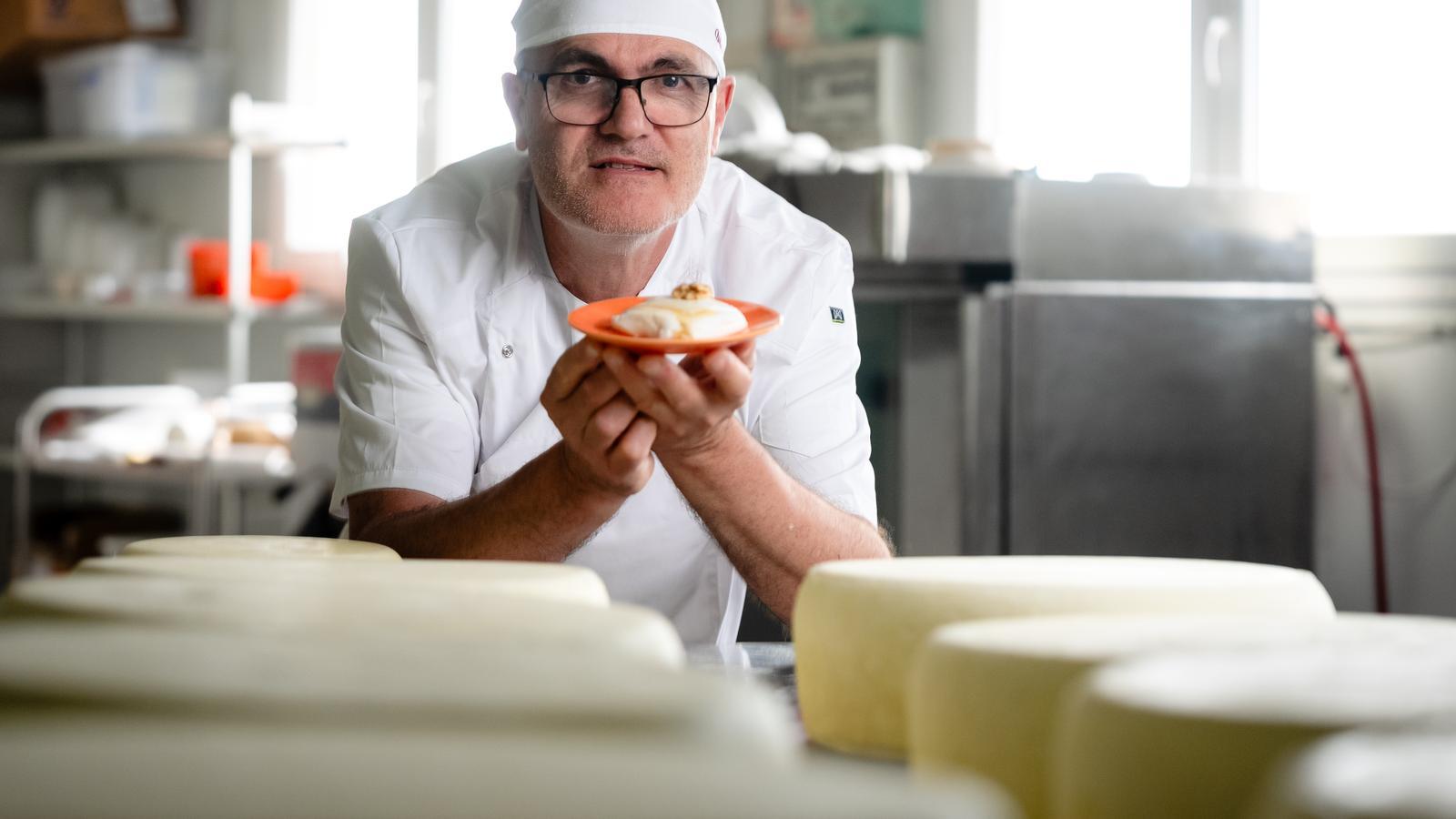
The producer Quim Martell, from the town of Fonteta, also produces ice creams, flans, cakes, and tiramisus with curd cheese

-
CAT -
CAST
Little fountainQuim Martell was supposed to be a butcher, because his parents owned the Fonteta butcher shop, but one day he followed the recipe for recuit that his grandmother, Grandma Rosita Rosacals, knew. In Girona, recuit was a well-known preparation, but it had become forgotten due to being so traditional and homemade. "More than thirty years ago, when I started, there wasn't a single professional producer in the Girona region dedicated to it; it had been lost," explains Quim Martell in his workshop, where he shows me the process of making Fonteta recuit, the name he registered when he saw that this preparation sold so well at his parents' butcher shop. "It was so well received by the public that I got excited, and little by little I started making more daily," he says. Today, he prepares an average of fifteen hundred units daily, every day of the year (except Sundays and Christmas), and depending on the time of day you go to buy, it's possible you won't find any unless you've pre-ordered one. "I sell them here at the shop, and I also distribute them to other towns." The price per unit is one euro and twenty-five cents.

Regarding the word recuit we must pause. "It creates confusion, books do not agree on it, there are contradictions, so I will give a definition, but there can be others". Recuit means cooked twice, and it has no possible translation into any other language. If we go back in time, it could be that milk had to be cooked twice, and hence it was called re-cuit". "If nothing else, it is my father's theory, and it makes sense given how milk was prepared in ancient times".

Thus, recuit is a unique cheese in both name and preparation: it is not a mató nor a brossat nor a ricotta nor a “requesón”, "which are all very good cheeses, but they are not recuit". What makes recuit unique and different is its creaminess, which is achieved with a very long curdling, between seventeen and twenty-four hours. It can be made from cow's milk or goat's milk, Quim makes both types, and the other ingredient he uses is calcium chloride, which is what helps to make the curd. And that's it. "I buy the milk from producers, because I don't have livestock, and I also buy it from other colleagues who also make recuits, like Lactis Pauet, who are in Jafre, and I buy about three hundred and fifty liters from them every day of milk per week".
Recuit without cloth, with paper
at the restaurant La Cort del Mos, in Palamós, the recuit, from Lactis Pauet, is placed on top of a coca de recapte, which has caramelized pepper, and he tells me yes, that recuit is used to prepare many dishes, because it goes well with many dishes, including pasta dishes. "Some macaroni or any pasta with recuit is a very good idea," comments Quim Martell.
Let's leave the recuits, the great star of the workshop, and continue with the products that are also selling well now that it's hot: ice creams. "I've been making them for two years, recuit with chocolate, with candied figs, and with hazelnuts, which are ingredients that combine well with it." When the temperature rises, ice cream is always good, but also "they can be put in summer dishes, like the ones we prepare at the restaurant El Magatzem de Fonteta, of which I am a partner," says Quim. The ice creams can be eaten immediately or taken away in half-liter boxes. And after the ice creams, Quim and five other people from the workshop have time to make blue cheese (made with three strains), which is increasingly in demand; a cured cheese; a semi-cured one; a goat cheese roll, and the recuit cake. The producer highlights them all, but the goat cheese roll the most, because he says that in our region the goat cheese rolls sold are mostly French. "I would say that I am the only one in Catalonia who makes them." To finish, a detail. The shop is called Casa Martell de Fonteta, where Quim Martell makes, on average, 1,500 Fonteta recuits daily with his grandmother's recipe, the preparation that has gone from being lost to being the most beloved.
