Amputate without anesthesia: the faster the better
The old hospital of Santa Caterina, located in the heart of Girona, preserves a beautiful pharmacy and many more treasures

-
CAT -
CAST
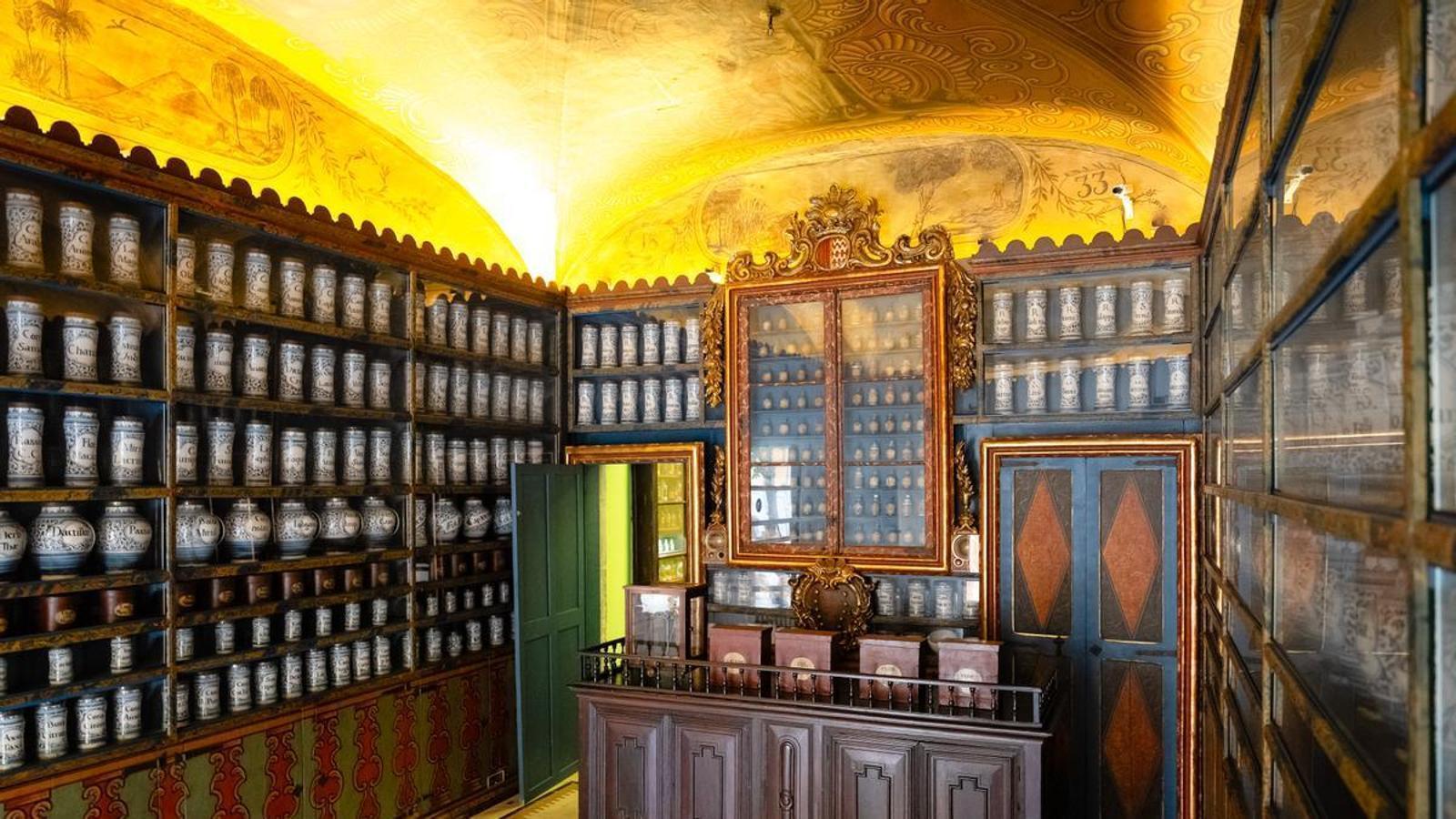
Of all the surgical instruments on display at the pharmacy I am visiting today, the one that impacts me most is a saw. Doctors used it to amputate. Since there was no anesthesia (patients were often given a few drops of ether, and that was it!) operations had to be done as quickly as possible. The most prestigious surgeons were the fastest.This collection of surgical instruments – very varied: some curved ones stand out, such as scissors, which are clearly not hairdressing scissors – is one of the elements that most catches the eye in the pharmacy – now a museum – of the old Santa Caterina hospital, in the center of Girona. In baroque style, like the entire building, the pharmacy also preserves mortars, scales, and a large quantity of pots (vases and jars). The jars are empty, of course, but they say what they contained. One says "belladonna", a substance that dilates the pupils. Some high society women used it because they said it made them more beautiful.Walking through the pharmacy takes me on a journey to the 18th century, when epidemics like cholera, plague, smallpox, malaria... were frequent, and to the 19th century, when tuberculosis and respiratory diseases reigned. The pharmacy was also active throughout the 20th century, but the diseases are now more similar – in reality, almost the same – to those we know today, although new ones have appeared, even epidemics, like covid. The one that has never been absent, of course, is gastroenteritis, which those of us outside the medical field call a tummy ache.The pharmacy, formed by two spaces (the sales area and the back room, where the laboratory was), is the great treasure of this hospital. But there is more. For example, the magnolia courtyard, a place of peace that gives access to a good part of the dependencies of the old hospital, including the pharmacy itself. The walls are lined with sgraffiti, which are not from the era when the building was constructed, but later, from 1928. What a delight the courtyards of Girona are! And how beautiful when the Flower Time arrives. A third treasure: the chapel, essential to any hospital. If the doctors didn't arrive, God did the rest, even if it meant taking the patient to the other world. It is certainly a large temple. In this way, both the sick and the entire congregation of the neighborhood or the city could attend mass (the pharmacy also served the population). The chapel, desacralized, is today an auditorium named after Josep Irla, who presided over the Generalitat in exile for many years. It is the seat of the Generalitat of Catalonia in Girona. Given its dimensions, a few years ago one of the largest paintings in Catalonia was installed there: The Great Day of Girona, by Ramon Martí Alsina. It is about 5 meters by 10 meters.

"This is a massacre!", I exclaim in front of the painting, where there is a multitude of characters, from very diverse social strata, some stretched out –dead– on the ground. And some about to die. "This work narrates the episode of war that took place in Girona on September 19, 1809, during the Peninsular War. It was a key moment of resistance", explains Paula Noguera, from the Girona Art Museum, while I wonder how the painting managed to get in here: I check the doors and don't see any very large ones.
Martí Alsina began to paint it in 1863 and never stopped: he worked on it for the rest of his life. With this work he wanted to provoke a turn in his career, establish himself as a recognized painter and abandon teaching. He wanted to demonstrate his artistic abilities with a work larger than "The Battle of Tetouan", by Marià Fortuny. He intended to send "The Great Day of Girona" to the National Exhibition of Fine Arts in Madrid, but in the end he did not. He was never able to see this great work hanging in the halls of a museum."We told jokes, sang songs... to the tuberculous"The Santa Caterina hospital still exists, but it moved to Salt. Therefore, if you want to visit the old one, the one in Girona, you have to put this in the location: "Old Santa Caterina hospital". This hospital center was in operation until the beginning of this 21st century, in 2004. Therefore, there are numerous patients and workers who have memories of it. Josep Maria Abad used to provide medication to the hospital. "There was little control, I would note down the missing medications and they would buy them all without hesitation," he explains. Josep Maria remembers that on the upper floor there were the tuberculosis patients. "They were never allowed out for fear of infecting others," he comments. "But since the tuberculosis patients were very bored, a group of young people used to go and tell them jokes, sing them songs... We were not afraid of getting infected".

