Russia takes advantage of Ukraine's lack of defenses and launches another massive attack against Kyiv
The Ukrainian army has not been able to shoot down any of the 28 Russian missiles, which have killed 17 people and injured about forty.

-
CAT -
CAST
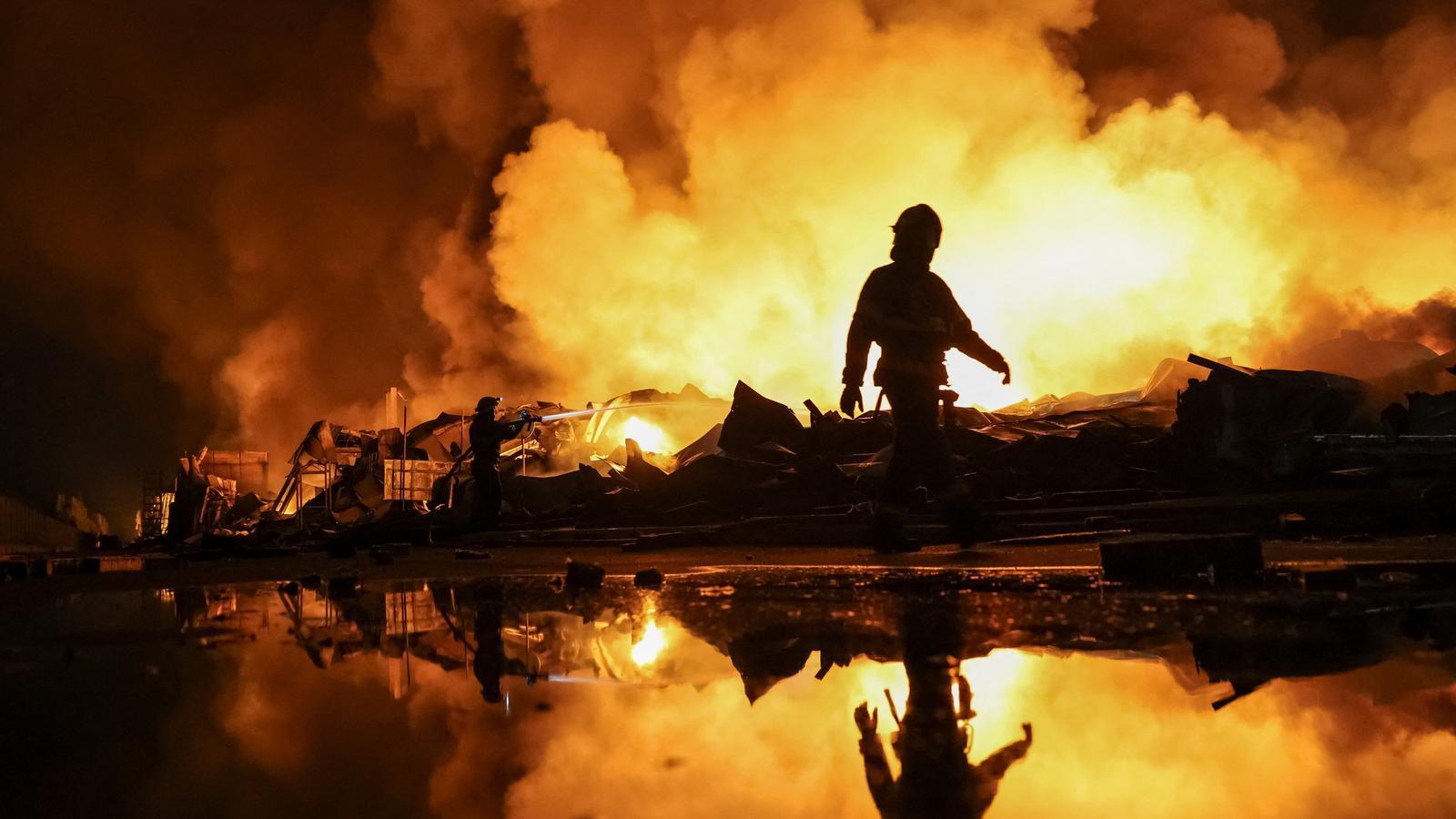
MoscowVladimir Putin has once again taken advantage of the weakness of Kyiv's air defenses to lash out at the Ukrainian capital. 24 ballistic and four hypersonic missiles hit the city and surrounding areas without any opposition, causing at least 17 deaths and more than forty injuries. The Russian army is responding in this way to Volodymyr Zelensky's strategy of daily targeting Wildberries warehouses, Russia's main online trading company.
The attack on Kyiv began after midnight and the alerts sounded for more than an hour. The military administration reported that at least seven locations were heavily bombed. Eight of the victims were waiting for the train at Kvitneve station, on the outskirts of the city, when a missile surprised them while they were on the platform. According to local authorities, the train was running late. In addition, the Silpo supermarket chain reported that six of its employees lost their lives when two distribution centers caught fire.
Some witnesses report that the missiles carried cluster bombs, and this seems to be evident from the attack videos. This system works in such a way that, as it approaches the ground, the projectile scatters small explosives that detonate on contact with the surface. It is a type of weapon illegal in many countries and, if used in densely populated areas, as is the case with Kyiv, where three million people live, it can cause great destruction, to the point of constituting a war crime. "There may still be people under the rubble," the city's mayor, Vitali Klitschko, had pointed out earlier, after emergency teams pulled two people from the wreckage of a destroyed warehouse near the city center.

Ukraine's Air Force shot down 98 of the 115 drones launched by Russia, but watched helplessly as it could not stop a single Russian missile. “Ballistic missile interceptors could have saved the lives of those killed today,” Zelensky lamented. “It is very important that our partners understand that delays in their supply, or a lack of willingness to provide anti-ballistic systems, directly lead to these horrific casualties and destruction,” he added. The Ukrainian president warns that Kyiv now receives a third of the interceptors it received a year ago.
Zelensky's desperation clashes with Donald Trump's reservations. It is estimated that the United States has spent approximately half of the missiles for Patriot anti-aircraft systems in its arsenal on the conflict with Iran. Furthermore, the American president refuses to allow Ukraine to manufacture them. “I don't think that's going to happen. There are people who are given this technology and who could one day turn against you,” he said recently.
The Kremlin is exploiting this opportunity to launch waves of attacks that overwhelm Ukraine's depleted defenses. In July alone, Russia fired 381 missiles at Ukraine, an average of twelve per day. Moscow had never before sent more than 300 missiles in a month and, therefore, had never sought to inflict so much damage on Kyiv and the country's main cities. A trend that continues in August: before Wednesday's attack, last Saturday another massive wave of Russian ballistic missiles killed at least nine people and injured more than thirty in the capital. The summer is proving to be particularly deadly for Ukrainian civilians.
This morning's bombing also hit a warehouse of Rozetka, an online trading platform, and another of Nova Poshta, Ukraine's main private courier service. Two targets interpreted as a reaction to the Ukrainian campaign against Russian logistics. According to the Russian Ministry of Defense, the attacked centers were “involved in the storage and delivery of various weapons and military cargo, as well as in the production and distribution of drones,” an argument similar to the one Zelensky uses to justify attacks on Wildberries.
Ukraine continues its attacks
In the last few hours, Ukrainian drones have again hit a logistics center of the company in Tula, about 200 kilometers south of Moscow, and have completely burned it down. Of Wildberries' fifteen largest warehouses in Russia, nine have been rendered totally unusable. Ukraine has also attacked a refinery in the Ufà petrochemical complex, almost 1,500 kilometers from its border.
Furthermore, this morning, near Yekaterinburg, a bomb exploded in the car of Vladimir Tkachuk, head of a plant that produces kamikaze drones in the Urals. The man survived, but is in critical condition in the hospital. So far, no one has claimed responsibility for the attack. On Tuesday, Zelensky authorized his secret services to carry out new actions inside Russia.
