In Llívia there is the only winery in Cerdanya that makes four transgressive white wines that are sold almost entirely in Catalonia
Marcel Cardeña, Xavi Domingo, Rosa Españó, Isaac Rigau Espiell and Anna Baqués Almirall are behind Llivins, which planted vines in 2012 and released its first wines in 2017

-
CAT -
CAST
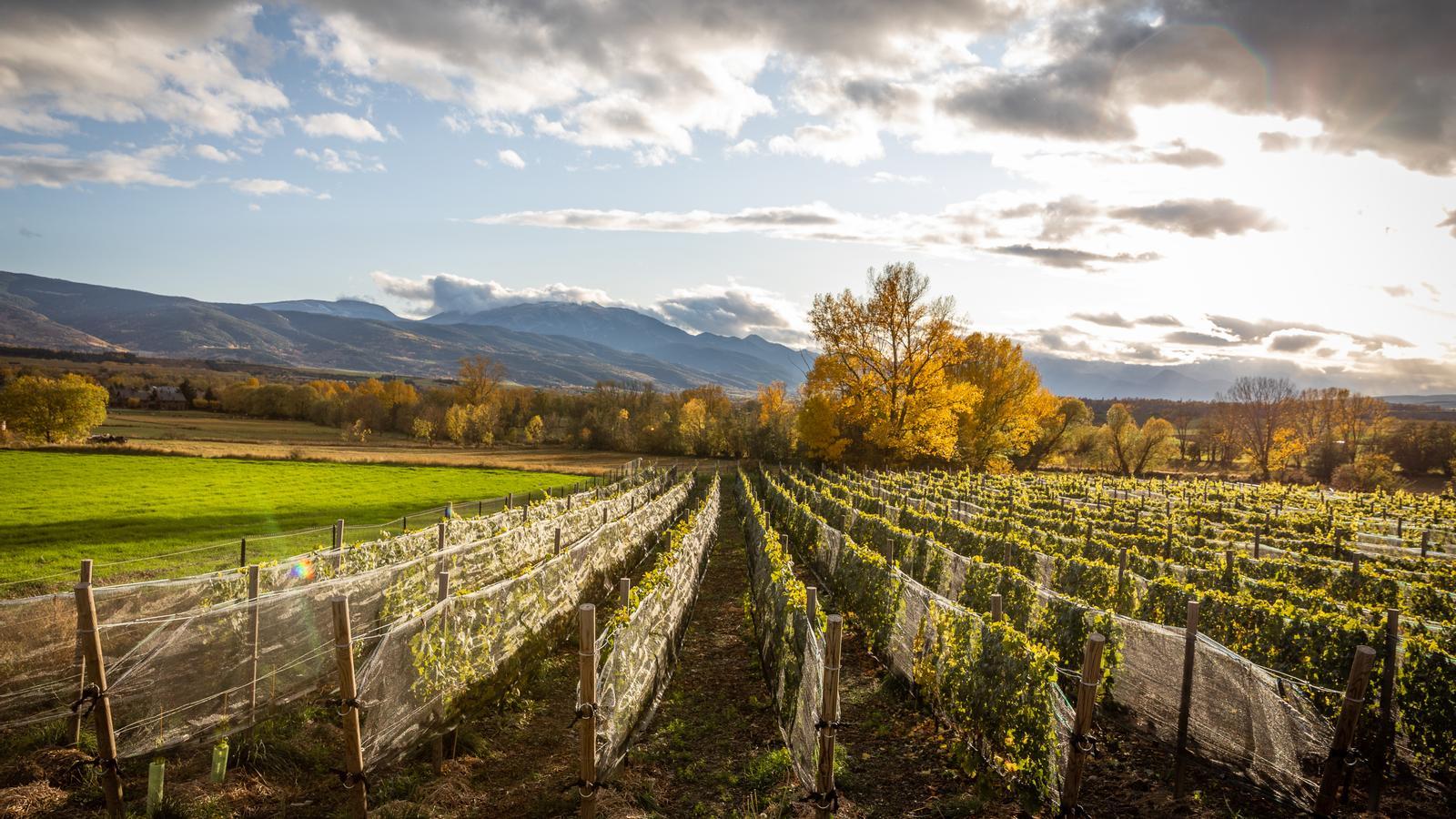
LlíviaOnce you arrive in Llívia, leaving behind the streets and the bell tower and heading out into the fields, there is Llivins, the winery that has two hectares planted with Sauvignon Blanc and that produces four white wines, four thousand bottles in total depending on the year. As soon as you observe the vineyards, you see that you are among different vines: they are protected by rigid mesh, which covers the entire plant, just as is sometimes done with apple trees. It is a resource to combat hailstorms, especially frequent in summer, which would damage the grapes. And another fact: the grapes have not yet been harvested. Not until well into October will they do so. The result of all this is four transgressive wines, just as the producers planned from the beginning, which are made at altitude, at 1,225 meters. The retail prices range between 25 and 48 euros, and they are not attached to any designation of origin.

It all began in 2012 when winemakers and couple Anna Baqués Almirall and Isaac Rigau Espiell, with experience in harvests in the southern and northern hemispheres and a passion for the mountains, decided together with Marcel Cardeña, Xavi Domingo and Rosa Españó to start the adventure that today has become a benchmark for high-altitude wines. From the winery, which in summer has a wine bar where the four wines can be tasted with tapas, you can clearly see the vineyards, framed by the mountains, where the Puigmal, the two peaks of the Pedraforca and more stand out.Planting vineyards in Cerdanya twenty years ago was a rarity “and it still is today”, explain Isaac and Anna. “Now there is more open talk about climate change”, with the temperatures this summer it is clear that the vine is suffering, and Cerdanya has always had unique characteristics in the Pyrenees. But, let’s be clear, it is also all more complex. “If we hadn’t had a passion for the mountains and for viticulture, we probably wouldn’t be here”, they say. They also add their experience in vineyards from all over the world. “In the Alps there is a valley, the Aosta Valley, very similar to Cerdanya, where viticulture had traditionally been practiced, and this fact also convinced us”, they explain. The fact is that Cerdanya is the only valley in the entire Pyrenees that is oriented from east to west, and this fact, combined with its height and width, results in 3,500 hours of sun in a year. To continue, the land is fertile, has gentle slopes, and the fogony effect occurs there, which is the mass of dry and warm air that reaches Cerdanya after it has discharged on the western side of the Pyrenees. It is what makes the valley have a dry climate with less precipitation, a fact that is very good for the vine, because it keeps away diseases derived from humidity such as fungi. And yet another favorable factor related to the climate: the thermal jump between day and night, which can reach fifteen degrees in summer. “The temperature contrast also favors the quality of the grape, because it matures slowly and progressively”, they affirm. If the fruit matures slowly, then it will have a good balance between sugars and acidity. All this theory is what the winemakers had in mind when they decided with their partner colleagues to plant a vineyard in Llívia. And they did it. It was the years 2011 and 2012. In Cerdanya there are other vineyard plantations; in the past there had also been some, and in recent years, more. In 1926 the geographer Pau Vila already referred to the Cerdanya vineyard, so they are not "innovators" with the vineyard in the valley, but they were the first to also build the winery next to the vineyards, to do the whole process nearby. They are still the only ones.
Wine from grapes harvested below zero degrees
When they were planting the vineyard, they were clear that they wanted to produce ice wine, an international category of wines, which consists of harvesting frozen grapes at temperatures between -5° and -9°. “We thought it made sense to make it in Cerdanya, because at night there is this drop in temperatures,” they comment. This ice wine and all of them, four in total, are single-varietal Sauvignon Blanc, which is a variety that has a short vegetative cycle, and this means that with few hours of sun it has ripe grapes. "In climates like that of Cerdanya, the usual varieties are Pinot Noir for red wines, Riesling, and Gewürztraminer. You find Sauvignon Blanc in different parts of the world, but the terroir and the climate make different wines, because it allows for many ranges of production." According to the winemakers, they also opted for it because it was when they decided on Cerdanya and high-altitude viticulture, which means more difficulty. They wanted to make wines different from those found on the market. “In viticulture, it is said that one hundred meters of altitude correspond to one hundred kilometers in northern latitude. Therefore, being in Llivins is equivalent to being a thousand kilometers to the north,” they comment. That is to say, the way of understanding the vineyard with this altitude and northern latitude is very different: hence the freshness of the wines, the natural acidity, and the long aging that can be done. “Traditionally, we have consumed white wines from the current year, but in Cerdanya, since we start from a grape with an acidity balanced with sugars, the wines have much more longevity in aging,” they point out.
The single-varietal wines they produce are Blanc Dneu, at 12 degrees, and Blanc Dgel, with frozen grapes, at 15 degrees. To make them, there are two types of harvest: on one hand, the traditional one and, on the other, the one done by letting the grapes over-ripen starting in October, when the cold arrives. “Then the leaves turn yellow and fall, and therefore, the grape dehydrates; the dehydration concentrates the sugars, and at night, when it is between 4 and 7 degrees below zero, is when we harvest.” The grapes are completely frozen and they take them to the winery, right next to the vineyards, to begin pressing them. “It is a small nectar, extremely sweet, with a very low yield, which usually is 10%.” Then they ferment it, and the result is the Blanc Dgel. In total, they produce four wines: two dry and two sweet, the ice wines, which they maintain can be drunk as appetizers, from the beginning of a meal. The second ice wine is the Floc Dgel, which they age in small barrels for fifteen months, a fact that gives it toasted, very delicious flavors. “We make the ice wines with grapes that have a lot of sugar but also good acidity because they have been frozen, which is why we achieve a good balance in the mouth of both flavors.” They have 15 degrees, about 80 grams of sugar, approximately, and good acidity that balances them; hence why the producers recommend them for savory dishes and not just as sweet wines taken with desserts.

To finish, Anna Baqués and Isaac Rigau define themselves as restless. "Perhaps there is no winery as small as ours that has two winemakers," they say. 30% of the four thousand bottles are sold in the Cerdanya region itself, and the rest in other Catalan counties. Occasionally they have export requests, but that is it, it is occasional. "Making wine in the Cerdanya is humility and recognizing that you have a lot to learn; you have no mentor who can help you, you start from scratch and everything is a challenge." There is no machinery that anyone can lend them, nor advice from other wineries, because (although there is indeed planted vineyard that belongs to other producers) they are alone as winemakers. Perhaps because of all this, the Incavi has asked them to be able to plant, next to theirs, an experimental vineyard, with experimental grape varieties, to study its vegetative cycle, which involves several years of research. "Someday we will be able to make a wine from a unique variety that does not exist in the world," they conclude.
