Ada Parellada: "I imagine closing Semproniana before I'm 70, and I don't know if my children will be nostalgic then"
Cook
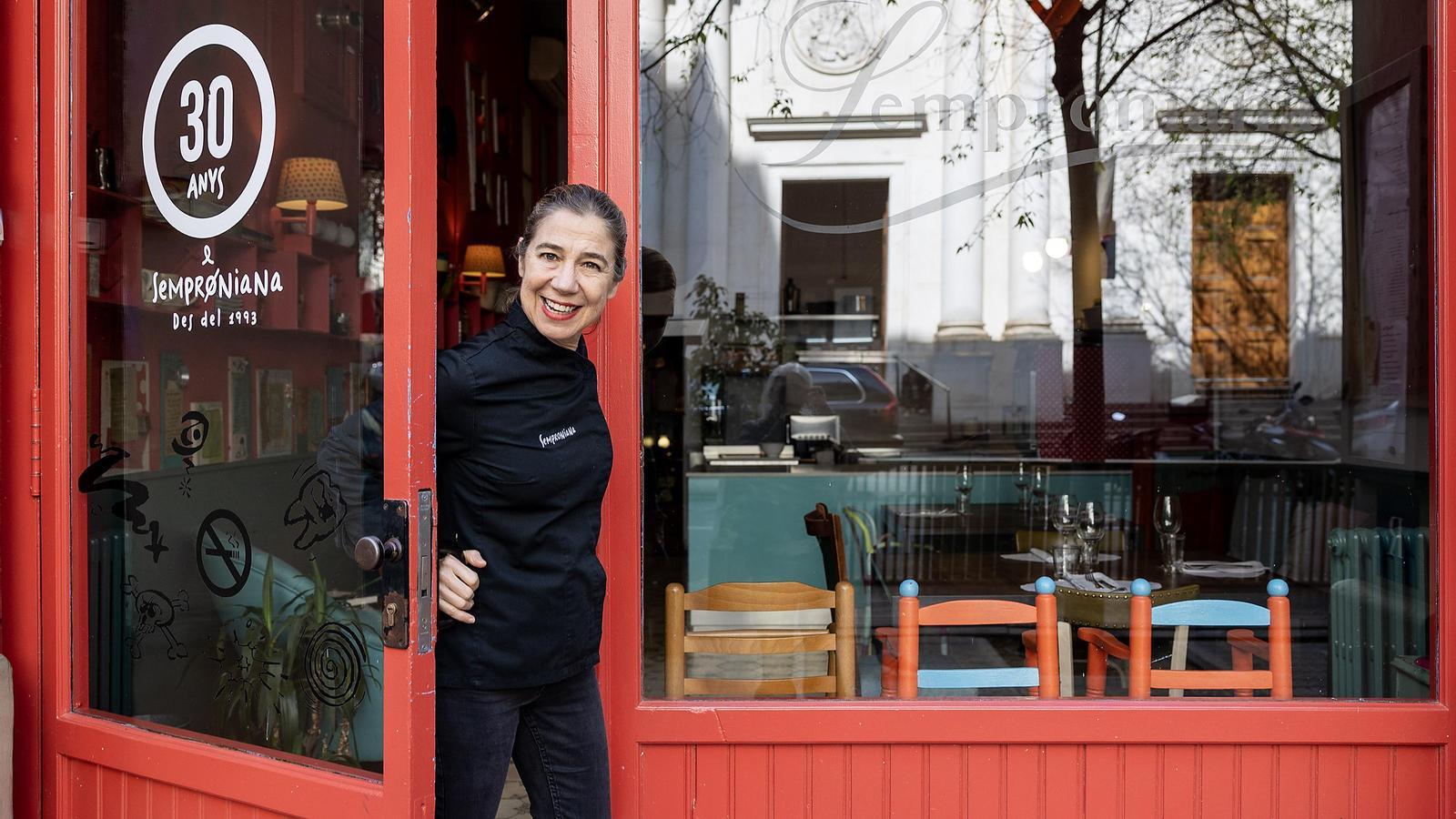

BarcelonaI interview the cook Ada Parellada (Granollers, 1967) one afternoon after she has finished recording recipe videos. She offers me a piece of a blueberry pie, delicious, which she has prepared with nine ingredients. Only nine ingredients, because that way everything is easier, she says. We start the interview by talking about the last one I did with her, in which she told me the story of her family, and how it was that she decided to open the restaurant Semproniana with her partner. Ada Parellada has just written the book Els plats del dia (Rosa dels Vents), in which she vindicates set menus, like the ones she prepares at her restaurant daily for 23 euros, and which are dishes made from start to finish, and elaborate Catalan cuisine.

I have listened to the interviews they have done with you on the radio lately, and in all of them they ask you about the succession, if you will have one, at the restaurant.
— I don't intend to die on stage, that is, working, but I don't feel like resting either, because I feel young, with aspirations. For me, working, doing paid activities, gives me life. Although Semproniana causes me anxiety, because I pay twenty salaries, I know that there are twenty families I have to support. It's a burden that suffocates me, because every month I have to guarantee their salary. I also have to tell you that I imagine closing Semproniana before I'm 70, and I don't know if my children will be nostalgic then.
What do you mean by "nostalgia"?
— That when they see that the parents are no longer there, neither Santi nor I, perhaps they want to continue it. I say it because I have seen it in other models in the city, such as Granja Viader, that when the mother explained that she had no successor, that it was closing, then her son said that he wanted to continue it. Traditionally, from the story of an effort, a son emerges whom the parents tell to leave, not to stay, or, if possible, to train and study for another trade. I know there are cases of sons who have trained, and who then returned to the same job as their parents.
— They are an example. And they are very good with patatas bravas. In fact, a restaurateur's dream is to dedicate themselves to a single product.
Every time I've come to dine at Semproniana, it's full. Now you're picking up the phone for upcoming reservations.
— I pick up the phone, and I write down the reservations on paper, yes. I prefer to stay in the 20th century even though I know that artificial intelligence will affect all professional sectors, that it is a paradigm shift like the internet was twenty years ago. When the internet appeared, encyclopedias on paper stopped being made.
I am moving to this future plan where you will no longer work at Semproniana.
— Then I will dedicate myself to dissemination, to holding workshops, to social media. I like books, but I think there are many about gastronomy. But I think about it and I see that they have a future, because with the internet it seemed that not, that it would kill books, radio, and no, everything is in good robust health. So much so, that we make books from my videos. In this way, we can say that the world is upside down.
I ask you about the word menu, that you claim it in the book.
— It is discredited and carries discredit. Furthermore, restaurants prefer to use another name, such as formula, solution, daily prices. That is to say, anything that is not a menu. However, the expression tasting menu is intact. The word menu appears there, but then nothing happens. It is a paradox.
How would you define the midday menu?
— It used to be the solution for the nearby worker at the restaurant, which also required a space for a nap after eating. Now it's not so much that, because lunchtime hours have been shortened to promote work-life balance. Therefore, they only have an hour and, sometimes, they don't even go out anymore because offices have kitchens or equipped spaces to heat up their food. The same supermarkets sell pre-cooked meals that people can eat on the spot, as they are also offering a space to eat.
So what function does the restaurant menu serve now?
— To cohere the neighborhood. I cannot say what happens in small towns, but in Barcelona, with urban pressure and gentrification, keeping the menu in restaurants is a militancy. We offer a space for people to sit, converse, and not worry about anything more than resting their minds and talking. I maintain that in a highly virtual environment, we must keep the table as a social altar, both in restaurants and at home.
I like the word altar.
— Yes. If we don't preserve the table, then how will we find out what happens to our children? How will we maintain culture? The table is a space for mental hygiene, and also for dignified cooking. If we eat at the table, one day we might eat a Yatekomo, but the next day, no. On the other hand, if we eliminate the table, if we eat in front of the TV, then everything will disappear.
The Semproniana menu is 23 euros.
— I know it's not economical, but we cook, we do everything ourselves. I was away for a few days for Easter, and I noticed that in many restaurants we went to, everything was fifth-range, meaning they opened packages and heated them up. And I understand, because there is no qualified staff and because the kitchens are very small and the rents are high. And, therefore, the larger space has to be for the dining room. On the other hand, the kitchens remain reduced.
Where are we going in the world of restoration?
— We are heading towards the end of the independently managed restaurant. The Semproniana model is on its last legs. And the chains are growing. I'm not saying they are low quality, but they achieve economies of scale: they have better margins, they can opt for better located premises, where a lot of people pass by, and, therefore, they can have the kitchen open all day. If they have the kitchen open all day, they retain talent because, for the teams, it is very attractive: they can have good schedules and, moreover, they can move up the ranks. These restaurant chains have a marketing department, a purchasing department... All in all, it's very different from the independent restaurant model like ours. Santi and I change light bulbs, we answer the phone. With the speed the chains work, we can't catch up with them.
When you say that restaurants belonging to chains will grow, you are not saying that the wolf is coming.
— No, because they are excellent groups; being a chain does not mean it is a bad thing.
Will there be another restaurant model?
— The restaurants of the elites. And there is another one, that of friends with a lot of talent who open their personal project, and which the chef Ferran Adrià already said years ago lasts five years. And there is still a last model, which is the one of a lifetime: that of the immigrant, the newcomer, who opens a bar, and spends all days of the week and all hours there. The children do their homework there, they spend their lives there. Have you seen the advertisement of the singers Estopa? They explain that they did their homework in their parents' bar. This is what happens with the Chinese, Pakistanis and Latinos. And it was also my family model. La Fonda Europa had given them money, but they always worked, every day and all hours.
Because there had been lean times before.
— They came from poverty, and they couldn't spend, nor travel, only work. The word holidays didn't exist, nor did you deserve it. Traveling was strictly forbidden. My niece told my father that she was going to London with her mother, and my father got angry when he heard the word trip. My sister Lourdes had to intervene to change the subject. They have passed on to us the value of work, it is the legacy we have received. My father and my mother couldn't stand us sitting around.
To finish, Ada, are you preparing any other books?
— I'm doing two more kitchen renovations, which I'll finish in the coming months. One I'll finish in May; the other, in June.
