The untold story of 'Filiprim', 40 years later
Witnesses who lived the program from the front line remember a format that showed that TV3 was also a television for entertainment
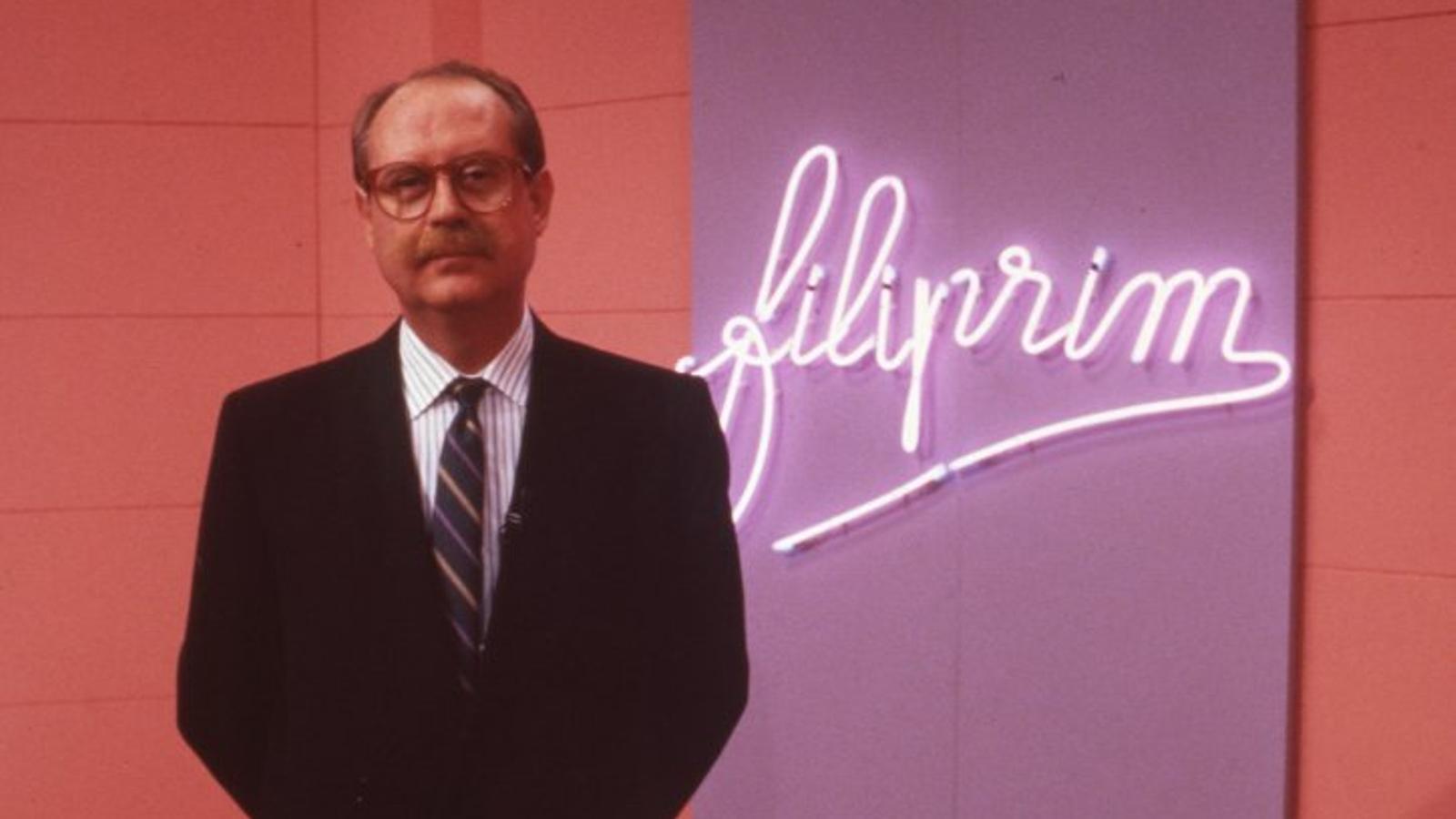

-
CAT -
CAST
BarcelonaAlthough it was only on air for four years, the program Filiprim marked an era on TV3. Taking advantage of the fact that it is 40 years since its premiere, ARA has spoken with some of the people who lived it firsthand so that they can explain, with their kaleidoscopic testimony, the history of that show presented by the iconic Josep Maria Bachs (and the last season by Jordi Estadella), beyond what was seen on screen.
Oleguer Sarsanedas
Head of programs (1990-1996)
After all this time I couldn't say who came up with Filiprim, but, knowing Bachs's personality, the format was surely his. He had a long career at Ràdio Joventut which, despite being that of the Movement, was the most playful on the airwaves. I imagine TV3 must have wanted to sign him and he made the proposal for the program. The program was also playful, therefore, and established direct communication with the audience through calls, which were common resources in radio, not television. His father, moreover, was a set designer, which would explain the elements of the staging that we still remember, like the eccentric telephones. The influence of the theatre was also noticeable in the incorporation of Mr. Encarregat, played by Jaume Sorribas, a true actor from Joglars".

Lluís Maria Güell
Head of programs (1985-1988)
"Following Rosa Maria Calaf's advice, I had already tried to incorporate Bachs before, who was at Televisió Espanyola. But I ran into reluctance from Alfons Quintà, the first director of the company, because he didn't want people from there, even though it was the only television available at the time. During the time of Filiprim the director was Enric Canals and there were no problems incorporating him. He was clear that he could contribute a personal, different and intelligent humor, like the one practiced today at home by Toni Soler".
Lola Cuadrado
Coordinator of 'Filiprim' and wife of Josep Maria Bachs
"I suppose Lluís Maria Güell must have proposed to him to do a program, but the idea was Josep Maria's. He had done some sketching in El Jueves and from there he knew Perich, Tom and Romeu, Miquel Arguimbau... and he wanted to work with them. I joined the later meetings, when the program was already designed. They were a very cohesive group and they always ended the programs laughing, drinking and damn it all. Arguimbau commented that the program could be called Filar prim and, from there, it jumped to Filiprim."
Ramon Navarro
Comedian
"I really remember the family spirit, which was awesome. For example, one day Perich grabs me aside and says: 'You're a son of a bitch, Ramon! I kill myself all day to make some little drawings and you come out for three minutes saying that the towns have been translated into Spanish and that now Igualada will be Empate and that Salou will be Salhuevo and the next day everyone is talking about you!' Of course, I was thrilled that he gave me this affectionate reproach, because it came from the guy I admire most, a whole philosopher."
Raquel Perich
Daughter of Jaume Perich
"I used to get nervous seeing him on television: I worried he might make a mistake! It still happens to me when I see any videos of him. It seems strange now, after everything that has changed, doesn't it? You can tell there was a more unhurried way of speaking. I was seventeen or eighteen then and I was flustered because I was super shy, so going to restaurants was torture for everyone: 'Professor Perich!! Tell a joke!'. But he's the only comedian I know who never told a single joke! In his office he had a cartoon that he had drawn for himself, which reflected this situation".

Ramon Navarro
"Since my recurring phrase was “Mr. Bachs, nyè!”, when I went through the streets and towns I could hear next to me «Nyè, nyè, nyè!» I had to park far away and arrive from behind, because it was tremendous. Following the Filiprim I released eleven records and a book, and with Sorribas we did the Filishow, a show for children that always filled up".
Mari Pau Huguet
Presenter
"Jordi Novellas, Francesca Fosalba and I were on the continuity shifts at TV3. We would rotate schedules and whoever was on the afternoon shift would then go up to the studio and present the image micro-contest: a video was shown and you had to guess how it ended, to win 25,000 pesetas from that time. I had been there as an audience member, before joining the television. People always left loaded with bags of little gifts".
Rosa Cornet
Presenter
"I will always remember the program because it was my first live broadcast. I had just started in continuity, replacing Mari Pau. It was a controlled situation, as you were sitting and reading the teleprompter. There, on the other hand, there was no closed script, but a rundown with the different sections. That first live broadcast, I remember thinking that at any moment I would fall to the ground, from how my legs were trembling. But I was fine right away. It was a happy time, as television was then, which was just being born".
Ramon Navarro
"The show was very free. One day we agreed with Bachs that I would tell him something in his ear and we would start laughing. We spent three minutes all laughing, him, me, and then the audience, as if there were no tomorrow, without really knowing what about. We were having a great time".
Lola Cuadrado
"Everything was very scripted, but live they dared to break it. In the end, since everyone had plenty of resources, they just went for it and let the sun shine wherever it wanted".
Jaume Ferrús
TV3 Director
"Following ARA's call, I've rewatched the latest episode uploaded on 3Cat and I find it holds up perfectly. Bachs did a fantastic job and the collaborations he had, like Perich's, were brilliant".
Mari Pau Huguet
"I am convinced that the fake mustache was to create a character and overcome shyness. I remember he used to go for a snack before the show and when he saw through the glass that the audience was climbing the ramp leading to the studio area, since he knew they were invited for a snack, he would leave in a hurry, because he found it difficult to be extroverted and didn't want them to think he was stupid if he came across as dry. On the other hand, with the mustache on and the lights on... he transformed".Oleguer Sarsanedas
"Bachs was practically agoraphobic, because you wouldn't find him out and about living the social life that other television colleagues of his age did. However, he could put on a great show and, above all, he was a professional like a cathedral. Knowing that a program was in Bachs' hands was a guarantee that it would run smoothly. He made sure nothing went wrong. I also remember that he was a bit like Hansi Flick: when it came to renewing contracts, he was aware of his worth and made sure to get it. He always made short contracts. It wasn't easy, but once the deal was closed, then everything was smooth sailing".
Lola Cuadrado
"When Filiprim was made, I was already Bachs' partner. I met him at nineteen, he was fifteen or sixteen years older than me and was already one of the big names at Ràdio Joventut, but the relationship started later, when he was at Miramar de TVE, as a weekend announcer. During our free time we would go up to the rooftop to have an aperitif and that's where we started dating. I became a producer and I've been at the Corporation for 40 years, whether at television or Catalunya Ràdio, because I only retired a year and a half ago".
Ramon Navarro
"It is true that Bachs could seem very shy, but once he started laughing, then he would fall apart".
Lola Cuadrado
"At home, the fun one was me! He appreciated the fun and immediately joined in whatever I suggested. He never had problems with traveling or doing the Rocío. He was very serious, but at home he really enjoyed people. On the street, it's true that he perhaps wore a mask: he was pleasant and kind, but not funny or especially witty, due to shyness. He used to tell me: 'If they know me, I can't snub them.' But he didn't pass by four times for them to see him, like others do. And I was clear that, if we went to a restaurant, I had to sit so that he had his back to the entrance, so it would be more difficult to identify him".
Lluís Maria Güell
"He was a very likeable character, a very, very good person, cultured, sharp in his sense of humor, which linked us to English humor, with his irony and gentlemanly appearance. This linked us to the series we were buying then, like "Young Ones". He connected with the audience of TV3 at that time, which was different from now. It was a very specific audience, with middle-aged and older people, who really identified with the channel and felt it was very much their own because they saw the dream of their own television fulfilled in modern Catalonia."
Lola Cuadrado
"They held weekly meetings to decide on the different programs and Arguimbau would take notes all afternoon, laughing. At home, he would put order and a certain structure to it. He would return with the script and the editors would cross out half of it and return the other half. There were political things that didn't happen, of course, but in general Bachs didn't say anything particularly big or substantial: he was rather ironic. In fact, talking about Palau de Plegamans was always the way to avoid relating news to real places. Everything happened at Palau de Plegamans and that way it seemed like it wasn't happening anywhere and it was more believable."
Raquel Perich
"In that era there were very taboo subjects. The royal family was not touched. Or the Church. And the subject of sex... very little, although he was allowed quite a bit, for what that era was. His father liked to talk about it openly, and he would ask if one preferred breast or thigh, but when he did, people called the television and the politicians of Convergència, who were more clerical, got nervous".

Lola Cuadrado
"From Palau de Plegamans they called us gratefully because it turns out that now everyone was going to see the dam that had fallen, as we had said, or the Virgin of Montserrat that they had placed on a mountain... that didn't exist, of course. They invited the whole team to lunch, because that would attract local tourism. They even named a street after us!"
Laura Vallbona
Councillor for Culture of Palau-solità i Plegamans (1987-1991)
"In those years, in the municipality, the L'Alzina urbanization was being completed. The mayor found all that joke with the program very amusing, so he proposed to have the street Filiprim. That was a joke: it seemed a bit foolish to us, but look, it went ahead! I suppose younger people don't understand what that name means".
Lola Cuadrado
"We weren't colleagues. We were friends. We were young and it showed. The friends I still have are people from television, because we were together morning, afternoon and night doing incredible and crazy things. It was the best stage of my life".
Laura Vallbona
"In 1988 they did the bell ringing here in Palau. But in the church there was neither a bell tower nor a bell, which now there is. The television people made a whole setup to place a structure and a bell behind the church".
Ramon Navarro
"En Llàtzer was not from the world of show business. He came from selling chewing gum to swallows. Between that and his age, at Filiprim he never remembered the lines very well. Since it was live, they kept cutting down his interventions. On the other hand, at Dicciopinta or Tres quarts de Bachs, since they were not live, we could do several takes. And when he managed it, on the sixth try, we all started applauding him and celebrating. L’Escarceller was a very, very beloved character. And he loved being on television. When we were filming at seven, he was already made up by four".
Lola Cuadrado
"The grandfather already arrived in the morning, he had lunch like this, and he took his nap. We told him: ‘Grandpa, today you have to say this and this other thing!’ And then he said whatever he wanted.
Raquel Perich
"My father going on television didn't excite him, but they paid well. He was prouder of other things he had done, whether in El Jueves, in Interviú... but it's what people remember him most for. I remember he always wanted to quit and said: come on, one more year and I'll leave. And it was always one more year, because even though he did many things as a freelancer, he had to round up his salary, and if he wanted to go on vacation, he had to pay for it himself. The press never increased their rates and this situation did make a slightly more bitter part of him emerge, about which I heard him complain".
Lola Cuadrado
"In some program changes, Sarsanedas and Bach did not get along. He, in any case, jumped from Filiprim to La Parada, which was weekly, with international interviews, performances, music... And Jordi Estadella took over from him".

Lluís Maria Güell
"Bachs on Filiprim was the axis of the program, and this required a lot of dedication from him, in addition to significant energy. I imagine he couldn't maintain it and looked for alternatives. TV can be very tough. Furthermore, La Parada was a prime time program, potentially with more audience and budget."
Ramon Navarro
"They must have thought that five years was already too much, and that's why he left and, when he returned, he made the Dicciopinta, which had many similarities, and then Dos quarts de Bachs, which were essentially continuations, with other names".
Mari Pau Huguet
, potentially with more audience and budget".
Ramon Navarro
"People still talk to me about Filiprim, , which had many similarities, and then the
Mari Pau Huguet
"One of the Sports colleagues revealed an anecdote to me: 'Maybe you don't know something, but the day you took the tests to enter TV3, Bachs passed by the control room for a moment, saw you, and said 'This girl is very good'.' He had never told me anything! And I started to cry, because I realized that I could never thank him for that support when I was a lost young woman on the set, with my legs trembling like a flame'.
