Between fjords and vineyards: the new frontier of wine is in Denmark
Climate change and rising temperatures are driving a new generation of Danish wineries where it was previously improbable to make wine

-
CAT -
CAST
Until now, Denmark has been a country recognized for its prestigious interior design firms, its pioneering commitment to sustainability and renewable energy, and for hosting some of the best haute cuisine restaurants in the world in the city of Copenhagen. Probably, when we think of a Scandinavian country, the first image that comes to mind is not that of tasting a glass of wine produced in a local winery. However, due to the effects of climate change, the countries of northern Europe are gaining prominence in wine production, where they see that they have a promising future.This is the case for Danish viticulture, which in the last five years has experienced a notable qualitative leap, driven by a handful of daring and visionary producers pushed by curiosity, who for the first time are managing to produce high-quality wines. This is reaffirmed by the journalist and wine critic for the Danish newspaper Politiken, Thomas Ilkjær, who asserts that the Danish wine sector “is today at a very exciting moment”. 10 years ago, wine production in cold climates like Scandinavia was considered a losing bet, but now the sector is in turmoil: “I believe that in 50 years we will look back and see that we are at the exact moment when everything began to grow,” says Ilkjær.Until now, the long, cold, and dark winters typical of the latitude of the Nordic countries had been the main obstacle to wine production. But global warming has caused the producing countries of southern Europe to face overripe grape berries with a high alcohol content, while Denmark has opened the door to the production of wines "with a marked acidity, a lot of minerality, and great freshness," asserts Ilkjær, a fact that is increasingly convincing gastronomic critics and restaurateurs.Regarding the number of Danish wine producers, in the last two decades it has gone from 10 to 150 professional wineries (with more than 1,000 amateur winegrowers) and new ones emerge every year. This has meant that in just six years the production of Danish wine has tripled and the sector is clearly on the rise. All this, despite the fact that Denmark's history as a wine-producing country only began in the year 2000, when the commercial cultivation of vineyards was approved under European Union regulations.According to the University of Copenhagen, the area dedicated to vineyards in the Nordic country is 250 hectares, of which 90% produce wine certified as organic. But although the production of Danish wine has increased and the quality has improved, the wine industry is still in its early stages, especially if we compare it with other countries like Catalonia, where there are 55,000 hectares of vineyards planted.In our country, a trend among Catalan wine producers to overcome the challenges of heatwaves and unpredictable weather is to relocate wine production by seeking cooler climates, for example by cultivating vineyards on higher mountain slopes, such as in the Pyrenees. In this sense, Danish producers feel they have the effects of climate change in their favor, as climatological studies predict that within 50 years the climatic conditions of the Nordic country could resemble areas of northern France or the Champagne region, with a cool climate, abundant rain, sporadic spring frosts, and warmer summers.Even with the clear effects of global warming, it does not mean that it is now easy to produce wine in Denmark, but "climate change has made it possible, or at least it has helped to improve the quality of the wines," says Ilkjær. Currently, the growing season in the Nordic country begins in April and the harvest does not take place until October, when the grapes have already ripened. During these months, the average temperature is about 13 degrees, an increase of 0.8 degrees compared to the 1960-1990 period. Regarding this, it is estimated that sunshine hours have increased by 15% on average, a decisive factor for producing wine. However, "we still have a cool climate, with the risk that some years it may be practically impossible to make wine, therefore, it is a challenge that one cannot fully rely on the climate, and this makes it difficult for producers to risk everything in a business as uncertain as wine production in Denmark," asserts Ilkjær.Most of the vineyards in Denmark are located no less than 10 km from the Baltic Sea and North Sea coast, spread across the country, from the Jutland peninsula to the island of Bornholm. The most used variety for white wine production is Solaris, appreciated for its resistance to cold weather, as well as for its early ripening capacity. Regarding red wines, the Rondo variety stands out especially, widely spread in Germany and the south of England. But if Danish wines are achieving greater projection it is thanks to the production of sparkling wines, which already represents nearly 20% of the country's total production.“A dream and a challenge to make wine here”
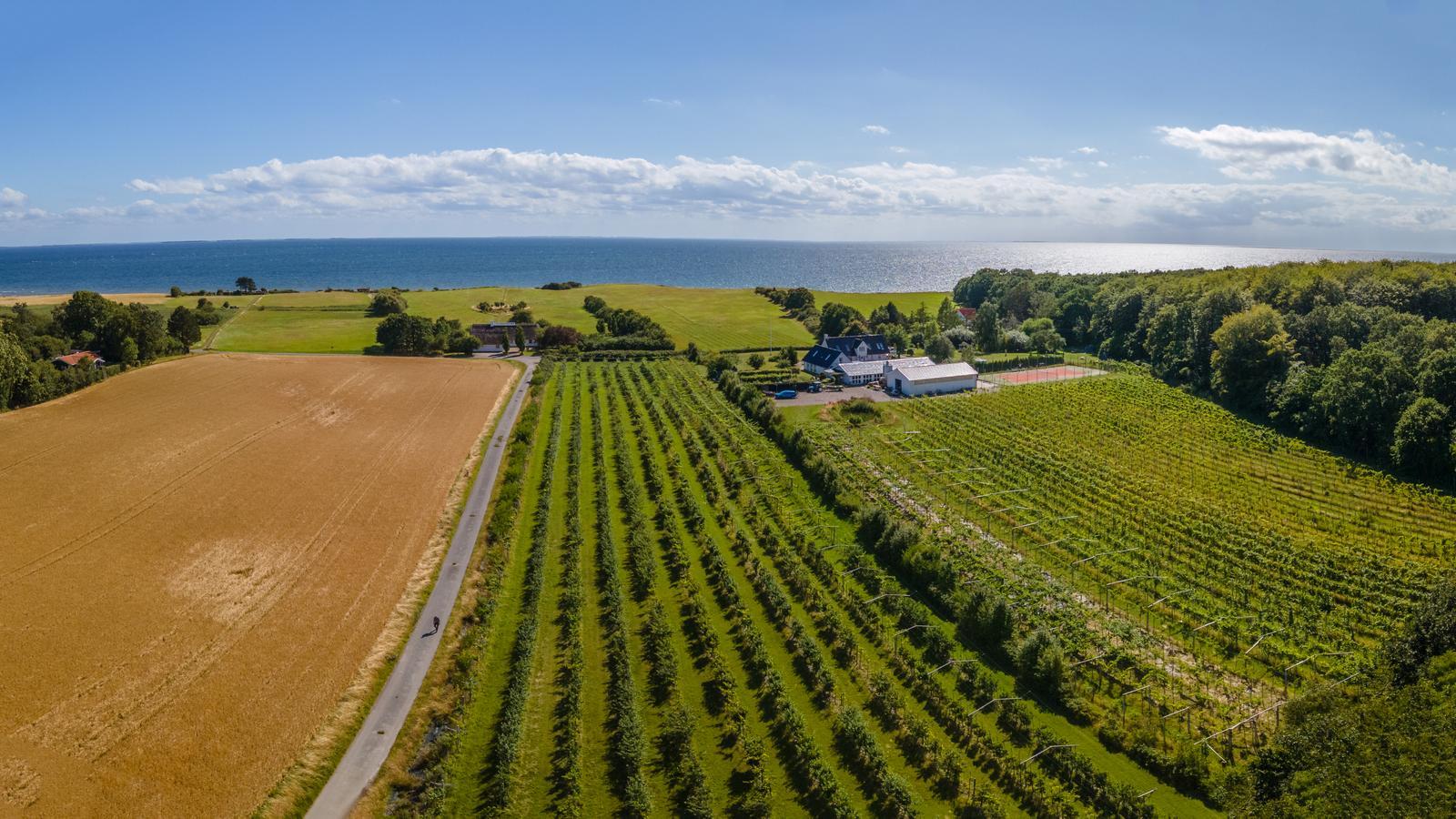
Amidst a green landscape, winding roads that cross small villages, and ancient stately castles, the island of Funen (Fyn) holds a postcard charm. In this bucolic location lies the By Stokkebye estate, a family winery that produces 20,000 bottles of one of the country's most prestigious sparkling wines each year. “It all started as a hobby in 2009”, for me it was like a dream and a challenge to be able to plant wine here, but I was sure I could achieve it, says Jacob Stokkebye, who runs the winery together with his wife, Helle. However, the path was not easy, and in the beginning, they had to throw away the wine because the quality was not good enough. This led Jacob to seek advice from French wine producers, who have helped him craft a wine inspired by the traditional champagne method.Today, the winery is one of the few that chooses to plant the Pinot Noir and Chardonnay varieties, even though they are less adapted to the rainy climate and frozen winters: "Part of our success is that we are located next to the sea where the wind always blows, this helps to dry the rain from the vineyard quickly," says Jacob.

As in the case of By Stokkebye, many of the Danish wineries “started in an amateur way, guided by the entrepreneurship and passion of the producers,” points out Hans Münter, president of the Danish wine industry association. “Over time, the sector has become professionalized, and this has contributed to the improvement of the wines,” says Münter.Little by little, wines produced in Denmark are making a name for themselves, especially on the menus of fine dining restaurants, while in more affordable restaurants or specialized shops, wines made in Denmark remain an eccentricity. Regarding the sparkling wines produced at By Stokkebye, they have achieved the recognition of being present on the wine lists of 25 Michelin-starred restaurants spread across Denmark, Sweden, Norway, Germany, and France: “This was our goal; since we are a new wine-producing country, we focus a lot on quality, not quantity, and that makes the difference. We are very critical before making a bottle of wine,” says Jacob Stokkebye. For journalist Thomas Ilkjær, this is a well-deserved recognition, as “in fine dining restaurants, they don’t put anything on their menus if it isn’t good enough, only when it has enough quality, and in the last 5-10 years, Danish producers have been achieving this,” he asserts. The price, an important factor
Despite the boom in wine production, some of the sector's challenges remain very significant. Climate change has brought about an increase in temperature that favors grape ripening, but also more volatile weather conditions in Northern Europe that can lead to a year with very intense heat, and excess rain the next. This makes harvests uneven and the amount of wine produced still small, and mostly destined for national consumption. Many of the wineries still have a very limited distribution network, which forces one to go directly to the wineries to taste their wines.Another of the great challenges is to achieve more competitive prices. Currently, a bottle of Danish wine costs on average between 30 and 40 euros, mainly because labor and production costs in the Nordic country are nearly three times higher than in the main European producers, such as France, Italy or Spain: “Price is very important, otherwise, you will feel like a fool paying a very high cost for a wine that is not really what you expect; price and quality must match,” says winemaker Jacob Stokkebye.Under these circumstances, many Danish producers still have trouble making wine production their livelihood and a profitable business. As Jacob asserts, even though his winery has managed to achieve economic viability and stable clients that guarantee the future of the project, “this is not a business to make money, at all; if you want to dedicate yourself to it to earn a lot, better forget it, you have to dedicate yourself to it out of passion”.
