The cities that will gain the most heatwave days
A study of climate simulations by the BSC indicates that the majority of cities in the State have not adapted buildings to the climate crisis
-
CAT -
CAST
BarcelonaHeat waves are becoming increasingly common, and beyond meteorological alerts, these mercury spikes also test the capacity of our cities. "We are building buildings for a climate that no longer exists," asserts Pablo Martínez, architect and founder of the think tank Trescientosmil. He is one of the authors of the'Atlas of Heat Vulnerability, developed together with the earth sciences department of the Barcelona Supercomputing Center - National Supercomputing Centre (BSC-CNS). This is a visual tool that collects up to 70 climate simulations to map out which cities in Spain will suffer more heat waves in the future, which will need more cooling measures, and which are less prepared to face them by 2050.
The conclusions of this atlas paint an unappealing scenario. In the set of analyzed municipalities, the number of days with heat waves will triple on average by 2050 compared to the year 2000. At the same time, the cooling demand for homes will increase by 65%. However, while the southern Iberian Peninsula concentrates the most significant projected increases in cooling demand, the Catalan and Balearic coast appears among the areas where heat waves will increase the most. In fact, Baix Llobregat and Garraf top the state ranking for the increase in heat waves, unlike cities in the interior and south of the country, which show more moderate increases. Specifically, the simulation indicates that the hottest days will increase in the period 2000 - 2050, especially in Castelldefels (80 more days), Vilanova i la Geltrú (+73), el Prat de Llobregat (+72), and Gavà (+71).
In contrast, no Catalan city is among those that will experience the highest increases in cooling needs on the peninsula, a ranking dominated by Andalusia and inland Spain. The main challenge identified by this study in Catalonia will not be so much the increase in energy demand for cooling buildings as the frequency and intensity of extreme heat episodes, especially on the coast and in the metropolitan area of Barcelona. Within Catalan territory, the differences are also significant. Barcelona starts from a relatively favorable position, with high income, a residential park with good indicators and good access to daily services, and some municipalities in Vallès combine some of the highest incomes in Spain with good levels of urban greenery and access to services, factors that can strengthen their capacity to adapt to the climate.
However, the most important thing is that these projections do not start from a single model. The climate data comes from the European project "Impetus4Change" and incorporates up to 70 global and regional climate models, executed with large computing infrastructures. Martínez emphasizes that although the models "more or less say" the magnitude of the increase, "they all point in the same direction": more heat and sustained. But the objective of this atlas is precisely to move away from the idea that temperature rises are temporary or seasonal episodes and to highlight a continuous trend towards a warmer climate that not all cities will be able to face from the same starting point. "Everyone thinks that climate change is like turning up the thermostat in the room and everyone has an equivalent increase. No," explains Martínez. "There are places that suffer it much more and places that suffer it much less. Everyone will suffer it," he concludes.

Inequalities in preparation
A municipality's vulnerability does not depend solely on how hot it will be. The tool also incorporates the quality of housing, urban green spaces, access to daily supplies, and the income of residents. In other words, it attempts to relate the climate threat to the real capacity of cities and their inhabitants to adapt to it. "If the city is better prepared, it will be easier for it to adapt to the new situation," summarizes Martínez. This is where one of the architect's main warnings appears. The problem is not just that it will be hotter, but that a large part of the current housing stock is not designed for these conditions. "Current building regulations are more concerned with protecting us from the cold than from the heat," he states. He focuses on the Technical Building Code, which uses historical climate series from the 1970-2000 period. "We are building for a climate that no longer exists," he insists.
To understand why the average cooling demand for homes will increase by 65%, one must look at one of the atlas's most technical indicators: cooling degree days (CDD). "It's not the average temperature, but how many degrees you are deviating each day from the comfort temperature," explains Martínez. In this case, the reference temperature is 23 degrees. It is a common indicator in the construction field, but not very intuitive for the general public. Therefore, the architect himself recommends focusing more on the percentage variation than on the absolute value. According to Martínez, this forces us to look at climate change from an urban scale. Three more degrees may seem like a relatively small variation when looking only at the thermometer, but when translated to buildings, it can mean a much greater need for cooling and more hot days. "This jump is of brutal magnitude when we compare it to the territory," he summarizes.
The atlas, therefore, does not want to be limited to pointing out which cities will be hotter. The intention is to show where this heat may coincide with worse housing, less green space, fewer services, or fewer economic resources to face the transformations. "There is a very big leap between the future that awaits us and how we are prepared to face this future," concludes Martínez. And this is, probably, the main warning that the tool leaves: climate change will not only arrive in the form of higher temperatures. It will also arrive at homes, in the streets, and in the (unequal) capacity that each city will have to protect its inhabitants.
A new heatwave is sweeping across Europe
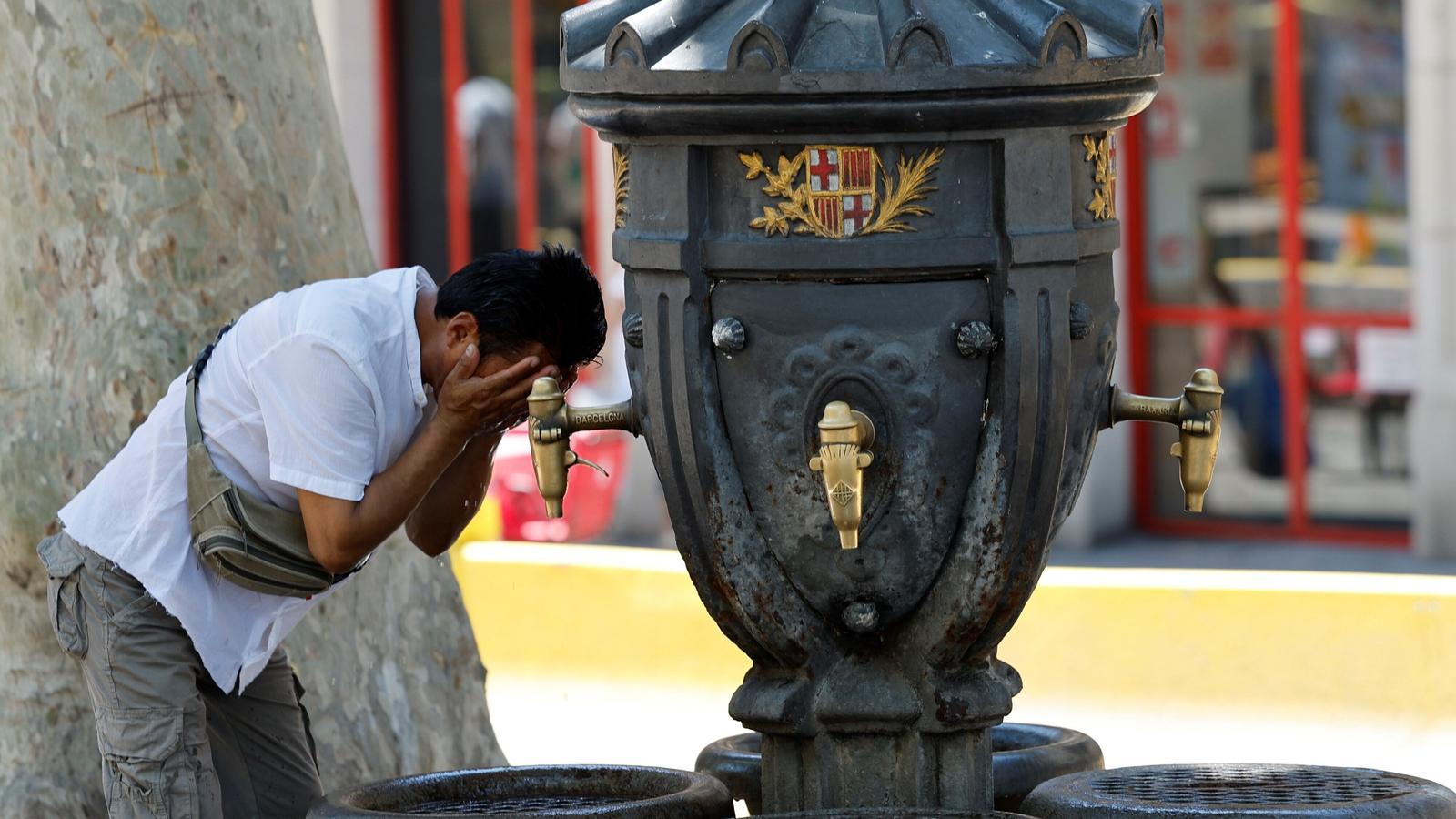
What is happening in a large part of Europe this week is a clear demonstration of this premise. A new heatwave, the umpteenth of this exceptionally warm summer, is particularly affecting France and the United Kingdom. In France, 80 departments are on orange alert for heatwave, while in England a warning remains in place covering a large part of the south and center of the country. The episode also arrives with very high temperatures across the Iberian Peninsula and other areas of Western Europe, although not all of these areas necessarily meet the official heatwave criteria of their respective meteorological services. Today, 37°C may be reached or locally exceeded in the warmest areas of southern England, while France may reach 40°C in wide areas and exceed them locally.
In Catalonia, 40°C will also be reached or exceeded in Ponent and the Ebro Valley, a situation that will be repeated in the warmest areas of the interior of the State. The origin of this situation is an area of very high atmospheric pressure, a kind of plug that prevents hot air from escaping and favors many sunny days and a progressive warming of the continent. This has allowed a mass of very warm air to spread from the Iberian Peninsula towards France and the British Isles. Forecasts indicate that from Friday onwards, the heat will begin to lose strength in Western Europe, although it will move east and could maintain very high temperatures over the weekend in Germany, the Alps and other areas of Central Europe.
