Sánchez presents his plan for AI: "Without human control it is stupidity"
The Spanish government plans to create a 600 million [euro] bond for technology companies and modify the school curriculum

-
CAT -
CAST
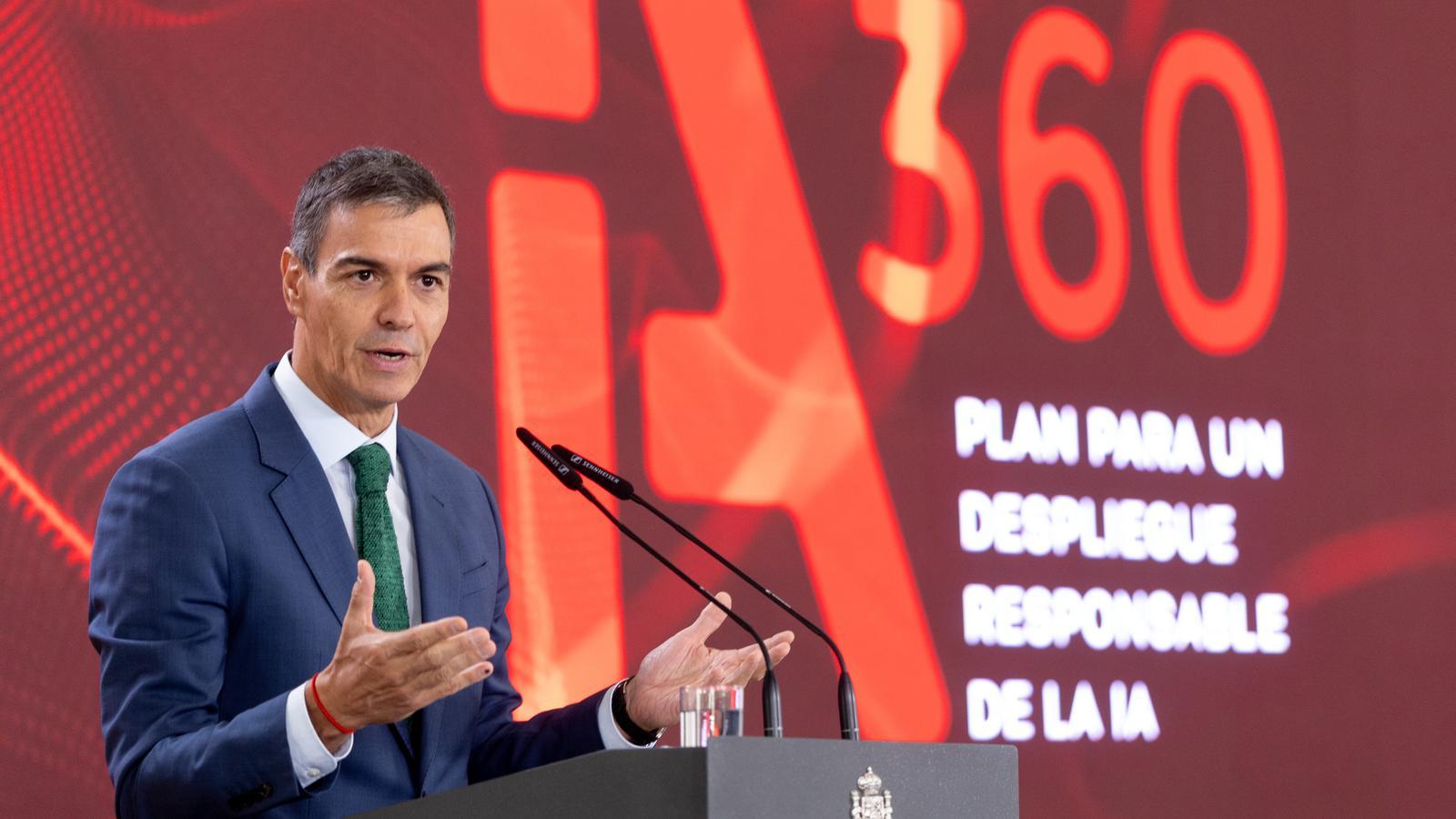
Madrid"Let no one have to choose between blind enthusiasm and fear." That is the goal of the Spanish government when it defends the need to regulate artificial intelligence (AI), especially at a time when the abrupt entry into an era marked by this technology is being questioned. The First Deputy Prime Minister and Minister of Economy, Carlos Cuerpo, summarized it this way this Monday, before the President of the Spanish Government, Pedro Sánchez, presented from Moncloa IA360. Plan for a responsible deployment of AI. It is a strategy aimed at regulating and promoting the ethical use of artificial intelligence that the Spanish government wants to roll out over the next 12 months. The intention is to make the leap from being the "seventh world power in AI dynamism to the fifth power".
For some time now, the central executive has positioned itself in favor of the regulation of this technology both on a national and global scale –Pedro Sánchez himself defended this in April, returned to it this Monday, and will showcase it this week in New York, where he will participate in the United Nations General Assembly and meet with Eric Adams, the mayor of the American city–. "It is a plan for Spain to take advantage of the opportunities that AI offers [...], but it places citizen security, trust, and the protection of the most vulnerable, starting with minors, at the center," explained Sánchez.
Sánchez did not hesitate to point again to the companies that own AI, but also the countries that control it: "If AI remains concentrated in a few hands and in a few countries, its impact will not be negative, but devastating," sentenced the Spanish president, who raised a dire horizon if it is not remedied: "An opaque, stampeding AI in few hands is the perfect cocktail for a disaster to happen. AI without human control is chaos and stupidity.".

The Spanish government argues that this regulation cannot be done in just any way. The ambition is for it to be a "cutting-edge" AI, but at the same time "transparent with people". The fifteen-page plan presented this Monday has four axes.
Gigafactory in 2028
The first axis consists of reinforcing the technological muscle, particularly the infrastructure, that the State has to face this new era. Projects come into play here such as the artificial intelligence (AI) gigafactory that is intended to be developed in Móra la Nova and Madrid –the intention is for construction to begin in February 2027 and for it to be operational in 2028– and the new AI models that are being developed hand in hand with the Barcelona Supercomputing Center. Furthermore, the government is betting on data centers, albeit by setting energy and environmental standards. In fact, the new regulation that the government wants to move forward regarding data centers has caused a clash with the sector.
Impact on companies and schools
Afterwards, the aim is to strengthen access to AI for SMEs and the self-employed. The goal of the plan is that by 2030, more than half of companies will have integrated the technology into their activity. Thus, an artificial intelligence business voucher endowed with 600 million euros will be approved to finance AI-based services that European technology companies might need. "The voucher will not finance license subscriptions, but rather transformative services for the company's production process," the document states.
At the same time, the plan provides for an adaptation of the secondary and vocational education curriculum to integrate AI. The initiative will be presented and negotiated with the autonomous communities in the first quarter of 2027. As stated in the document, society's adoption of generative AI is ahead of the productive fabric: 21.1% of companies use it, while 44.2% of the working-age population do.
The third axis focuses on security: both in cybersecurity and in supervision regarding the most offensive frontier models. Among other things, the government plans to create an Artificial Intelligence Safety Institute.
Tripartite agreement
Finally, there is an appeal for a "social contract" regarding AI, which would translate into a state pact. Sánchez plans to convene social partners – unions and employers' associations – in October to address a tripartite agreement. In parallel, there is an intention to convene sectoral tables and even a permanent observatory to analyze the impact of this technology on the labor market.
The presentation event for the plan, which took place at La Moncloa, was attended by various ministers as well as unions and employers' associations, along with experts from the technology sector. "The open debate in recent weeks [surrounding AI] confirms that the path we have taken is the right one," the Spanish government maintains.
