This is how artificial intelligence factories are
The global race to build AI infrastructure has unleashed astronomical investments (and Catalonia also wants to play in it)

-
CAT -
CAST
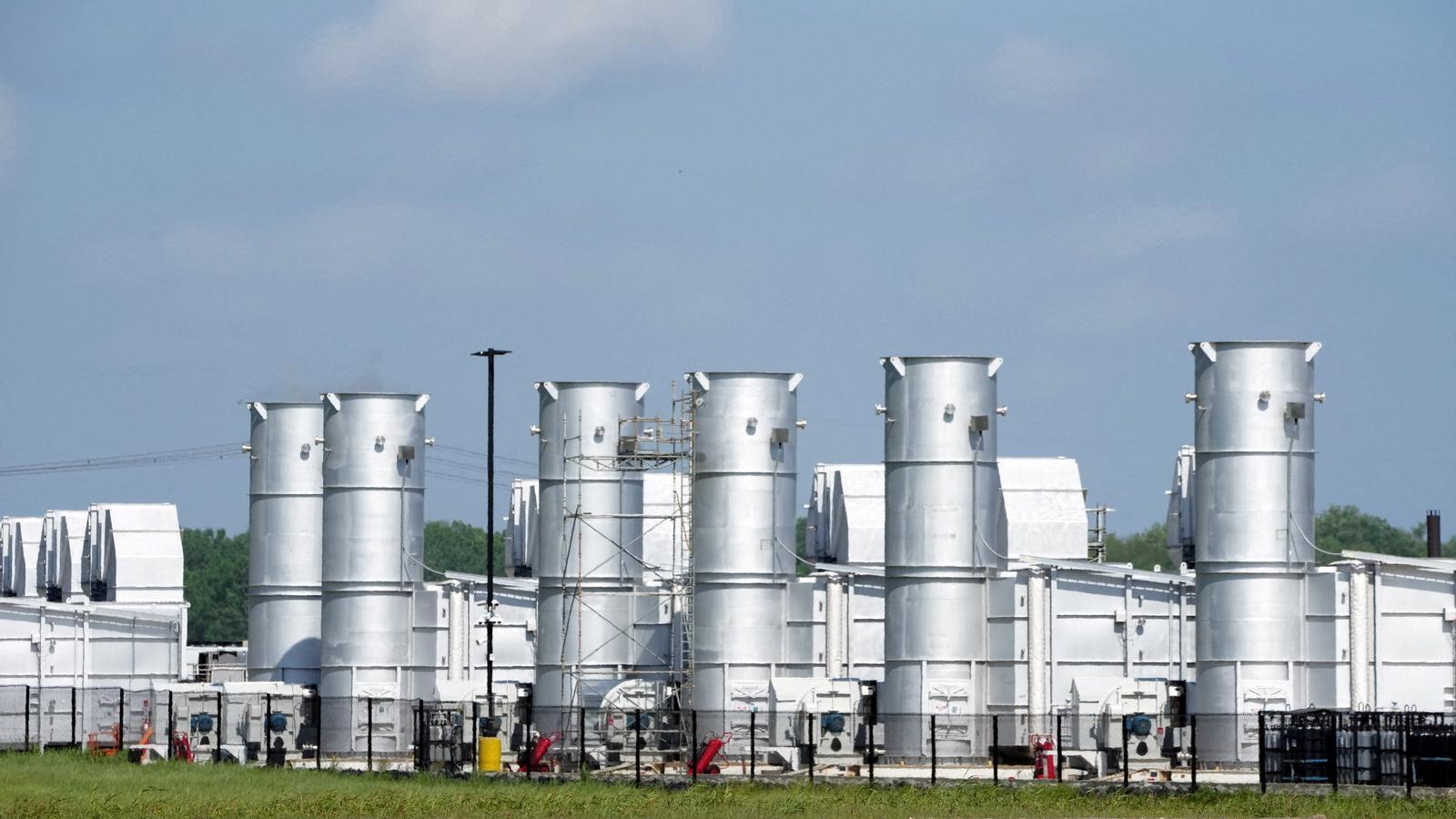
BarcelonaA conventional data center and an artificial intelligence gigafactory (or gigafactory, the fashionable Anglicism, adopted by analogy with the name Tesla gives to its automotive factories) share the same exterior appearance: immense industrial warehouses surrounded by ventilation systems and electrical substations. But inside they are completely different. The first is a warehouse of bits: it stores data and serves it when requested. The second is a manufacturing facility, but instead of car parts or cookies, it produces responses generated by artificial intelligence (and the resulting "brain" from training the algorithm with millions of data).
In addition to being conceptual, the difference is also electrical and thermal. In a traditional data center, each rack, the standard metal cabinet full of servers, consumes between 5 and 15 kilowatts. In a gigafactory equipped with latest-generation graphics processors (GPUs), the same cabinet can exceed 100 or 150 kilowatts. Such extreme energy density means that air cooling systems are not enough: gigafactories resort to direct liquid cooling to the chip (DLC) or immersion of components in dielectric liquids, a system that captures heat with an efficiency up to 3,000 times higher than air.
Graphics processors are used because drawing pixels on a screen is a process that requires working many processes in parallel, and training AI models also works this way non-linearly. GPUs, designed to execute many simultaneous operations, are the architecture that best adapts. NVIDIA made the decisive leap by making them programmable and creating a software ecosystem that opened them up to AI researchers. The difference compared to video games is the scale: current models are much larger than any graphic texture, which has led to a surge in demand for high-speed memory and inter-chip communication networks. The internal transit of a gigafactory demands extremely low latency networks (the time it takes to react), to coordinate thousands of GPUs as a single unit. And unlike conventional centers, which manage variable loads, a gigafactory in training mode maintains 100% utilization for weeks or months, implying a constant industrial load for the electrical grid.
Learning and responding: two phases with opposite demands
The AI lifecycle has two stages with almost opposite infrastructure requirements.
The first is training: the phase in which a model learns from massive datasets, hundreds of billions of words, images, and computer code, through brute-force calculations that require thousands of GPUs working in parallel for weeks. What matters here is the volume of computation per unit of time, and the cost can be hundreds of millions of euros.
The second stage, which is what the gigafactories cater to, is inference: the moment when the already trained model responds to user queries in real time. Here, response speed matters more than raw power. Although inference is less spectacular than training, it is what concentrates the real cost throughout the life of a system: it is estimated to represent between 80 and 90% of the total operating cost of an AI platform, due to the volume of requests it must answer.
Two recent techniques expand the capabilities of AI models. RAG (Retrieval-Augmented Generation) allows the model to consult external databases in real time, and to ensure updated information without having to retrain everything. AI agents, for their part, are autonomous systems that manage multi-step processes with minimal human supervision: they can plan, search, draft, and send, in sequence, without the user having to intervene at each step.
Catalonia on the map of global infrastructure
A week ago, we explored the possibility of running AI models locally, on home computers. But while some users are content with models that fit on a laptop, major industry players are building infrastructures of incomparable magnitude.
Barcelona is one of the nodes on the European map. The Barcelona Supercomputing Center (BSC-CNS) has a 129 million euro contract to expand MareNostrum 5 and turn it into a European AI Factory, integrated into the EuroHPC JU program, to make advanced computing capacity available to SMEs, startups, and research groups on the continent.
On the other hand, the State has attracted private investment from major North American hyperscalers. Amazon Web Services (AWS) has increased its plan in Aragon to 33.7 billion euros until 2035. Microsoft has committed 2 billion euros in the short term and plans to reach 10 billion in the next decade, also in Aragon. Oracle will invest more than 1 billion euros in a third cloud region in Madrid, aimed at data sovereignty for the financial sector.
Europe seeks technological sovereignty
The European Union is accelerating to avoid falling behind in the AI infrastructure race. The EuroHPC JU program has planned 19 AI Factories across the continent, with the goal of at least thirteen being operational before the end of this year. Brussels has allocated 20 billion euros to the InvestAI fund, aimed at building up to five European gigafactories, each with more than 100,000 next-generation processors. In addition to Barcelona's MareNostrum 5, five new supercomputers for AI will be located in Finland, Germany, Italy, Luxembourg, and Sweden.
In this context, Spain and Portugal have formalized a joint bid to host one of these gigafactories. The main site would be Móra la Nova (Ribera d'Ebre), with a planned capacity of 54 MW in a first phase and an additional 125 MW in a second. San Fernando de Henares (Madrid) has been added as a complementary site to the bid, where processing centers already exist that would allow for immediate computing capacity while the Móra facilities are being built. The estimated joint investment exceeds 4 billion euros through a public-private consortium led by Telefónica, which anticipates having a stake of between 10% and 15% of the capital.
A global race
Despite the European public effort, the magnitude of North American private initiatives is on another scale. The Stargate project, an alliance between OpenAI, SoftBank, and Oracle with the participation of the Abu Dhabi sovereign fund, has exceeded 340 billion euros in committed investment and is approaching 7 gigawatts (GW) of planned capacity, with the goal of reaching 425 billion euros and 10 GW before the end of the year. The main facility, in Abilene (Texas), is already operational and plans to host 400,000 NVIDIA Blackwell GPUs. xAI, Elon Musk's company, has built the Colossus gigafactory in Memphis in just 122 days, which is already in service with 200,000 GPUs and aims to reach one million.
Profitability: long-term and if there is enough energy
So much capital, which will globally exceed 700 billion euros in 2026, raises doubts about profitability. Profit prospects exist, but on a much longer timeline than in traditional computing: while the cost of conventional hardware is recovered in about ten months, recovering the investment in AI infrastructure can take between two and four years, due to the complexity of integrating it into business processes.
Component manufacturers like Samsung or SK hynix have multiplied their profits due to the demand for AI memory, while they are undersupplying the market for conventional chips and driving up the price of many consumer electronic devices, including smartphones.
The main bottleneck, however, is not technological but physical: energy. Nearly 40% of planned projects could suffer delays due to a lack of connection to the electrical grid or a shortage of transformers. AI gigafactories are not only transforming the technology industry; they are redrawing the energy maps of the territories that host them.
